Her på Skagen Fuglestations blog bringes korte nyheder i dagbogsformat om hændelser på fuglestationen.
-
FORSIDE

- Blog
How can you lose a Swan!?
onsdag 14. januar 2026
Today was a day of good fun, nice fieldwork, 15,000 steps, and some good birds of note.
We started the day getting ready for the first Fulmar (Mallemuk) survey of the year. Simon gave us a much-appreciated lift to Gammel Skagen to start the survey, so thank you Simon. For some context, the survey is 10km and conducted to locate, record, and collect any dead birds who have been stranded or died naturally before washing up on the beach. Certain species such as Gannets (Sule), Kittiwakes (Ride), Puffins (Lunde), Guillemots (Lomvie) and Skuas (Jager) are collected for the new ‘Seabirds Under Pressure’ (SUPRE) project, and as of yesterday, our data will become part of a new national survey looking at Seabird wrecks in Denmark, focusing on dead seabirds recorded and collected along the North Sea coast. More on the survey can be heard here by Simon who was interviewed on early morning radio news yesterday.
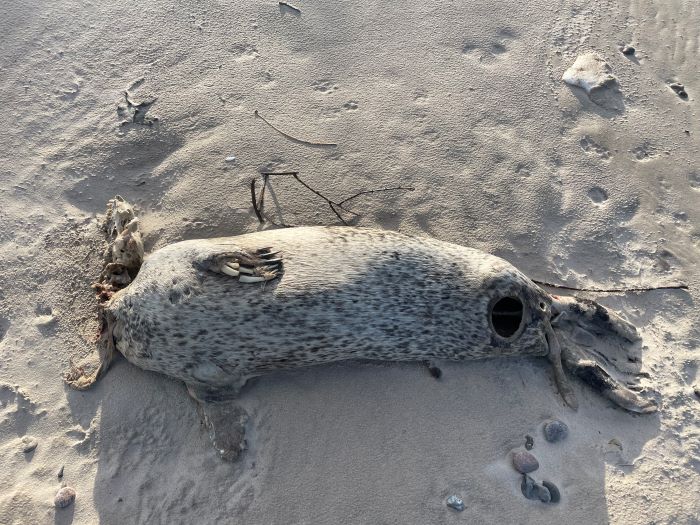
Picture 1: Deceased Seal.
Our aim to find and record dead birds was aided by Eagle-eyed Eleanor, who found a lot of nice pebbles and sea glass, however interrupted mainly because I was checking out the gull (Måge) flocks along the route, as well as the live birds resting on the sea. The first find of the day in the flocks involved a 4th calendar year Caspian Gull (Kaspisk Måge) near Gammel Skagen, the first one Eleanor has ever seen, and always a notable species in the area. This was followed by our first dead wildlife including a Common Gull (Stormåge), and a male Harbour Seal.
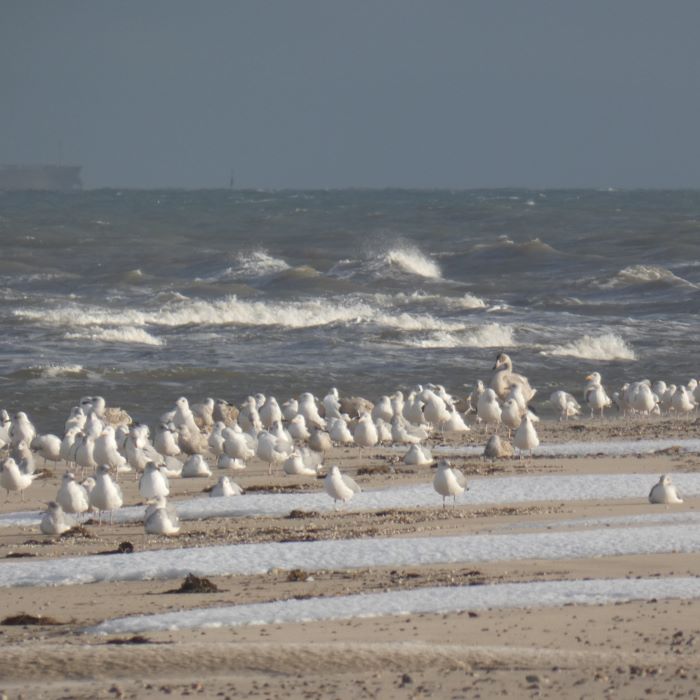
Picture 2: Spot the odd one out!
Coming across a flock of about 700+ Gulls (Måge) near Nordstrand resulted in zero ‘white winged gulls’, however we found another bird with white wings hidden in the flock, it was a 2nd calendar year Whooper Swan (Sangsvane)! Very odd and unusual to say the least, and even more crazy is that we lost it within a few minutes of finding it due to a walker scaring all the gulls (Måge) – hence the blog title ‘How do you lose a Swan!?’ A few more kilometres passed, and we found the swan flying along the beach near the Tip, magical. The area around the Sandormen track was very wet, due to the snow melt, so this section involved giving Eleanor a piggyback across the water with all our bags. Our reward came in the form of great views of a Rough-legged Buzzard (Fjeldvåge), and luckily no wet shoes. A couple more dead birds were found including a Cormorant (Skarv) and a Gannet (Sule), before returning to the lighthouse for lunch.
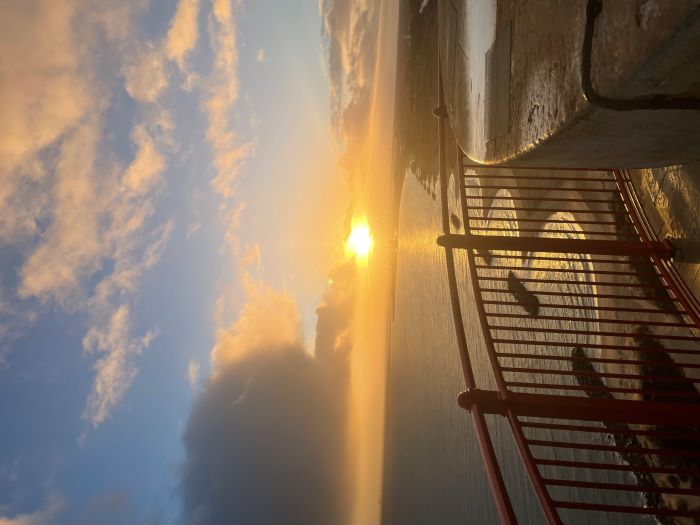
Picture 3: Lighthouse View
After lunch, we decided to check the solar panel for snow or ice, of which there was none. We decided to go up the lighthouse to enjoy the views before we cleaned the apartment ahead of the arrival of Jånos’, another volunteer who will stay with us for a week. Breaking news came when Knut found a beautiful Great-northern Diver (Islom) in the harbour, we will look for this tomorrow! However, light was fading, and some more net sewing was completed by Eleanor, whilst I completed more tasks and made a nice dinner for the two of us. A long but fulfilling day. And whilst I write to blog, we welcomed Jånos!
Observers: Thomas Weston, Eleanor Harris, Simon S. Christiansen, Knut Pedersen, János Schadl