
Her på Skagen Fuglestations blog bringes korte nyheder i dagbogsformat om hændelser på fuglestationen.
-
FORSIDE

- Blog
European Birdwatching (and Pipit) Day
lørdag 3. oktober 2026
Every morning (or sometimes already a few days in advance), we check the weather forecast, not only to know whether we can go out, but also to somehow guess which birds might turn up. Before we checked the forecast again, we sadly had to say goodbye to Pauline, who left back to Berlin. We will miss you, it was such a great time with you here!
So, the weather today was almost the same as yesterday, with less wind and some sunshine. From the forecast, it was somehow clear that there wouldn’t be that much going on over the sea, but, as yesterday, it looked quite promising for good passerines again. And that was exactly what happened:
As Luis and I walked to Worlds End 3 today, we already got to hear one Lapland Bunting (Lapværling). For today’s count, we chose a dune that was around two dunes west of Worlds End 3 and a bit higher, giving us better views over the inland area behind us.
In that inland area, also Kabeltromlen is located, where Jule, Páll, Sophie, Simon, and Laura went out ringing today. Already in the first round, they caught a young Yellow-browed Warbler (Hvidbrynet Løvsanger). To see this beautiful bird, some locals and I also went to Kabeltromlen.
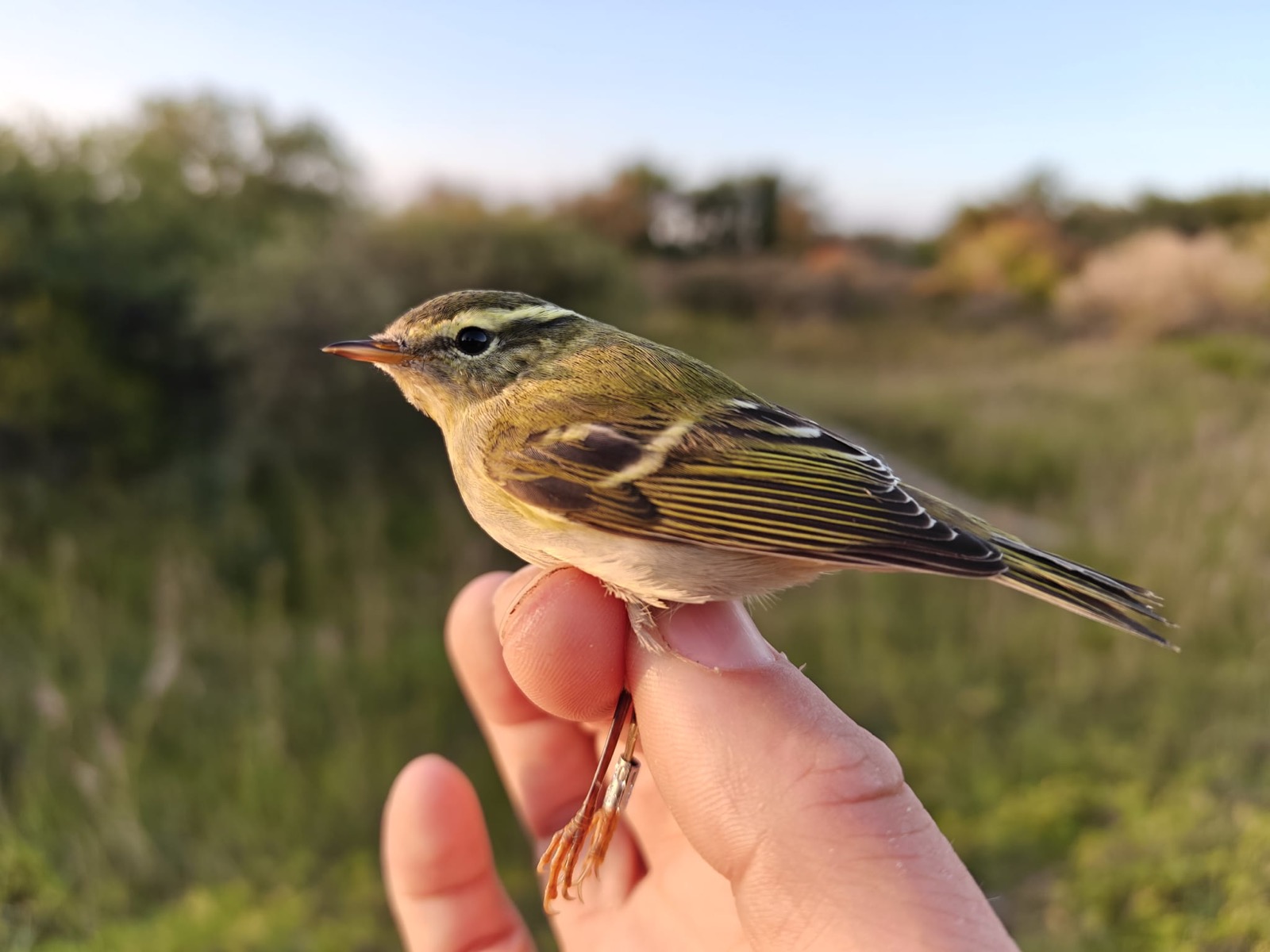 First good bird of the day: young Yellow-browed Warbler (Hvidbrynet Løvsanger). Photo by Laura Tamminen
After my quick walk to Kabeltromlen, I headed back to Worlds End 3, where Luis kept everything under control. Today, we paid particular attention to counting many of the resting Gulls (Måger) and Gannets (Suler), because it was European Birdwatching Day, when we compare numbers and observations from different places all over Europe!
While counting the Gannets, we received the message that the ringers had caught a Red Crossbill (Lille Korsnæb). How exciting!
And just some time later, Luis and I heard a “tsiip” call over the dune while counting. Unfortunately, we only heard that one call without seeing the bird, so it was impossible to say anything for sure at that point. But (!), I had a recorder running right next to me (I suggest to everyone that you always have a recording running while you are out birding ;-) and we checked the recording later. There, we could clearly see that the call we had heard was the call of an Olive-backed Pipit (Tajgapiber):
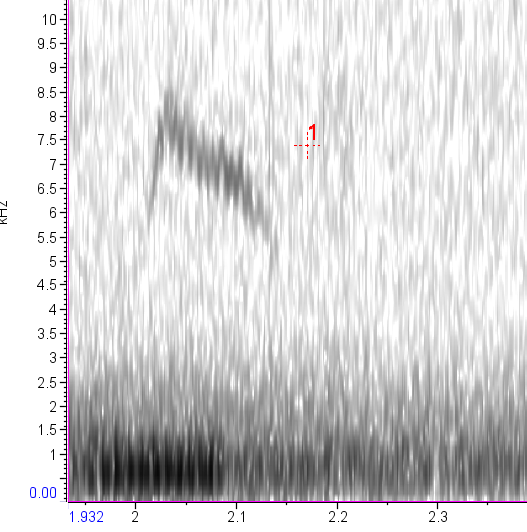
Spectrogram of today’s Olive-backed Pipit (Tajgapiber). Those calls are very similar to the calls of Tree Pipits (Skovpiber), but the calls of Olive-backed Pipits are generally higher-pitched, less modulated, and more downslurred. Sound file of the call here! Spectrogram and sound recording by Mio Brix
After the second counting hour, I switched with Jule, so she went to the count with Luis at Worlds End 3, while I went to Kabeltromlen for the last rounds. As I arrived there, we all got a decent look at a resting adult Hobby (Lærkefalk) which was sitting on top of the Sort Sommerhus!
While we were ringing a late Garden Warbler (Havesanger), Luis and Jule spotted a Great Skua (Storkjove) over the sea, and a bit later, there was a Great Grey Shrike (Stor Tornskade) sitting just a bit north of Kabeltromlen.
After Jule and Luis ended the count with two Rough-legged Buzzards (Fjeldvåge), Laura, Hendrik, Páll, Sophie, and I started closing the nets at Kabeltromlen. As we were closing the last net, we heard three very loud and beautiful “pssiii” calls from a Red-throated Pipit (Rødstrubet Piber), which was just flying abouve us! What a great end to the morning!
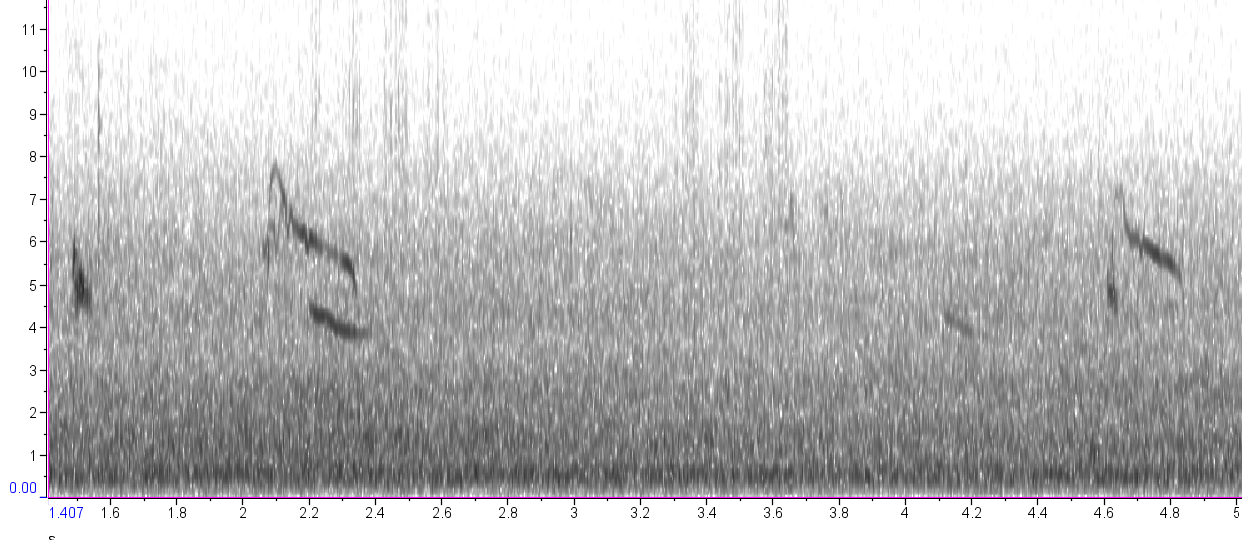 Spectrogram of two calls of the Red-throated Pipit (Rødstrubet Piber).They look a bit like a water slide. Listen to its call up here! Spectrogram and sound recording by Mio Brix
After we headed back to the station, there wasn’t any time to rest. It was time to clean the station and then go to Skagen town for ice cream to celebrate yesterday’s Nutcracker (Nøddekrige) observation.
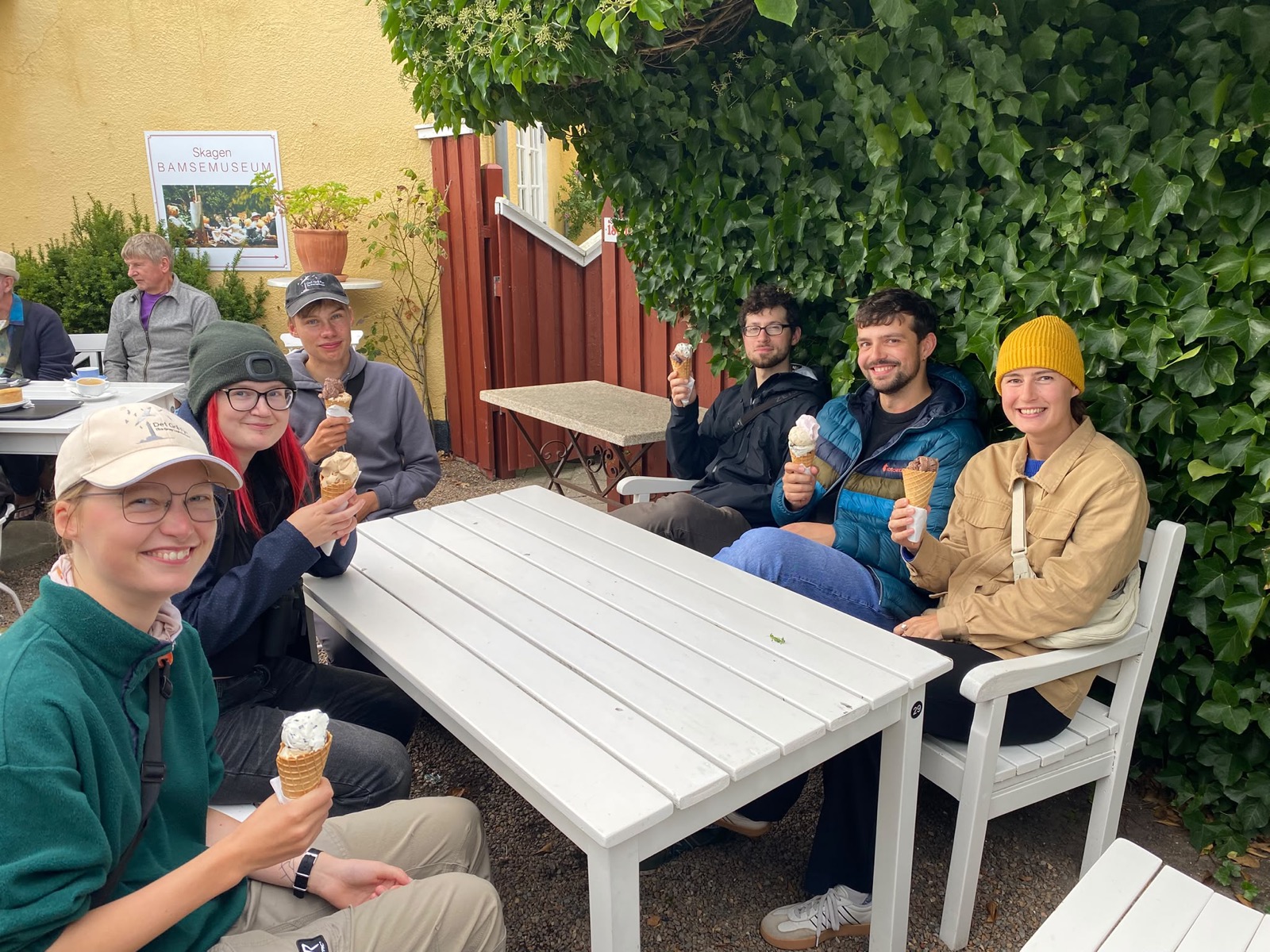 Celebrating the Nutcracker observation with ice cream. Photo by Simon S. Christiansen
To round up our day, our guests Anders and Dorthe made a wonderful dinner for us, and Lisa and Simon also joined us.
I could write down a lot more things about the day, but then this blog wouldn’t come to an end...
Highlights from the observation:
Olive-backed Pipit (Tajgapiber)-1
Red-throated Pipit ( )-1
Great Skua (Storkjove)-1
Lapland Bunting (Lapværling)-1
Hobby (Lærkefalk)-1
Link to todays observations in the Dofbasen from observers in the area.
Ringing Kabeltromlen:
| Coal Tit (Sortmejse) | 1 |
| 1 | |
| Chiffchaff (Gransanger) | 4 |
| Garden Warbler (Havesanger) | 1 |
| Blackcap (Munk) | 6 |
| Wren (Gærdesmutte) | 24 |
| Song Thrush (Sangdrossel) | 1 |
| Robin (Rødhals) | 6 |
| Dunnock (Jernspurv) | 2 |
| Red Crossbill (Lille Korsnæb) | 1 |
| Reed Bunting (Rørspurv) | 3 |
Total: 50
People: Jule Tappe, Pauline Nähring, Mio Brix, Laura Tamminen, Luis Q. Langfeld, Dorthe and Anders Østerby, Simon S. Christiansen, Páll Vang Kjærbo, Sophie Booker, Lisa Vergin, Jørgen Kabel