
Her på Skagen Fuglestations blog bringes korte nyheder i dagbogsformat om hændelser på fuglestationen.
-
FORSIDE

- Blog
Beluga!
tirsdag 19. maj 2026
Last night, we went out to try and catch some Great Snipes (Tredækker). We got the sight and heard a singing Bluethroat (Blåhals) and a Nightjar (Natravn). But no Great Snipes (Tredækker)! After an hour of not seeing them in the thermal we decided to head back to the station via Gyvelmarkerne to listen for some Spotted Crakes (Plettet Rørvagtel), but all we heard were lots of Natterjack Toads.
Today János, Olga and I were at the ringing. The weather looked good, so we had our hopes up for some nice birds. Unfortunately, it was rather slow throughout the morning, but we still caught a couple nice birds like some male Chaffinches (Bogfinke), and Icterine Warbler (Gulbug), and a Long-tailed Tit (Halemejse). We also caught a few Common Whitethroats (Tornsanger) which are difficult to age so it was great to get some good practice on them.
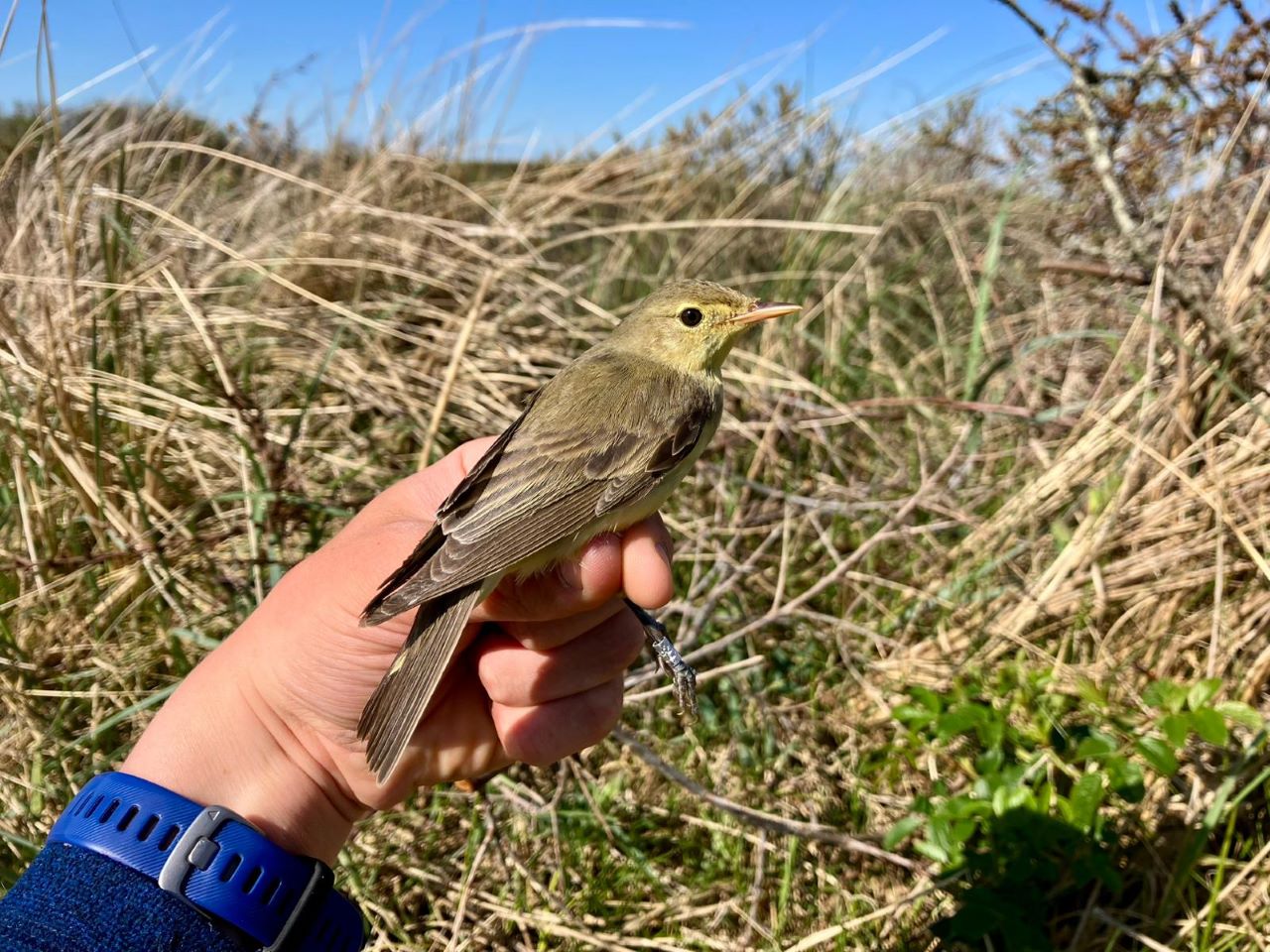
Icterine Warbler (Gulbug)
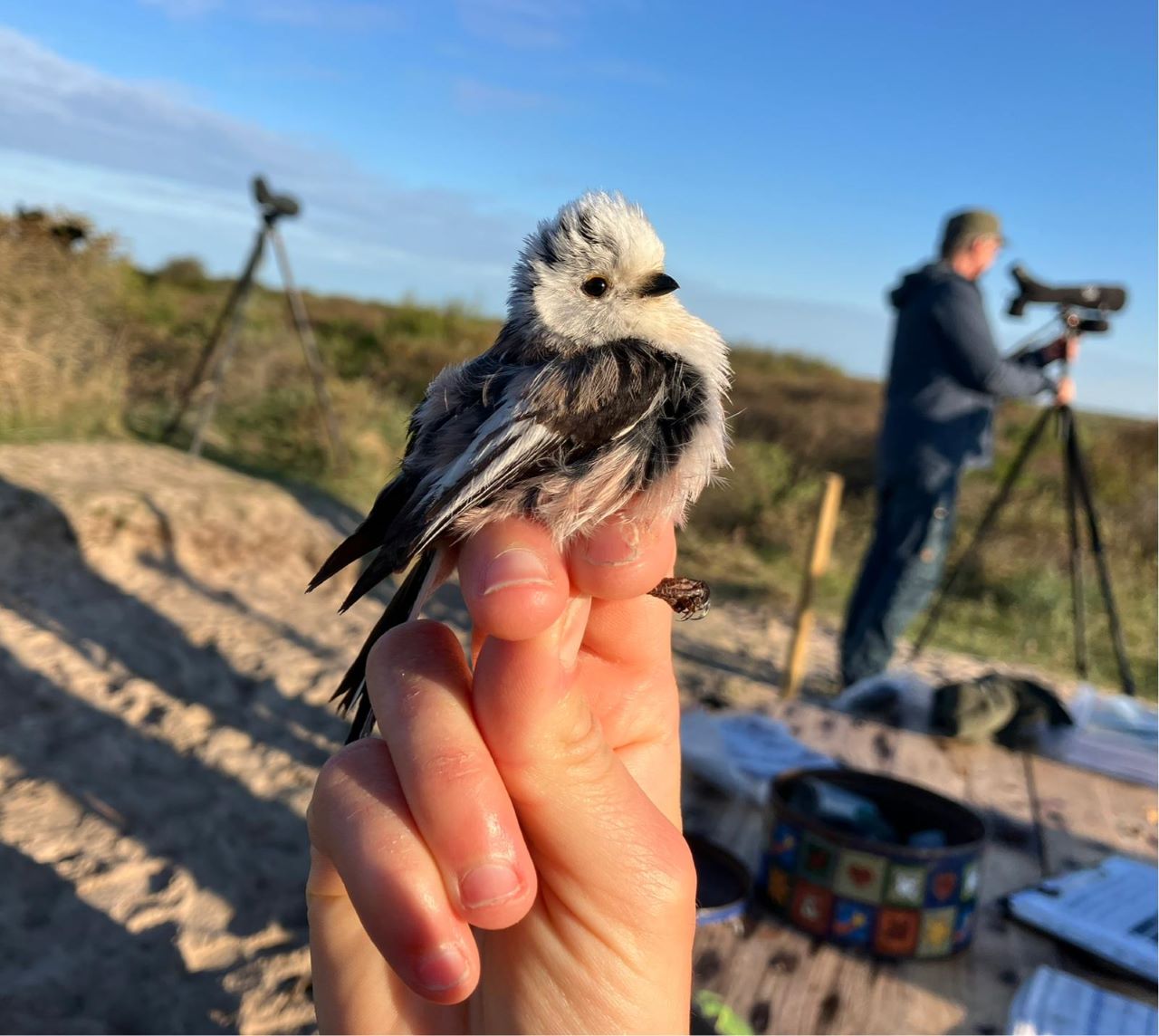
Long-tailed Tit (Halemejse)
The migration counters today were Alvin and Julian. It was a very slow morning, but they had a few nice sightings like two Cuckoos (Gøg) flying out to sea, a Black Kite (Sort Glente) and some Honey Buzzards (Hvepsevåge). Yesterday a Beluga Whale (Hvidhval) was seen further down the coast in Denmark. Luckily, today it was seen in Skagen! Most of the team got to see it from Grenen. It was amazing to see, and we all wonder how it ended up here. It felt very weird seeing a white whale in the sun! This is the first record of a Beluga whale (Hvidhval) in Skagen. There was also a Red-rumped Swallow (Rødrygget Svale) seen but none of us managed to see it.
Beluga whale (Hvidhval)! Video taken by Jonas Pederson.
Once we were all back, we completed our daily tasks and then took some very long naps. Last night’s late night meant we were all incredibly tired the next day, so our long naps were much needed. Hopefully tomorrow produces some more nice birds for us.
Ringing (Kabeltromlen):
Rødhals - 2
Gærdesanger - 3
Løvsanger - 2
Gulbug - 1
Havesanger - 1
Munk - 1
Tornsanger - 5
Gransanger - 1
Rødhals - 2
Gærdesanger - 3
Løvsanger - 2
Gulbug - 1
Havesanger - 1
Munk - 1
Tornsanger - 5
Gransanger - 1
Halemejse - 1
Bogfinke - 2
Total: 19
Total: 19
People: Alvin Johansson, János Schadl, Julian Helbig, Dylan Daunt, Olga Fernández Enríquez, Simon S. Christiansen, Rikke Jakobsen, Lisa Vergin
Red on Blue
mandag 18. maj 2026
When I went out to Sandormsvinget (a little bit west of Sandklit) with János and Olga this morning, I expected it just to be a perfectly normal migration count, like I haven’t had one in a while. A matter of routine.
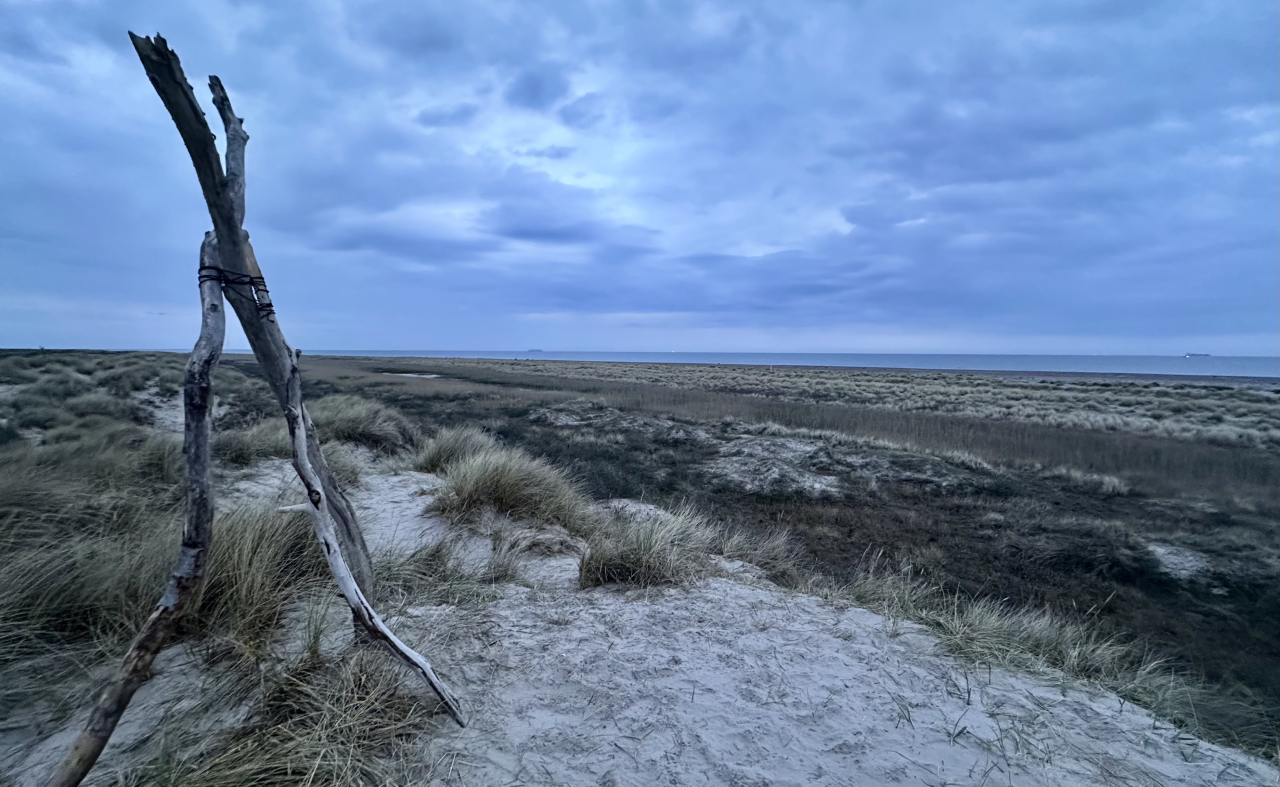
Sandormsvinget before sunrise – in the foreground the recently established “Dylan mark”.
And at first it started off as expected: Not very busy migration wise, especially on the sea, but a lot of Barn Swallows (Landsvale) and Yellow Wagtails (Gul Vipstjert), and just a calm and wholesome atmosphere. But one and a half hours in, Simon called us from Kabeltromlen saying they caught a Red-spotted Bluethroat (Nordlig Blåhals)! Olga and me left the observations to go see it, while János duteously continued counting completely on his own. We weren’t the only twitchers, when we arrived at Kabeltromlen, many other people came by to see not only the Bluethroat (Blåhals), but also the Wood Warbler (Skovsanger) they caught in the same round. Overall they had quite a lot of birds, including two Reed Warblers (Rørsanger), a Siskin (Grønsisken), multiple Garden Warblers (Havesanger) a Sedge Warbler (Sivanger) and more. Rikke was at the ringing too, and really enjoyed seeing here first Bluethroat (Blåhals) as well as all the other birds up close in hand. We also saw a Golden Oriole (Pirol) flying past Kabeltromlen. For Alvin it was actually the first one he’s ever seen, he only had heard them before.
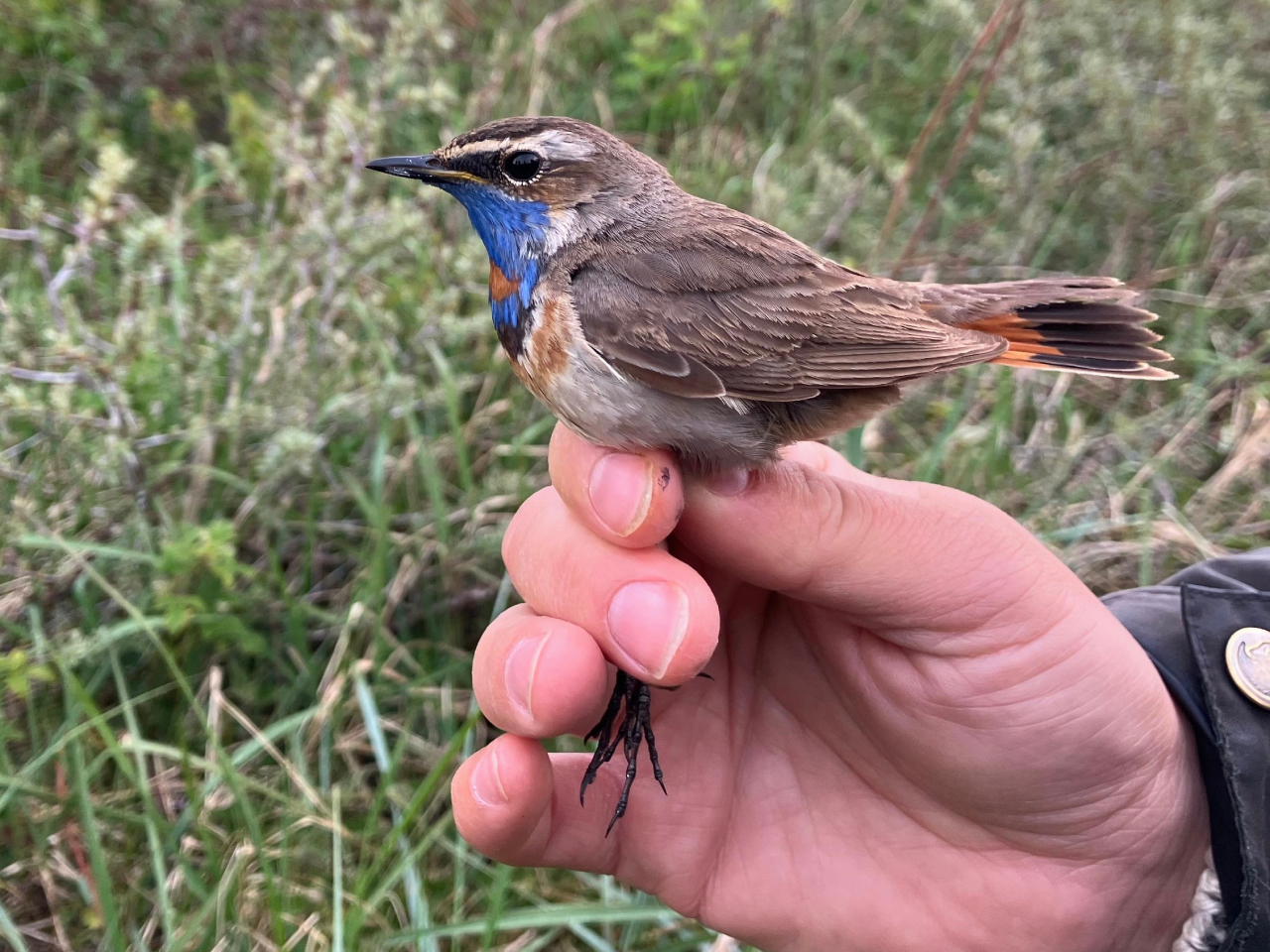
Red-spotted Bluethroat (Nordlig Blåhals)
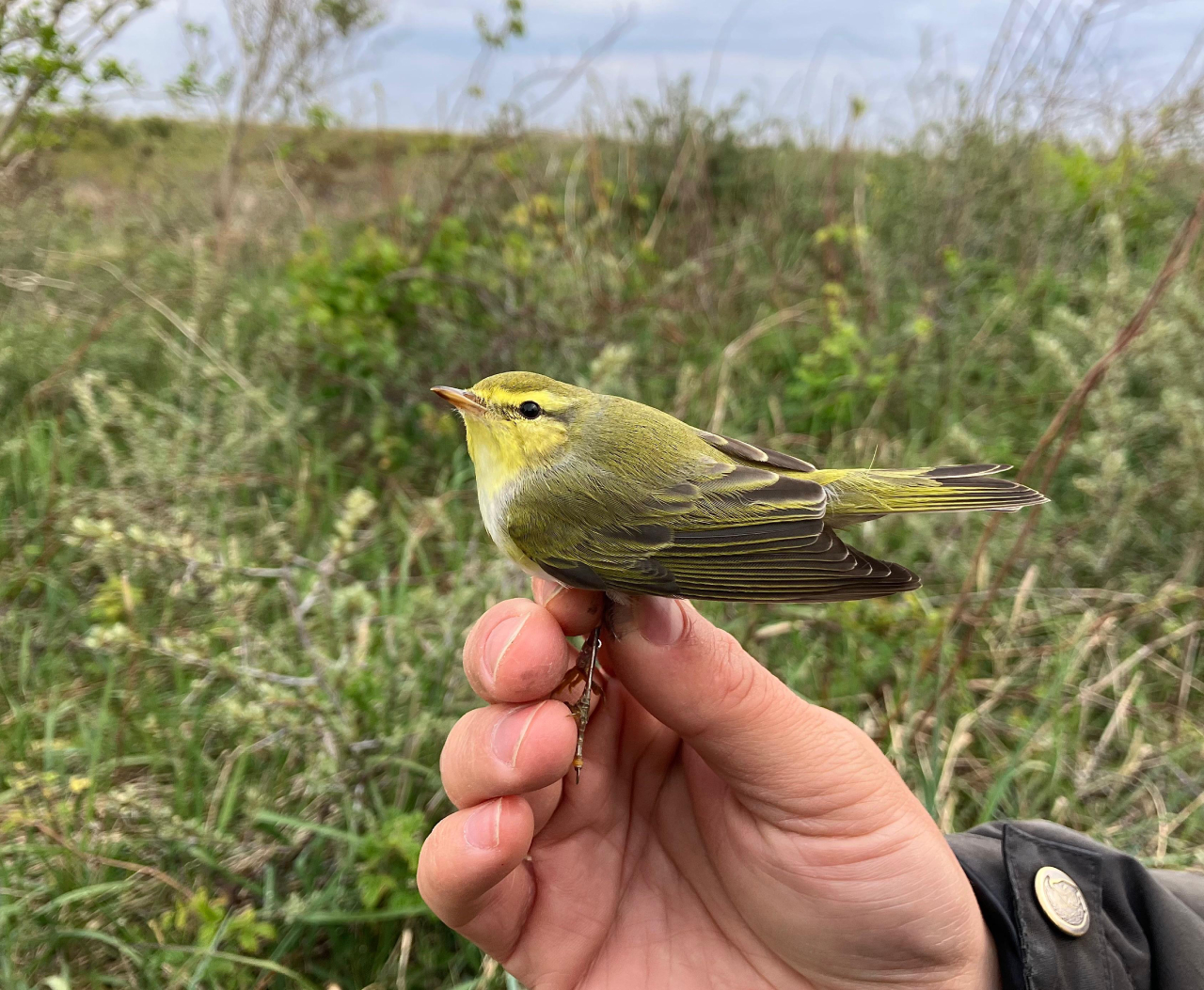
Wood Warbler (Skovsanger). According to Simon the prettiest of the Phylloscopus.
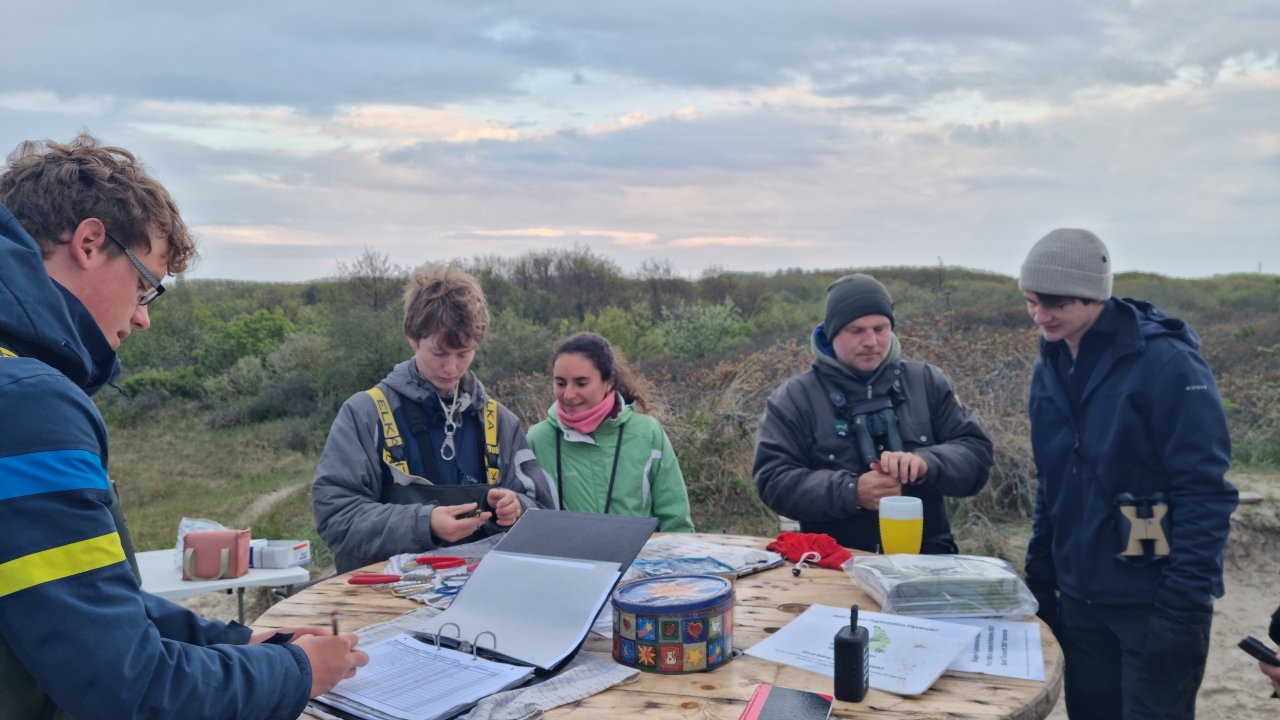
Ringers and twitchers at Kabeltromlen.
After our little visit, Olga and I biked back to the migration count, but only ten minutes later, Simon called again. He said they could need some extra sheets for the protocol and help with all the birds. We decided that I should bike back to the station, get the sheets and then support Alvin and Dylan at Kabeltromlen. In the meantime, János and Olga continued the observation, with the highlights being a resting Grey Plover (Strandhjejle), a Spotted Redshank (Sortklire) and a Temminck’s Stint (Temmincksryle). On his way back, Dylan had a female-coloured Red-breasted Flycatcher (Lille Fluesnapper) that flew over the Sandormen Tracks, and then landed in the reservation area.
After good lunch and entering all the data from this morning, we all went for some rest, which we might need later this day. Also, we are now done with all the feather samples we need for the DNA-project about vagrants by the university of Aarhus, after having taken the last sample of a Common Whitethroat (Tornsanger) today. Later, Simon took Dylan and János on a trip to Kandestederne a bit further south, where they wanted to ask the owner of the patch in which the Great Snipes (Tredækker) have been singing the past nights for permission to enter the area and try to catch and ring them. We got the permission and will go there late at night today, wish us the best of luck!
After that, they went birding in the area for a while. They saw many Wheatears (Stenpikker), a singing Red-backed Shrike (Rødrygget Tornskade) and a Corn Bunting (Bomlærke). In the same time, the rest of us up here went out for a bit too: Rikke went to Grenen first, where she and others heard a singing Ring Ouzel (Ringdrossel), later she watched some raptors at Saftevandsbakken. The Black Kite (Sort Glente) was a lifer for her. Alvin went to town, and had a Firecrest (Rødtoppet Fuglekonge). I wandered about through the heathlands. On my way back, I observed a Cuckoo (Gøg) hunting for larvae close to the lighthouse. After the rainy days before, we all finally enjoyed the sunny and warm weather again.
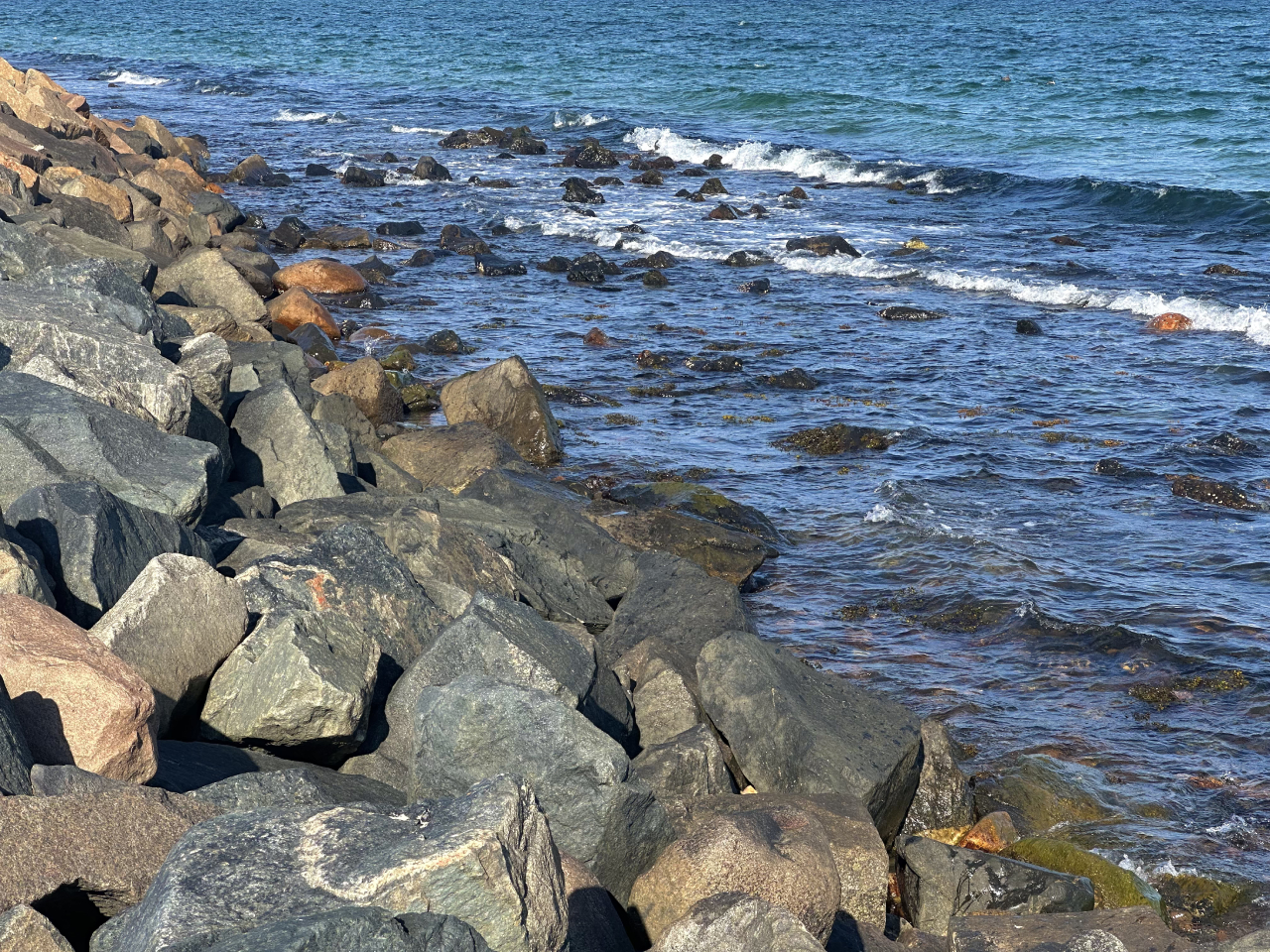
The sea is blue again
Highlights from the observations:
Barn Swallow (Landsvale) - 1592
Yellow Wagtail (Gul Vipstjert) - 1207
Golden Oriole (Pirol) - 1
Grey Plover (Strandhjejle) - 1
Spotted Redshank (Sortklire) - 1
Red-breasted Flycatcher (Lille Fluesnapper) - 1
Corn Bunting (Bomlærke) - 1
Barn Swallow (Landsvale) - 1592
Yellow Wagtail (Gul Vipstjert) - 1207
Golden Oriole (Pirol) - 1
Grey Plover (Strandhjejle) - 1
Spotted Redshank (Sortklire) - 1
Red-breasted Flycatcher (Lille Fluesnapper) - 1
Corn Bunting (Bomlærke) - 1
Ringing (Kabeltromlen)
Sangdrossel - 1
Musvit - 1
Rødhals - 1
Nordlig Blåhals - 1
Skovsanger - 1
Grønsisken - 1
Gærdesanger - 14
Rørsanger - 2
Sivsanger - 1
Løvsanger - 4
Broget Fluesnapper - 1
Gulbug - 1
Havesanger - 6
Munk - 4
Tornsanger - 3
Gransanger - 4
Total: 46
Sangdrossel - 1
Musvit - 1
Rødhals - 1
Nordlig Blåhals - 1
Skovsanger - 1
Grønsisken - 1
Gærdesanger - 14
Rørsanger - 2
Sivsanger - 1
Løvsanger - 4
Broget Fluesnapper - 1
Gulbug - 1
Havesanger - 6
Munk - 4
Tornsanger - 3
Gransanger - 4
Total: 46
People: Alvin Johansson, János Schadl, Julian Helbig, Dylan Daunt, Olga Fernández Enríquez, Simon S. Christiansen, Rikke Jakobsen
At the end of the rainbow there is a Manx Shearwater
søndag 17. maj 2026
Today Dylan and Alvin were at the migration count, and János, Olga, and Julian were at the ringing accompanied by Simon.
The sea migration was comparably slow today, numberwise. Although some challenging weather with rain and wind, we had a good morning with a beautiful rainbow.
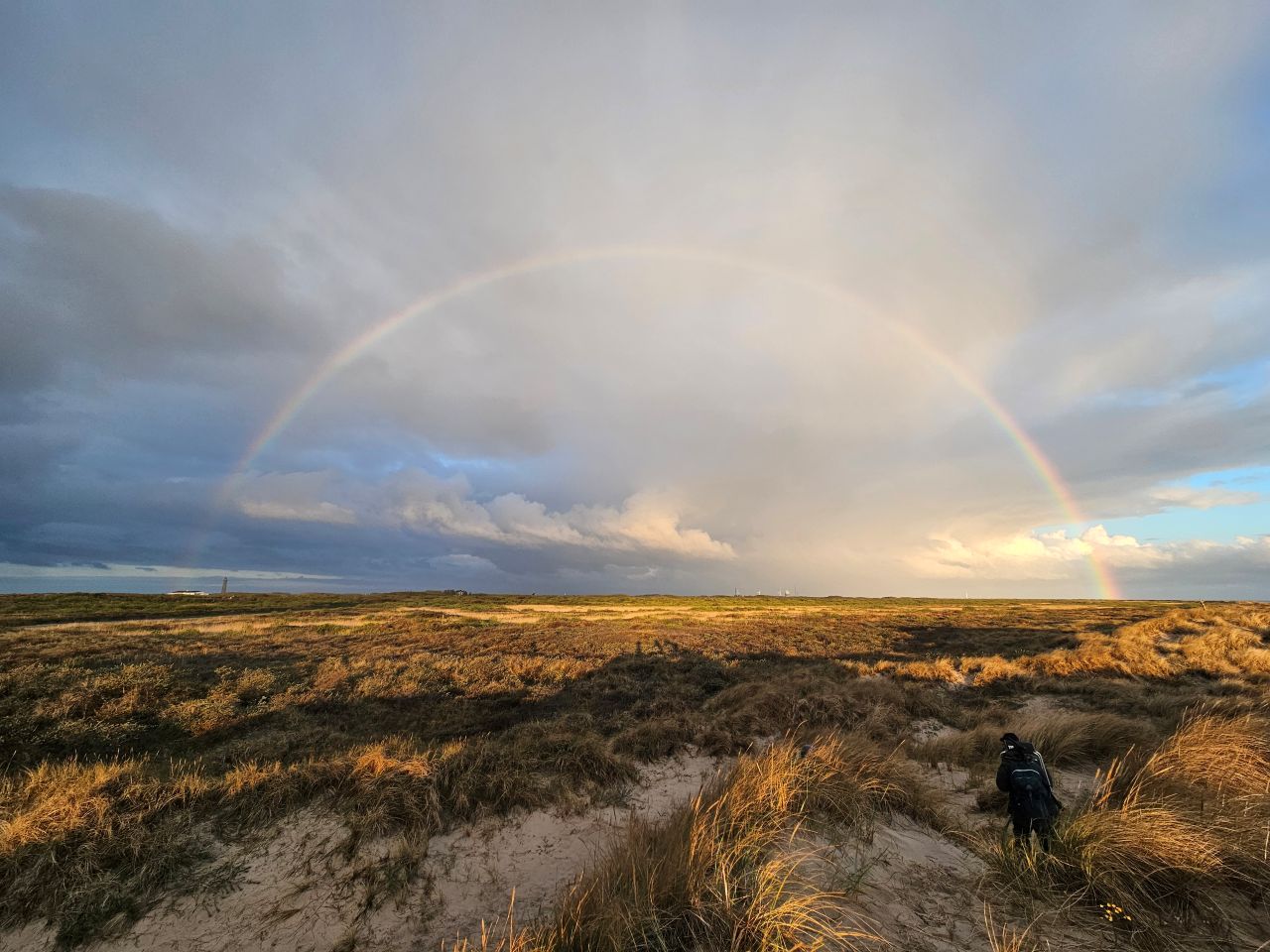 Rainbow seen from Sandklit
There was a Turtle Dove (Turteldue) seen at Grenen which Dylan got a brief glimpse of as it flew away. A few Great Northern Divers (Islom) passed close as they flew northwest, basically overhead.
In the last minutes of the standardized count, a Manx Shearwater (Almindelig Skråpe) was called out from Nordstrand flying east, which meant it would pass us at Sandklit within a minute or two. And it did. Very cool to see the difference in flight style compared to all the Fulmars (Mallemuk) we have seen in the past days.
The ringing was slow in the first hours with some rain showers, but picked up later in the morning. A lot of people from Dof Ung were also there and got to see some cool birds. In one round they caught three Garden Warblers (Havesanger)
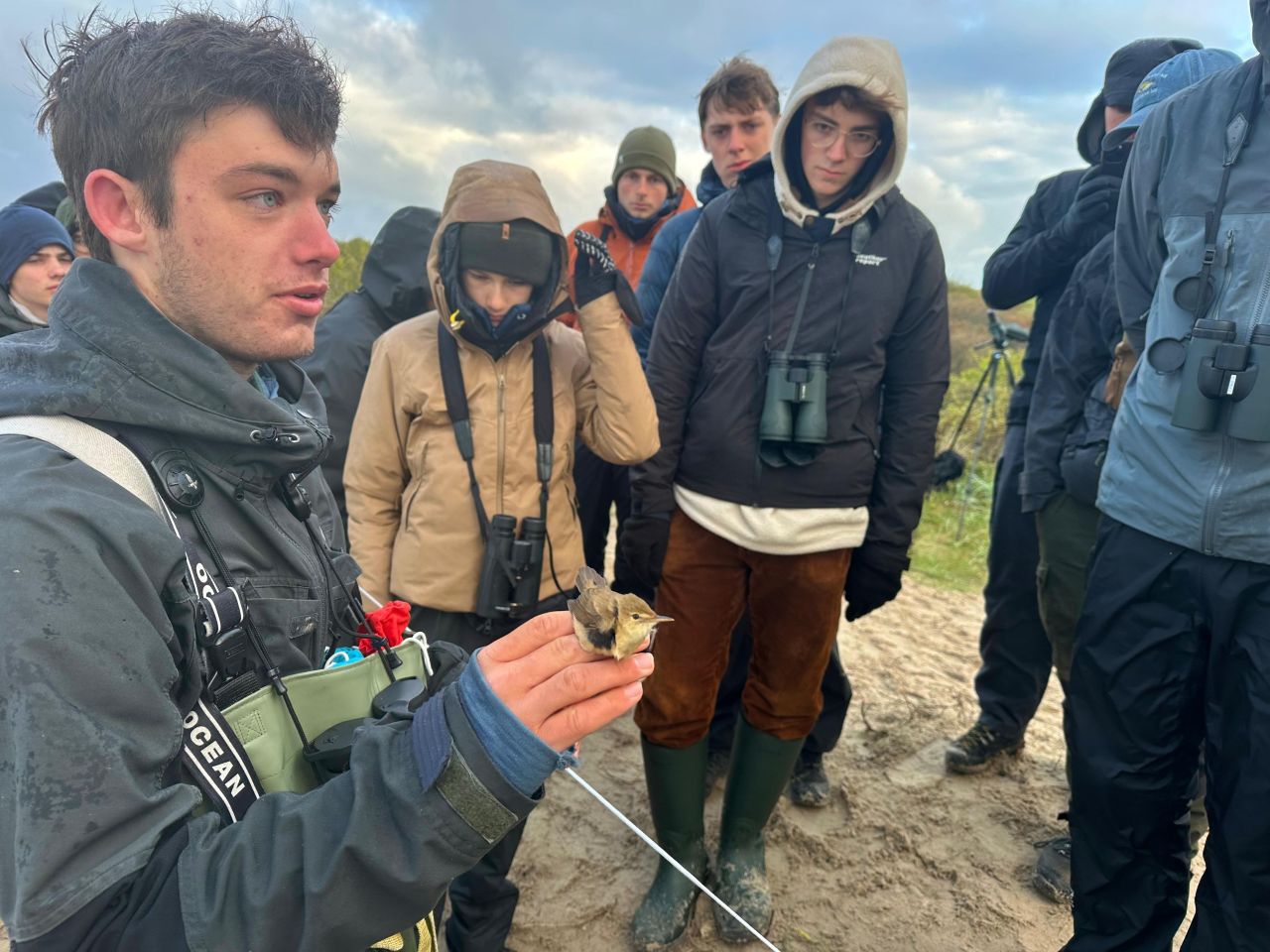 János with a Reed Warbler (Rørsanger)
For most of us, the afternoon was spent taking long naps and cleaning the station.
Rikke Jakobsen: our new apartment guest, also arrived today and will be staying with us for the rest of the week.
Highlights from the observations:
Manx Shearwater (Almindelig Skråpe) - 1
Great Northern Diver (Islom) - 3
Turtle Dove (Turteldue) - 1
Ringing (Jenne sø):
Gransanger - 1
Gærdesanger - 2
Bogfinke - 1
Tornsanger - 1
Total: 5
Ringing (Kabeltromlen)
Rørsanger - 1
Gulbug - 1
Havesanger - 3
Gærdesanger - 6
Løvsanger - 2
Munk - 3
Bogfinke - 1
Total: 17
Link to today’s observations in DOFbasen from observers in the area
Summary of today's raptor migration in DOFbasen
People: Alvin Johansson, János Schadl, Julian Helbig, Dylan Daunt, Olga Fernández Enríquez, Simon S. Christiansen, Rikke Jakobsen
Regn, regnbuer og en synlig gøg – sidste dag på Fuglefestivalen
lørdag 16. maj 2026
Lørdag begyndte grå og våd på Skagen Fuglestation. Regnen forsinkede ringmærkningen, så nettene kunne først åbnes klokken 6.30. Simon, Lisa, Julian, Dylan og Emil Skovgaard Brandtoft stod for dagens ringmærkning – med besøg fra Ørneklubben.
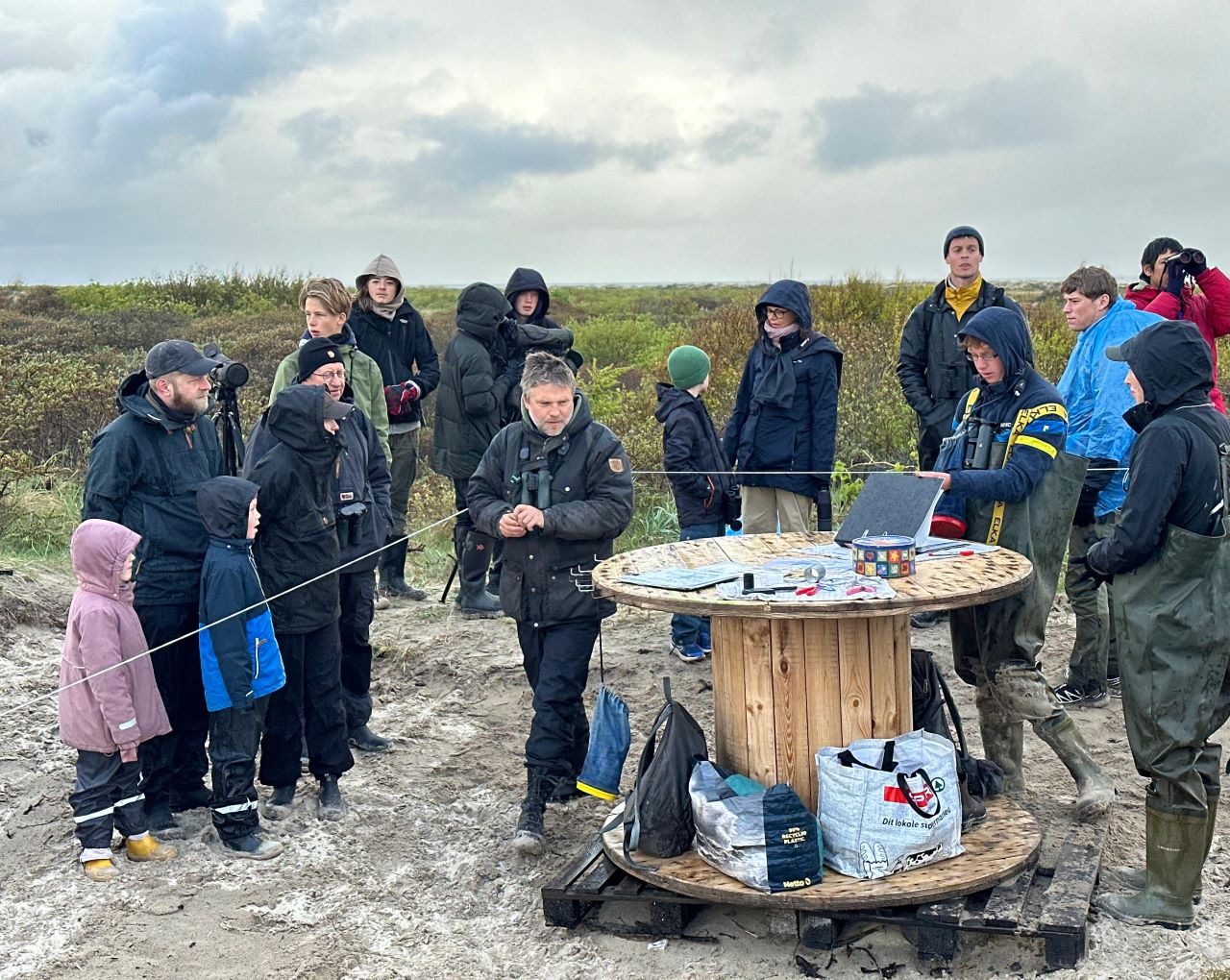
Ørneklubben ved Kabeltromlen (foto: Julian Helbig).
I ringmærkningen var et rørspurvepar blandt dagens fine oplevelser, og senere kunne Julian glæde alle ved Kabeltromlen med hjemmebagte cookies.
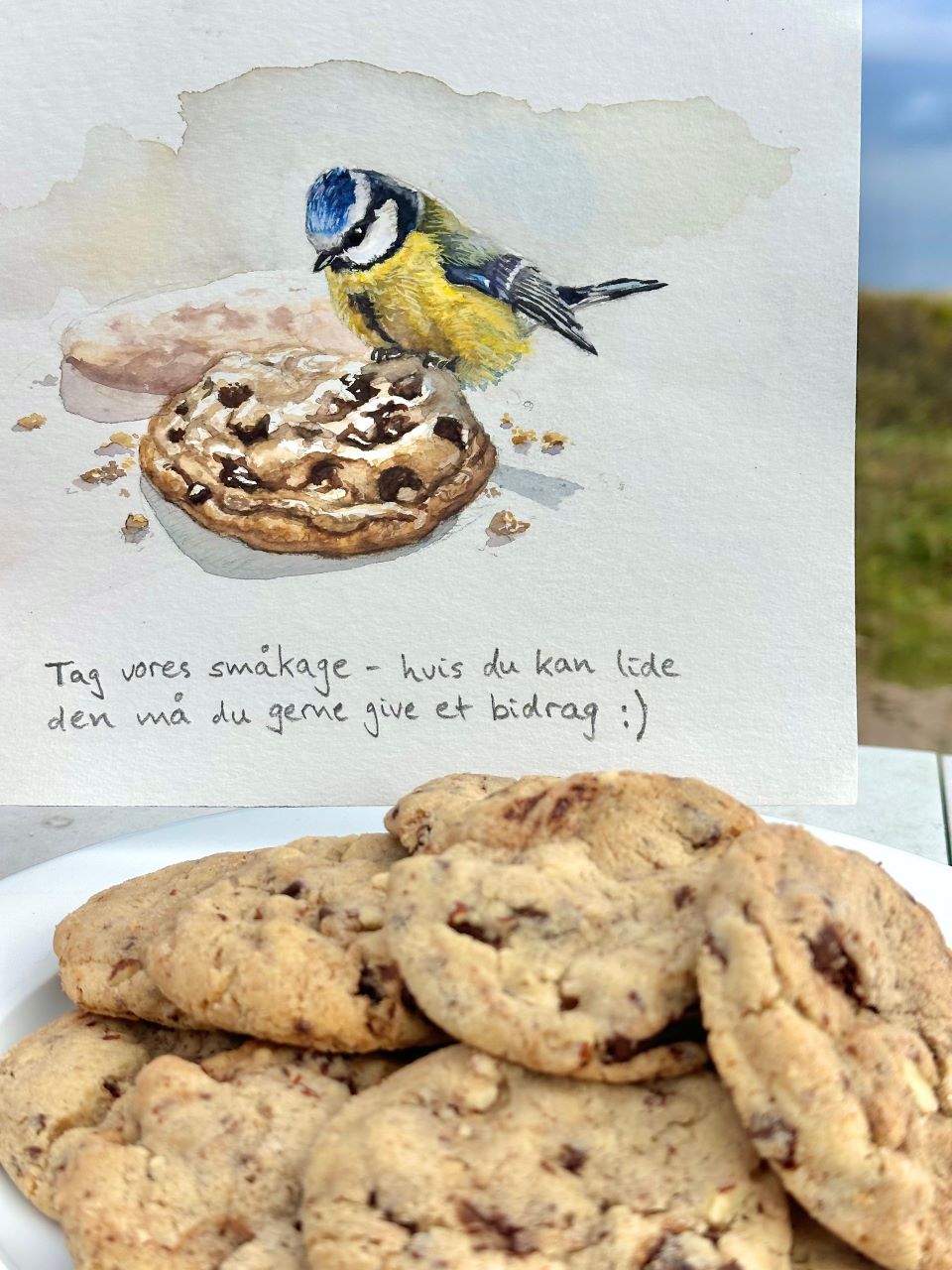
Cookies på Kabeltromlen (tegning og foto: Julian Helbig).
Og som så ofte i Skagen viste dagen sig alligevel fra sin helt særlige side. Olga, Alvin og János tog ud på havobs i regnvejret. Vejret holdt en del mennesker væk fra Grenen, og derfor blev det en ekstra god dag for Olga til at lære nyt i ro og mag. 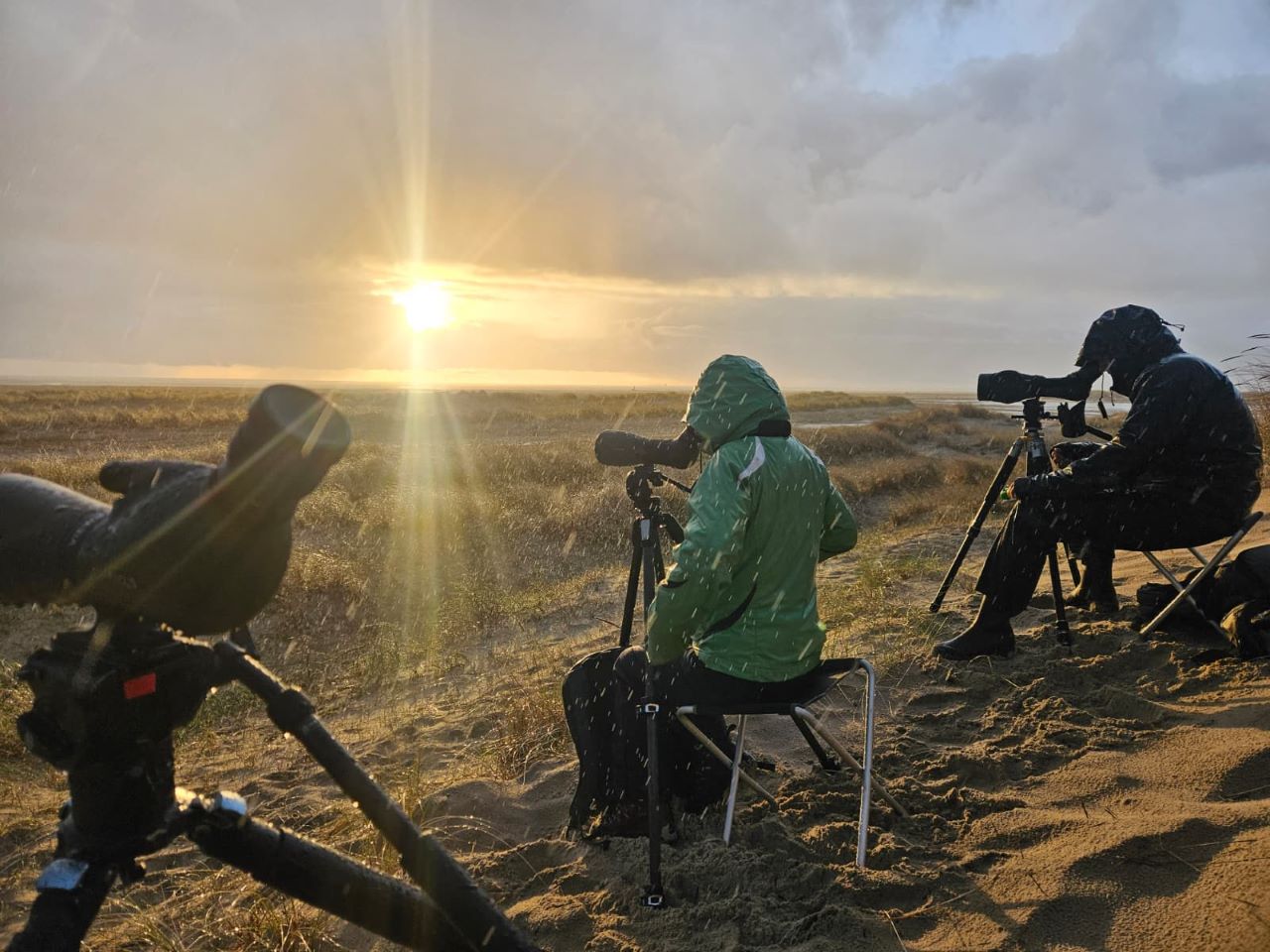 Olga og János på Sandklit (foto: Alvin Johansson).
Der blev set flotte arter over havet og langs kysten: Særlig fin var Storkjove (Great Skua), og også Almindelig Kjove (Arctic Skuas), Krumnæbbet Ryle (Curlew Sandpiper), Sortstrubet Lom (Arctic Diver), Canadagæs (Canada Goose) og flokke af Sortand (Common Scoter) og Fløjlsand (Velvet Scoter), som kom usædvanligt tæt på land. Også Lomvier (Guillemots) trak forbi i det grå lys. Midt mellem regnbygerne dukkede en regnbue op over sandklitterne – et klassisk Skagen-øjeblik.
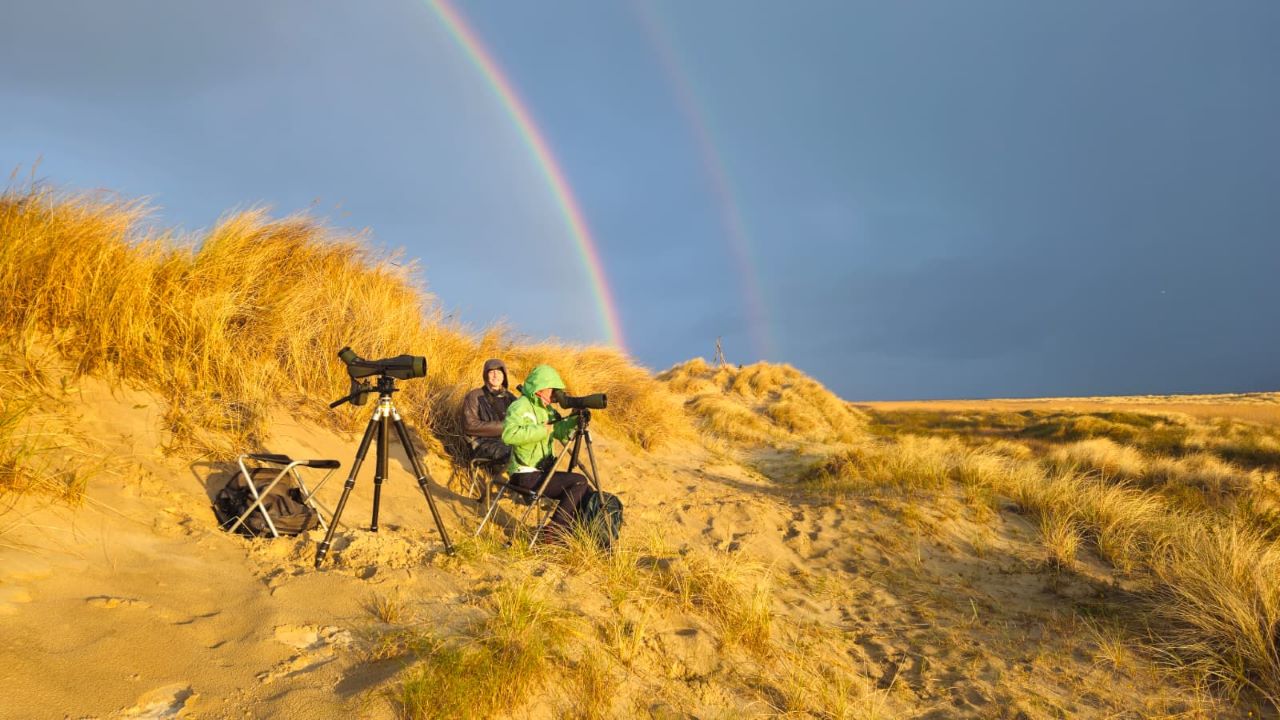 Alvin og Olga på havobservation (foto: János Schadl).
Søren og Karen Marie gik tur i Ellekrattet og nød de mange småfugle mellem træerne, inden der senere blev handlet ind til aftenens grillmenu.
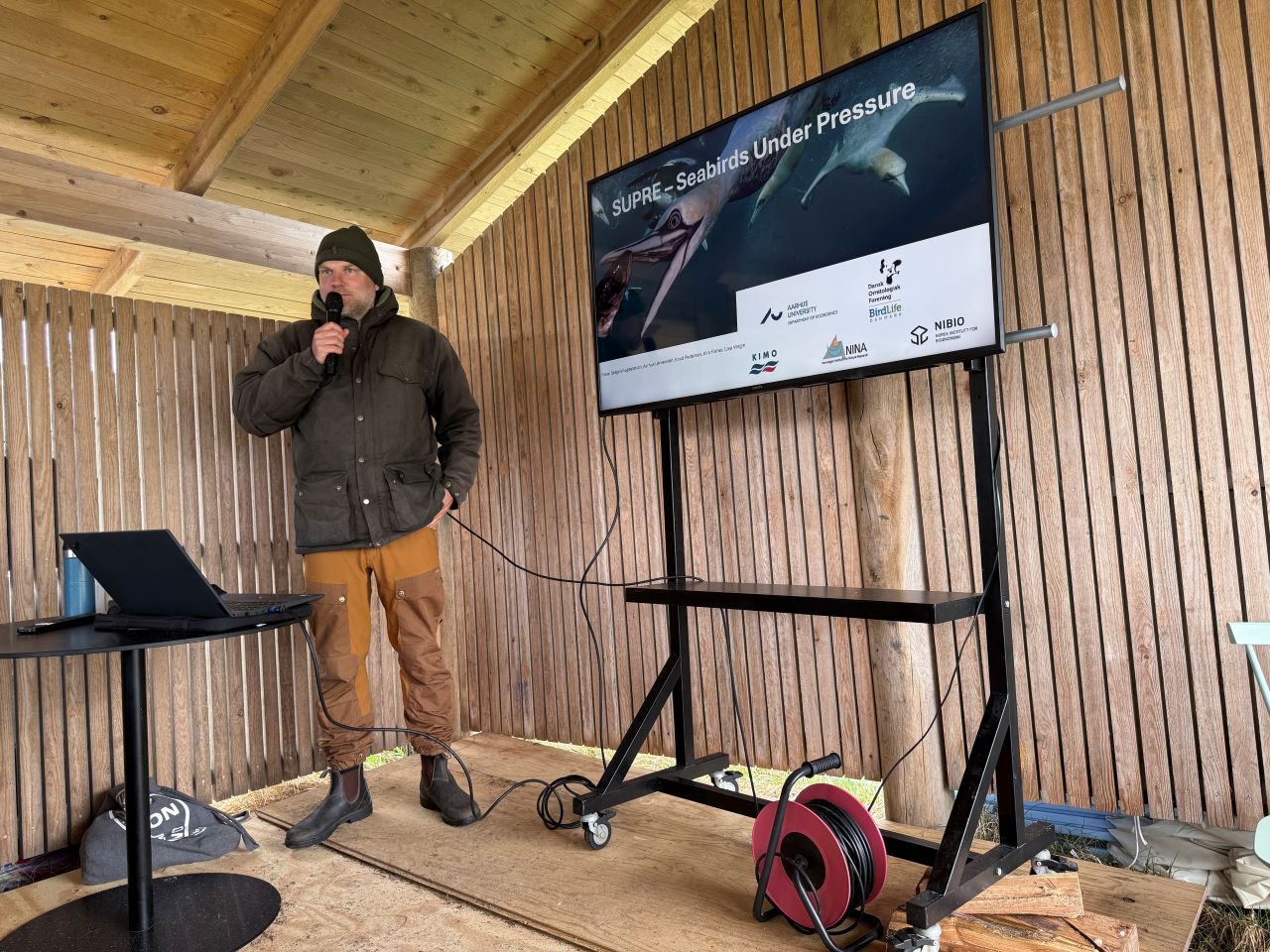
Simon S. Christiansen holder foredrag (foto: Søren Leth-Nissen).
På festivalens sidste dag holdt stationsforstander og naturvejleder Simon S. Christiansen også foredrag om Projekt SUPRE – Seabirds Under Pressure. Med levende fortællinger fortalte Simon om de nordatlantiske havfugle, som i stigende grad er under pres i danske farvande. Klimaændringer, fødemangel, sygdomme, plastikforurening og marint affald påvirker bestandene alvorligt, og i perioder skyller tusindvis af døde havfugle op på de danske strande. Projektet ledes af Aarhus Universitet i samarbejde med DOF BirdLife, norske forskningsinstitutioner og KIMO Danmark og løber frem til 2028 med støtte fra VELUX-fonden. Frivillige strandtællere indsamler data gennem citizen science, så forskerne kan blive klogere på udviklingen og skabe bedre løsninger til beskyttelse af havfuglene og havmiljøet.
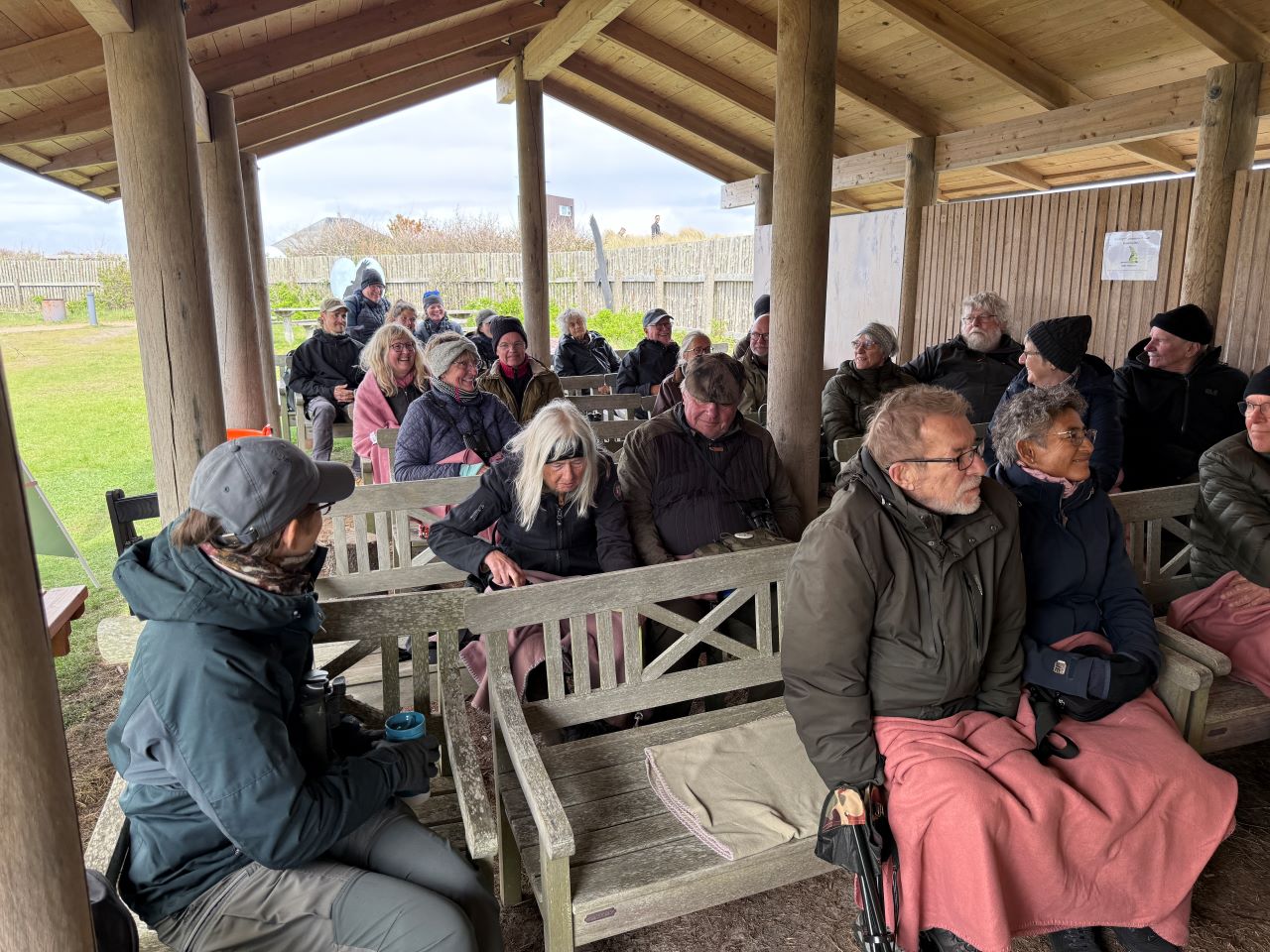
Publikum ved festivalens sidste foredrag (foto: Søren Leth-Nissen).
Senere på dagen blev der også tid til tegnekursus med den lokale tegner Jens Thomas Larsen. Opgaven var at tegne fugleskitser i felten – ikke helt let i regnvejr. Heldigvis satte en gøg sig meget synligt på en busk og blev dagens perfekte model.
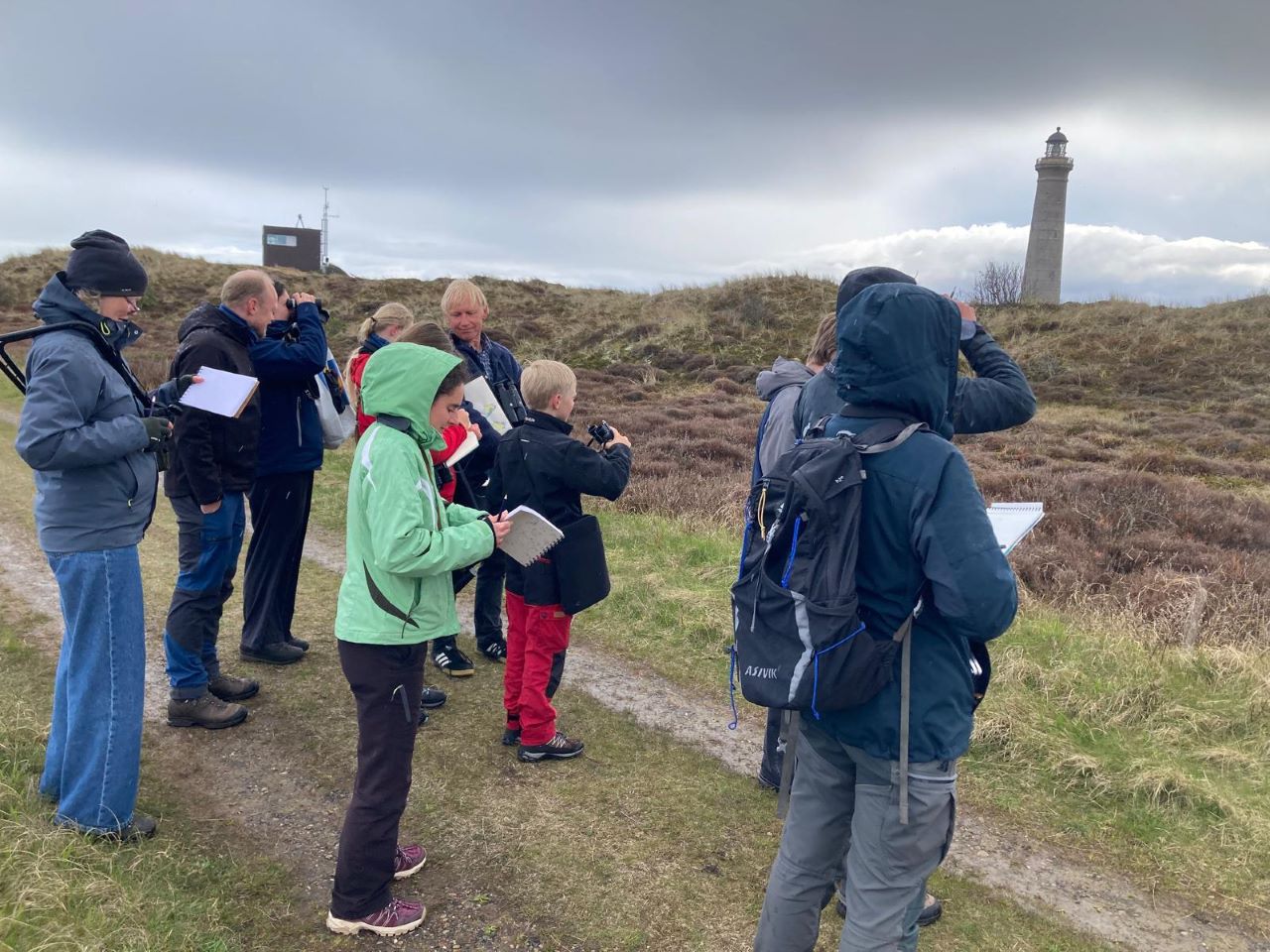
Tegnekursus med Skagen-tegner Jens Thomas Larsen (foto: Lisa Vergin).
Dagen – og årets Skagen Fuglefestival – sluttede med uddeling af fugleprisen for festivalens bedste fugleoplevelse. Prisen for den mest interessante art, en mellemkjove, gik til Joakim Matthisen fra DOF Ung. Volsted Distillery havde doneret en flot gin-gavepakke til vinderen.
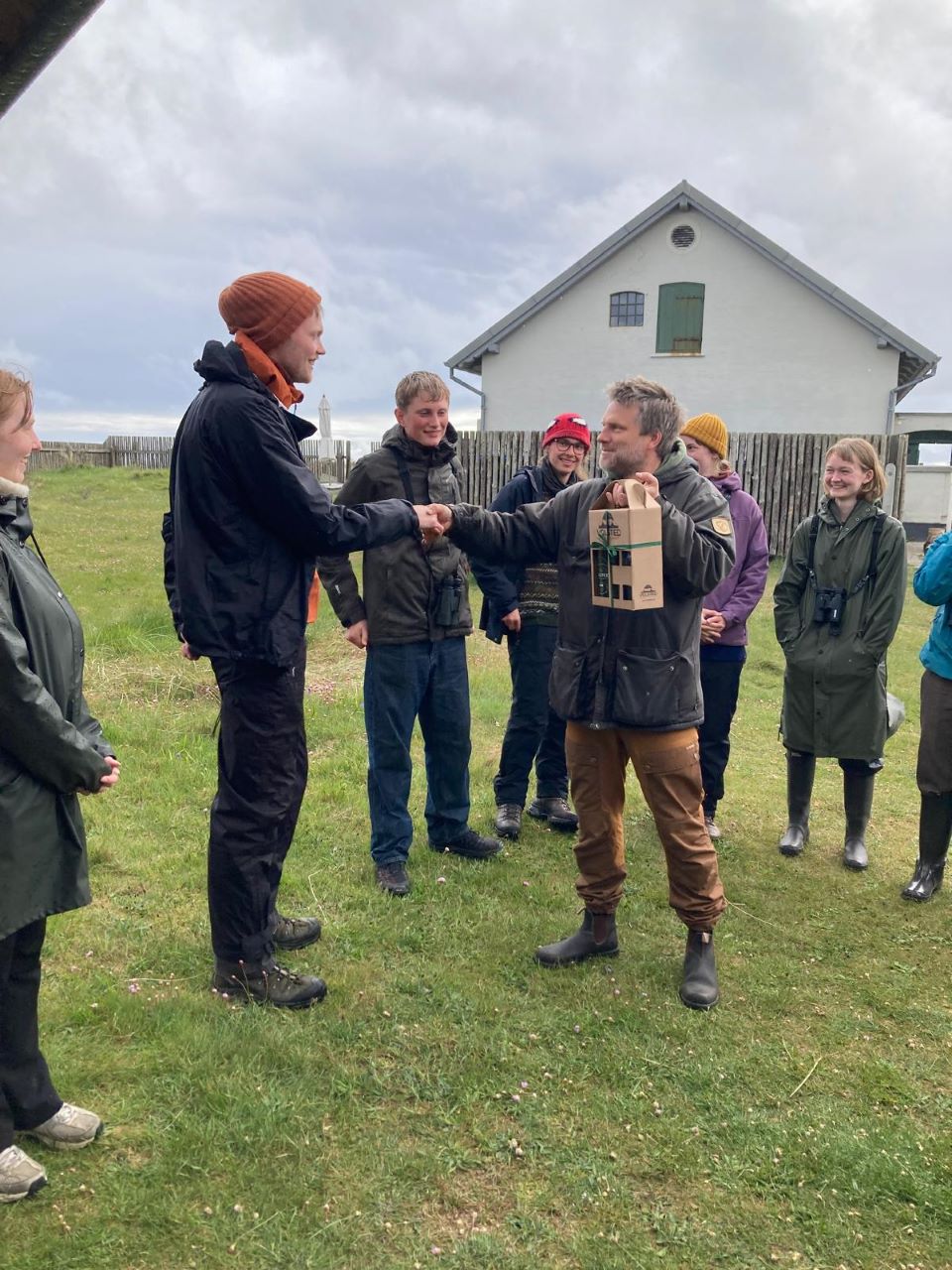
Joakim Mathiesen vandt prisen for bedste fugleoplevelse (foto: Lisa Vergin).
Stort tillykke til Joakim – og tak for endnu en Fuglefestival fyldt med fugle, fællesskab, regn, grin og store naturoplevelser.
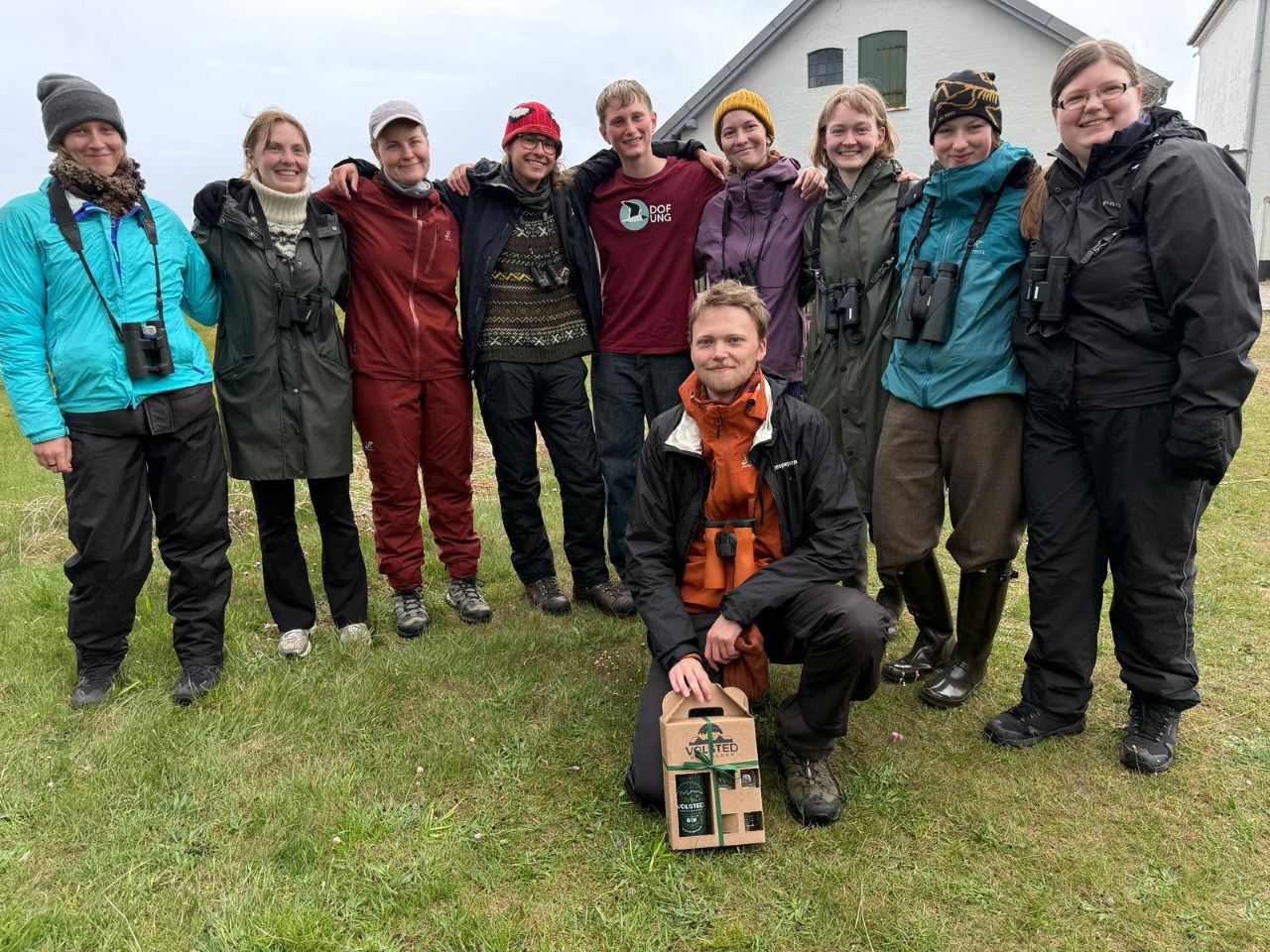
Joakim Mathiesen og en del af flokken fra DOF-UNG (foto: Søren Leth-Nissen).
Festivalen sluttede af med grillaften i Fyrhaven ved det Grå Fyr. Tak for i år!
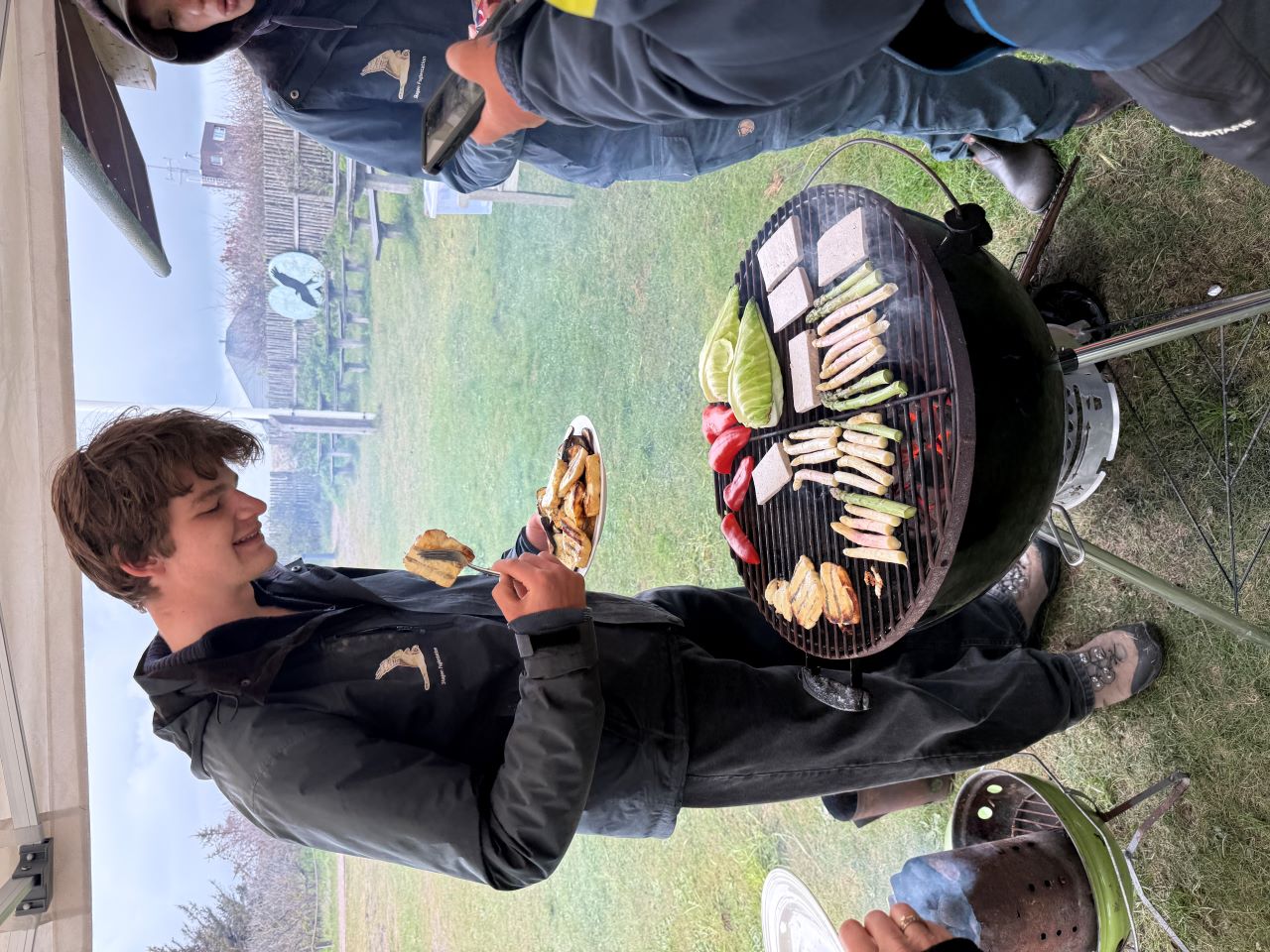 Julian ved grillen (foto: Søren Leth-Nissen).
Ringmærkning (Kabeltromlen):
Gransanger - 1
Gærdesanger - 5
Løvsanger - 1
Munk - 1
Tornsanger - 3
Total: 11
Great Snipes!
fredag 15. maj 2026
Today's blog must start with yesterday evening when we went out for the Great Snipes (Tredækker) at Wester Ingklit. They had been found the night before, and we were hoping to see them display and maybe even try to ring them if the situation allowed it. When we arrived at the location, it didn't take long until we heard the first song notes, and when it got darker, we had a full hour of display with five birds singing and dancing. It was a lifer for many of us, and what a show!
Thermal image video
This morning also started early for me and Alvin when we got up after three hours of sleep to try our luck nightcatching again. We walked over the Sandormentracks, the new ponds at Sandklit, and to the tip at Grenen. We got close to a Short-eared Owl (Mosehornugle) and a few Common Sandpipers (Mudderklire) and Ringed Plovers (Stor Præstekrave). Not only that, but we also tested opening nets at Kabeltrommlen, but the strong winds made it impossible to ring this morning, unfortunately.
It was sadly also the last day of the visit of my brother Mika, who stayed here at the station for a week. It was very nice to see him again, and I think he really enjoyed his stay at the station and learned a lot of new things about birds.
As there was no ringing this morning we were quite a few observers this morning at Sandklit, where we also went down the dunes a bit to be better sheltered from the strong southerly winds. It was one of the best migration counts we had so far, with several Great Northern Divers (Islom), Shags (Topskarv) and Temminck's Stint (Temmincksryle) migrating and resting at the beach.
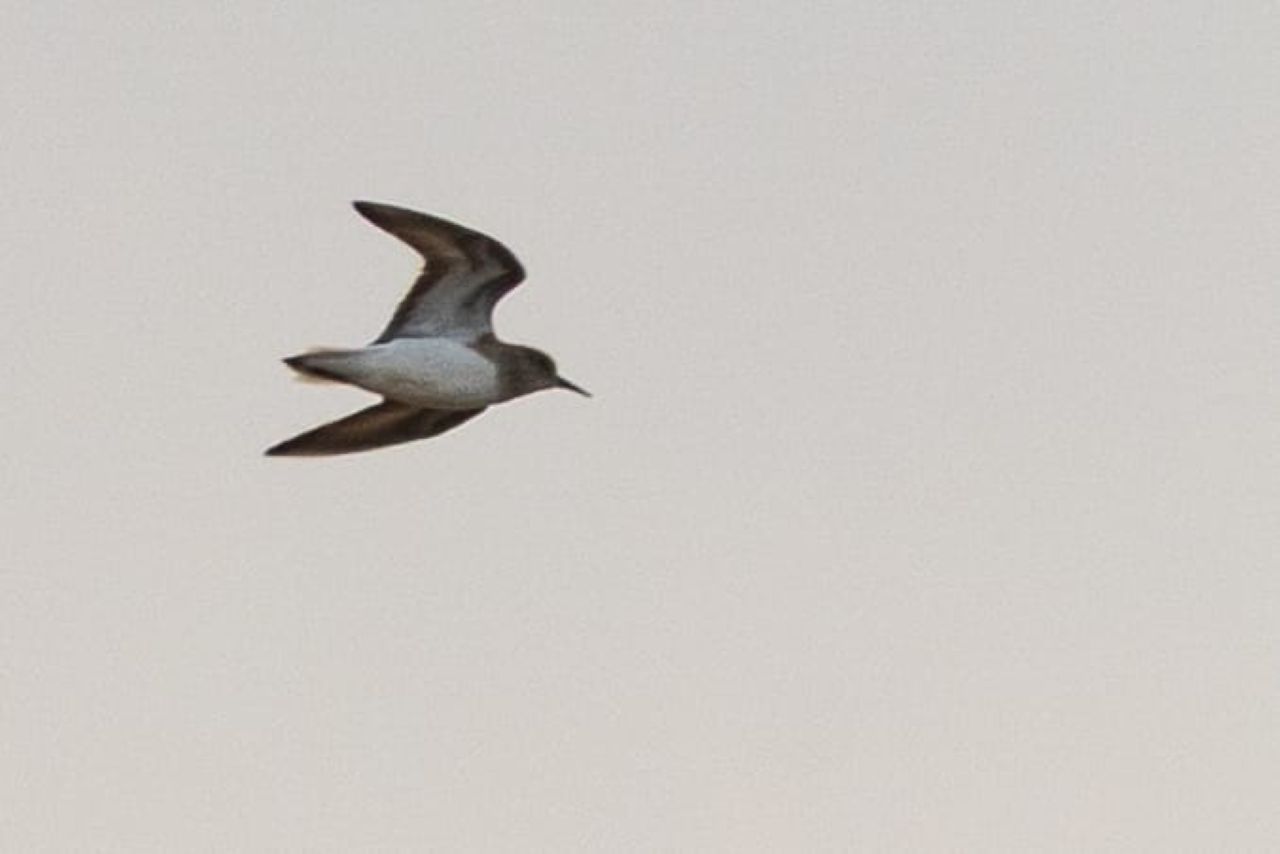
Temminck's Stint (Temmincksryle)
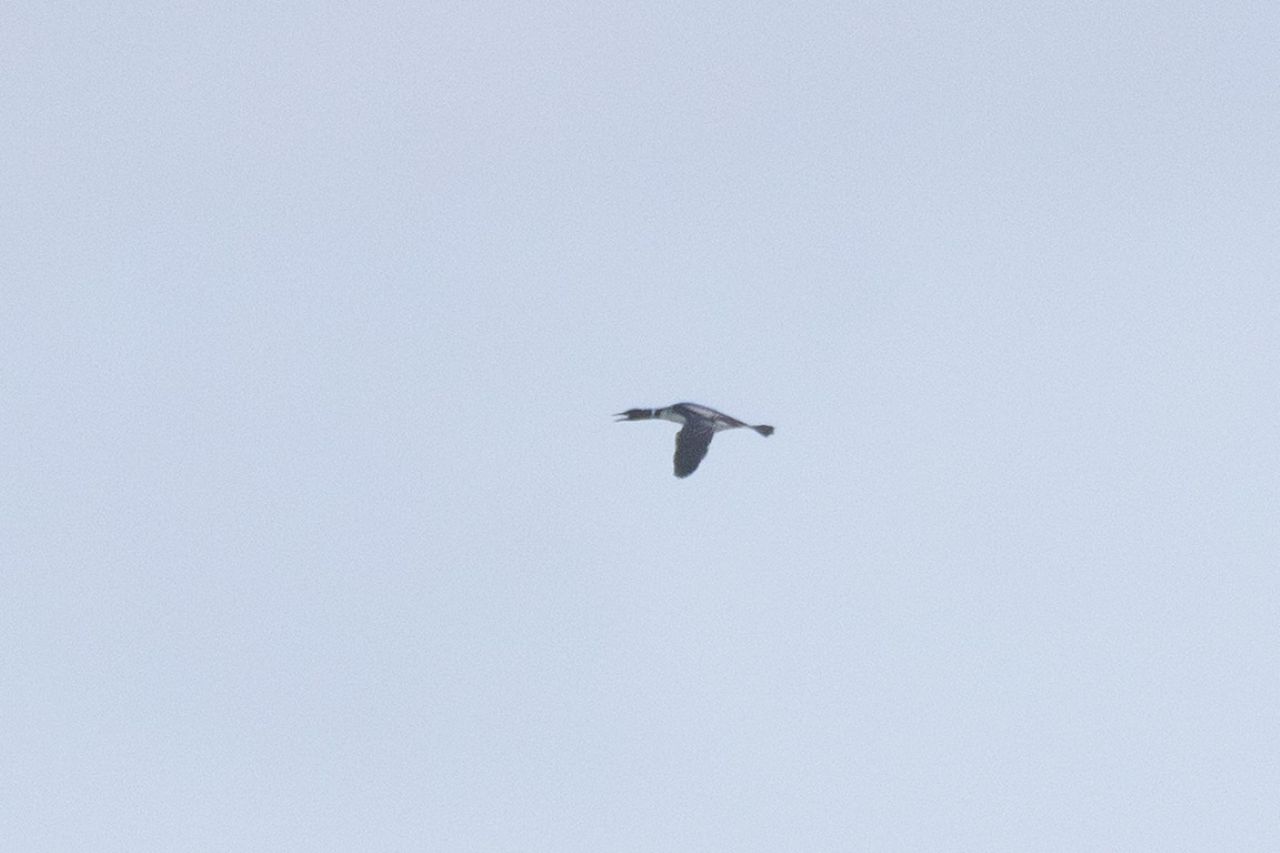
Great Northern Divers (Islom)
A highlight was also a 2nd CY Arctic Tern (Havterne) resting and feeding close to the shore. This is a very rare plumage in spring in Europe and is not annually recorded in Skagen, as most immature birds spend their first years south of the equator.The best bird of the morning, however, was a light morph Pomarine Skua (Mellem Kjove) giving prolonged views at a medium distance. Again, a lifer for many and for me the first light morph adult.
Pomarine Skua (Mellem Kjove)
After the count we immediately went to Storsig to look for raptors, where we also saw an adult male Montagu's Harrier (Hedehøg) but not much else. We took a nap on the hill before we went back to have lunch.
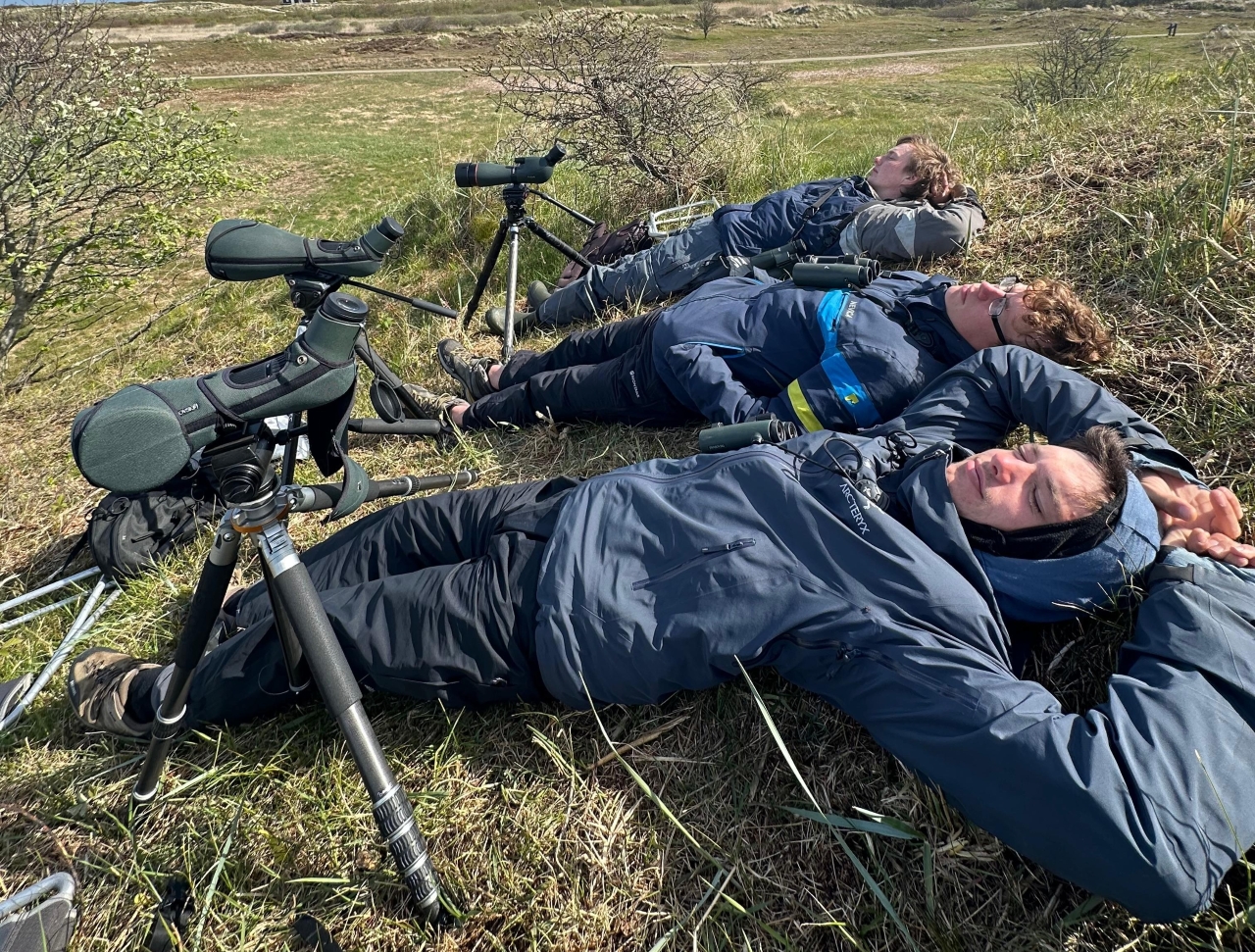
Napping volunteers at Storsig
There were also two talks in the afternoon, one about GPS tagging of Common Buzzards (Musvåge) and one about the raptor migration in Batumi (Georgia), a major bottleneck for bird migration in eastern Europe. Beside that, it was raining again, so we used the time to get the office work done and have some rest.
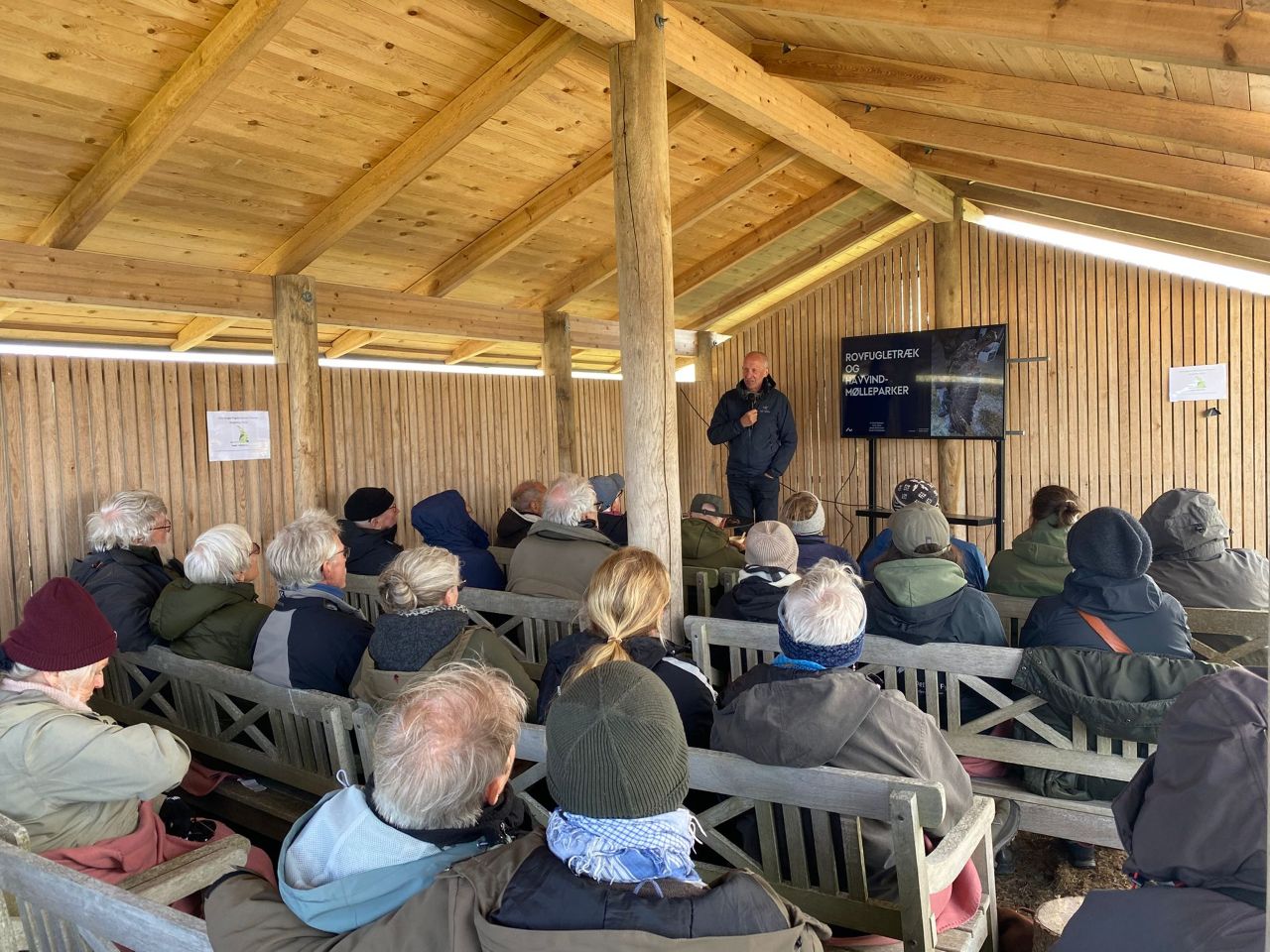
Talk about GPS tagging of Common Buzzards (Musvåge)
I was planning to go see the Great Snipes (Tredækker) again and was already thinking of biking there, when Jørgen offered to take us. While Alvin, Dylan, and Saxe went out to Vester Engklit to look for them, Julian, Jørgen and I had an amazing time with the Snipes again. Although there were many more people than the day before (probably over a hundred), the birds did not seem to be disturbed by that.
I also managed to get some good recordings of the song, and we got lucky seeing a bird sitting well before sunset and got good views of it.
Great Snipes (Tredækker) display song
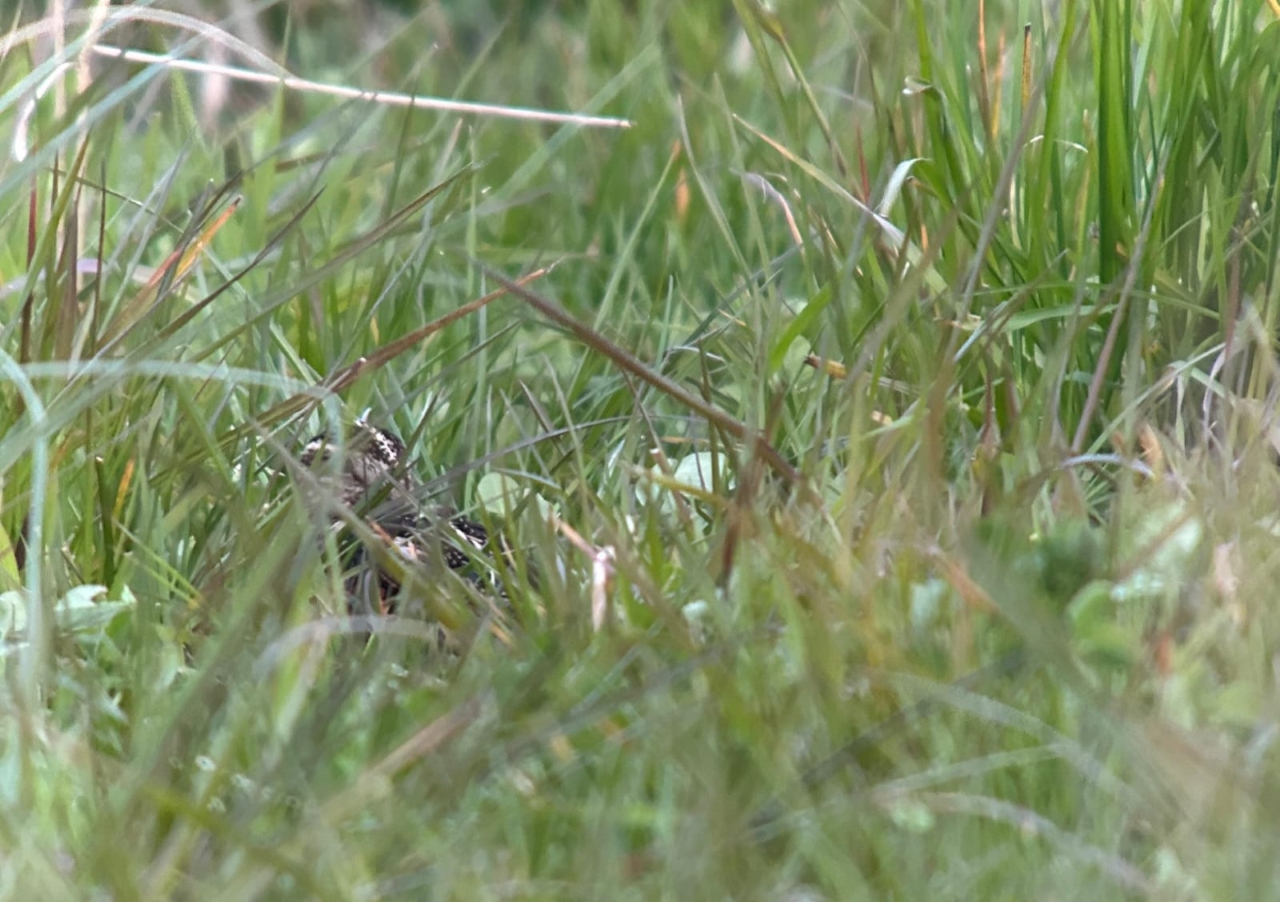
Amazing views of a resting Great Snipe (Tredækker)
Highlights from the observations:
Temminck's Stint (Temmincksryle) - 18
Great Snipe (Tredækker) - 5
Shag (Topskarv) - 8
Great Northern Diver (Islom) - 4
Pomarine Skua (Mellem Kjove) – 1
Short-eared Owl (Mosehornugle) – 1
2nd CY Arctic Tern (Havterne) - 1
No ringing today because of rain
Link to today’s observations in DOFbasen from observers in the area
Summary of today's raptor migration in DOFbasen
People: Alvin Johansson, János Schadl, Mika Schadl, Julian Helbig, Dylan Daunt, Simon S. Christiansen, Lisa Vergin, Sverre Dahl Porsgaard, Anton, Ole, Olga Fernández Enríquez, Karen Marie & Søren, Jørgen Hulbeck, Saxe, Gustav
Short-eared Owl and Bird Festival
torsdag 14. maj 2026
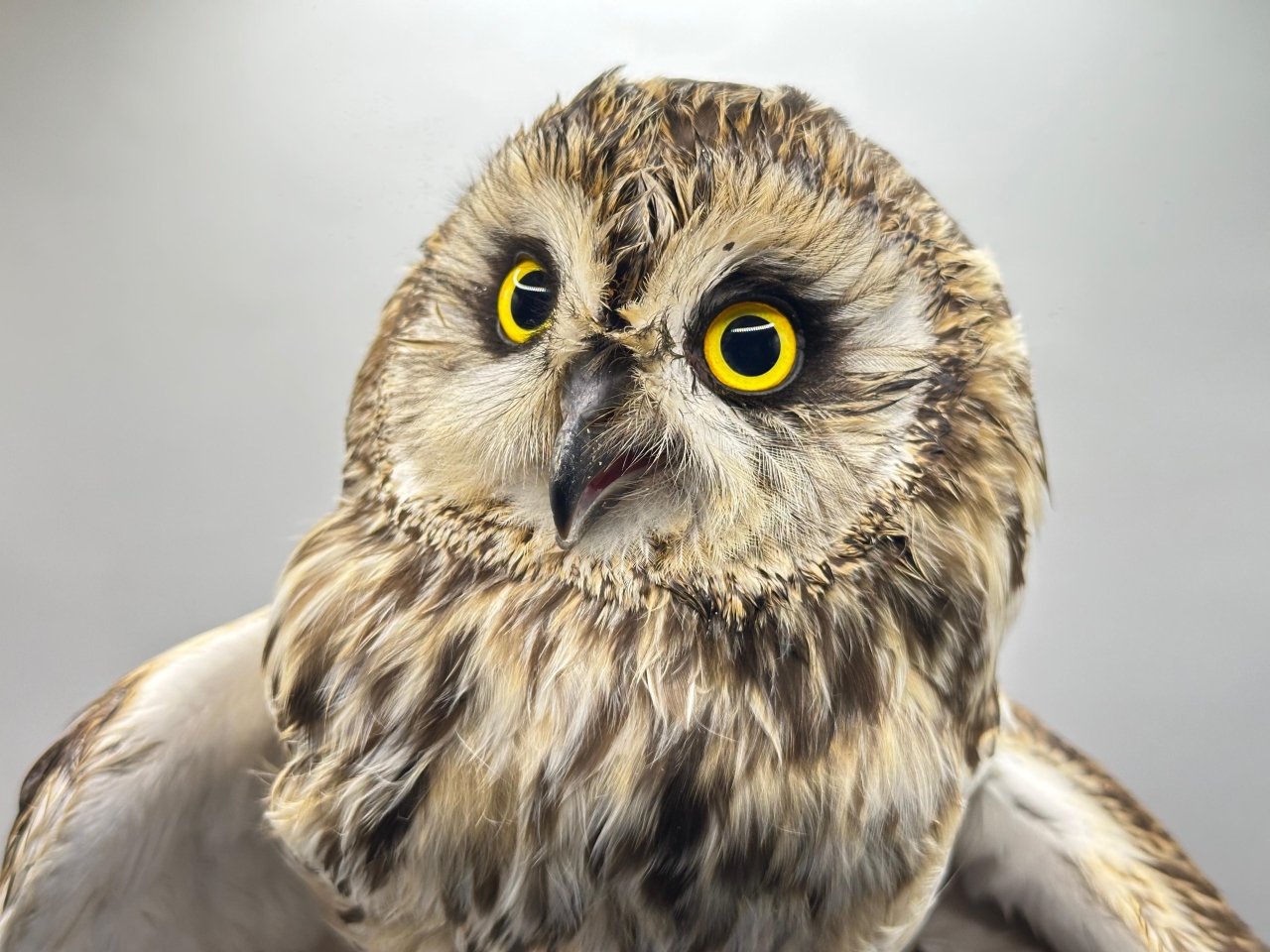
The day couldn’t have started better. János and Dylan had decided to go on night catching at 2 am, as the weather was going to be cloudy, rainy and windy, which is perfect for night catching. They went to the beach and walked for around an hour. No birds in sight, everything seemed too quiet. It was raining heavily and they ended up completely wet so they decided that it may be better to come back to the station. And on their way back they saw it, a dark shadow sitting on the floor. It was a short-eared owl (Mosehornugle)!! Dylan walked slowly towards it, very carefully, step by step, holding the torch. The owl looked at him and then looked away several times, as if it were about to fly away at any moment. But it didn’t, and when they were close enough János was able to trap it with the net.
At around 3:15 Alvin’s phone started to ring. “We have got a short-eared owl!” All of us were waken up and went down with high excitement to the lab. There, the owl was waiting for us. It was a 2cy male, as we could tell from the white colour under the wings and the pattern of the feathers on the chest. We know it was born last year because the white spots on the tip of the central feathers of the tail (in adults they have black spots). The poor owl was so wet because of the rain that Simon used a hair drier to dry it. After the hairdressing session (or featherdressing session), came the photo session to capture the details and beauty of this bird. Some of us could hold it in our hands, one of those was me and it was a very special moment for me. Finally, it was released.
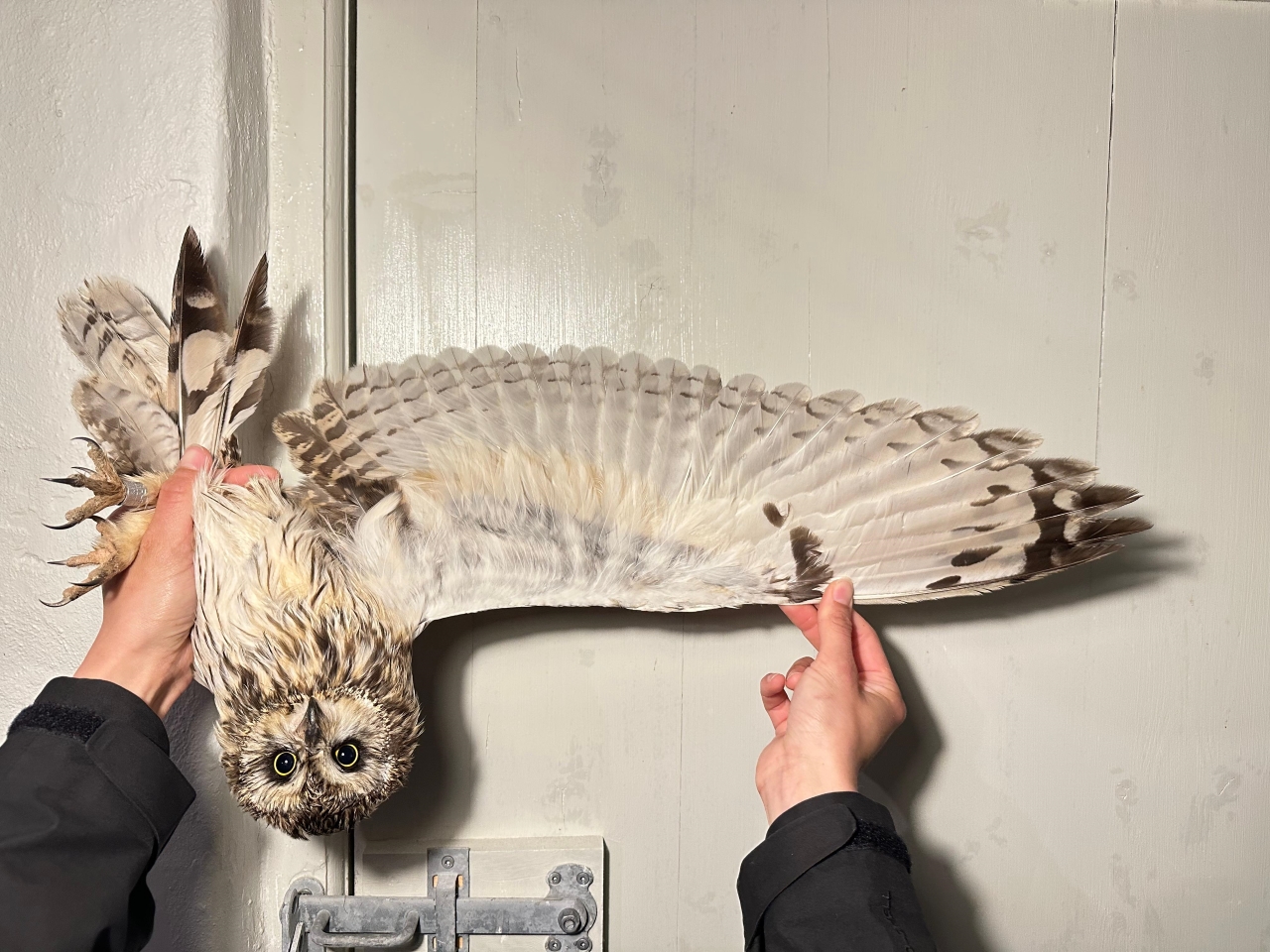
Underside of the wing. It is very white, what tells us it's a male.
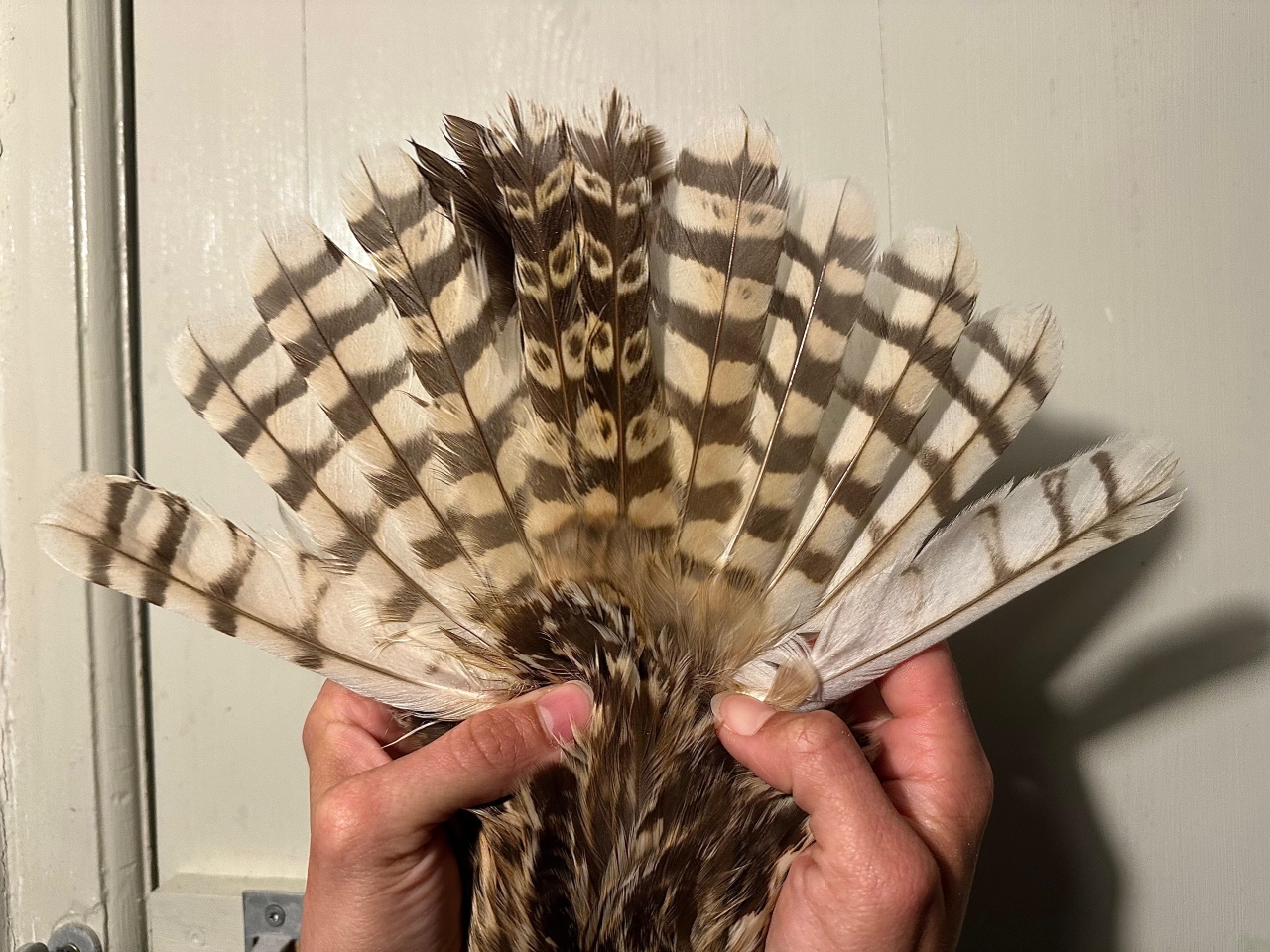
Juvenile tail.
János and Alvin wanted to keep on trying to find more birds so they went outside again. The rest of us went to sleep again, the rain was still heavy, which meant that the ringing was cancelled for today. János and Alvin didn’t catch anything else, but Alvin decided to go to do the migration counting although it didn’t stop to rain in the whole morning. He could see some waders like oystercatchers (Strandskade), redshanks (Rødben), dunlins (Almindelig Ryle), 4 Temminck’s stints (Temmincksryle), 1 bar-tailed godwit (Lille Kobbersneppe) and 1 red knot (Islandsk Ryle).
Apart from that, today it was the first day of the Skagen Fuglefestival. The weather may not have been the best, but that didn’t stop most of the activities to go as planned. We set up the stands and at 10:00 Simon and Oluf gave a speech to inaugurate the festival.
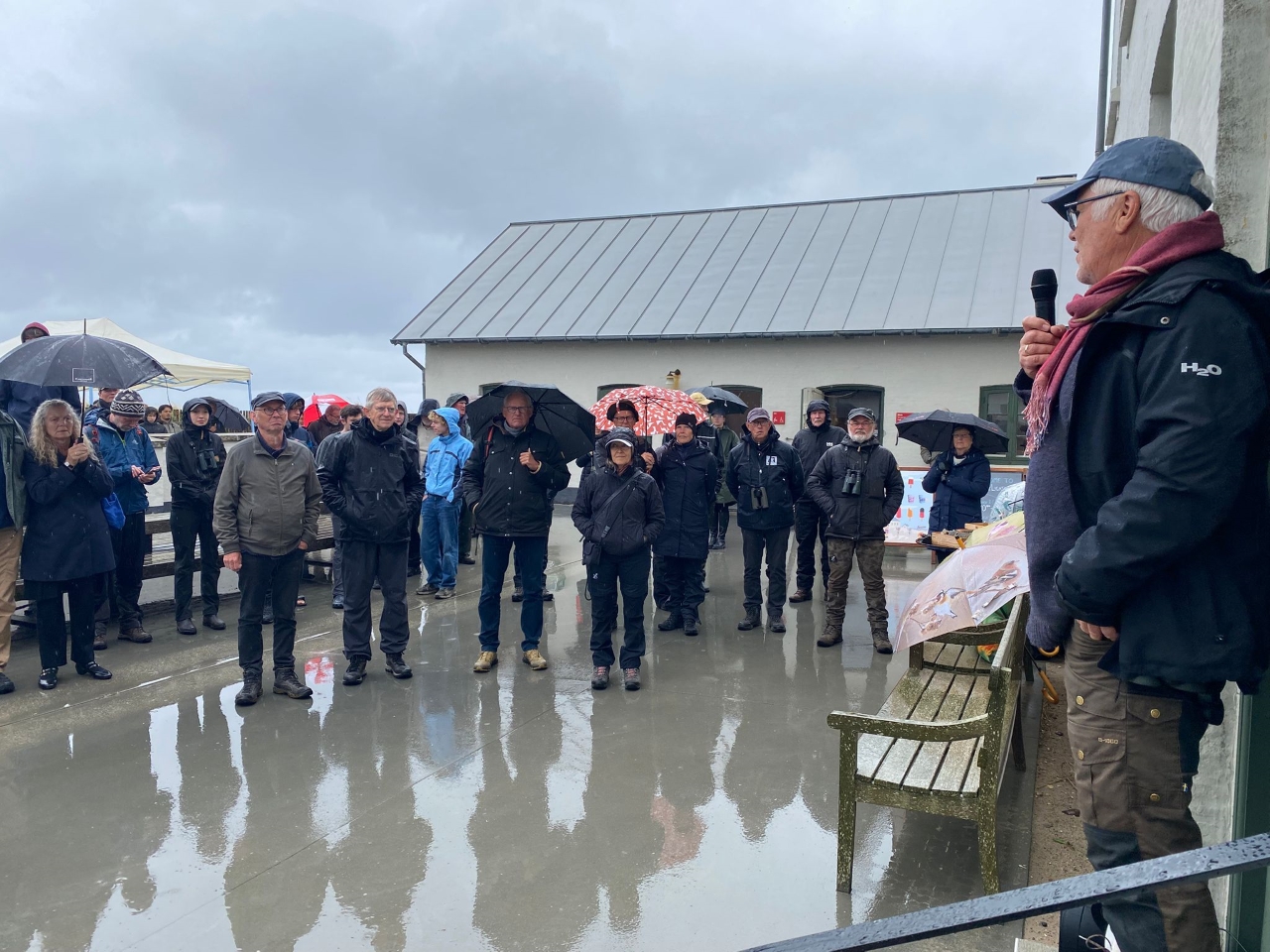
After that, people conversated, bird merchandising and birdwatching equipment was sold and coffee and food were served. In the afternoon, we could enjoy two presentations: Tårnfalke og ICARUS projektet, by Lars Bo Jacobsen; and Fugle i Ny Natur (FiNN), et levende laboratorium for fugle og biodiversitet, by Jacob Jensen from DOF.
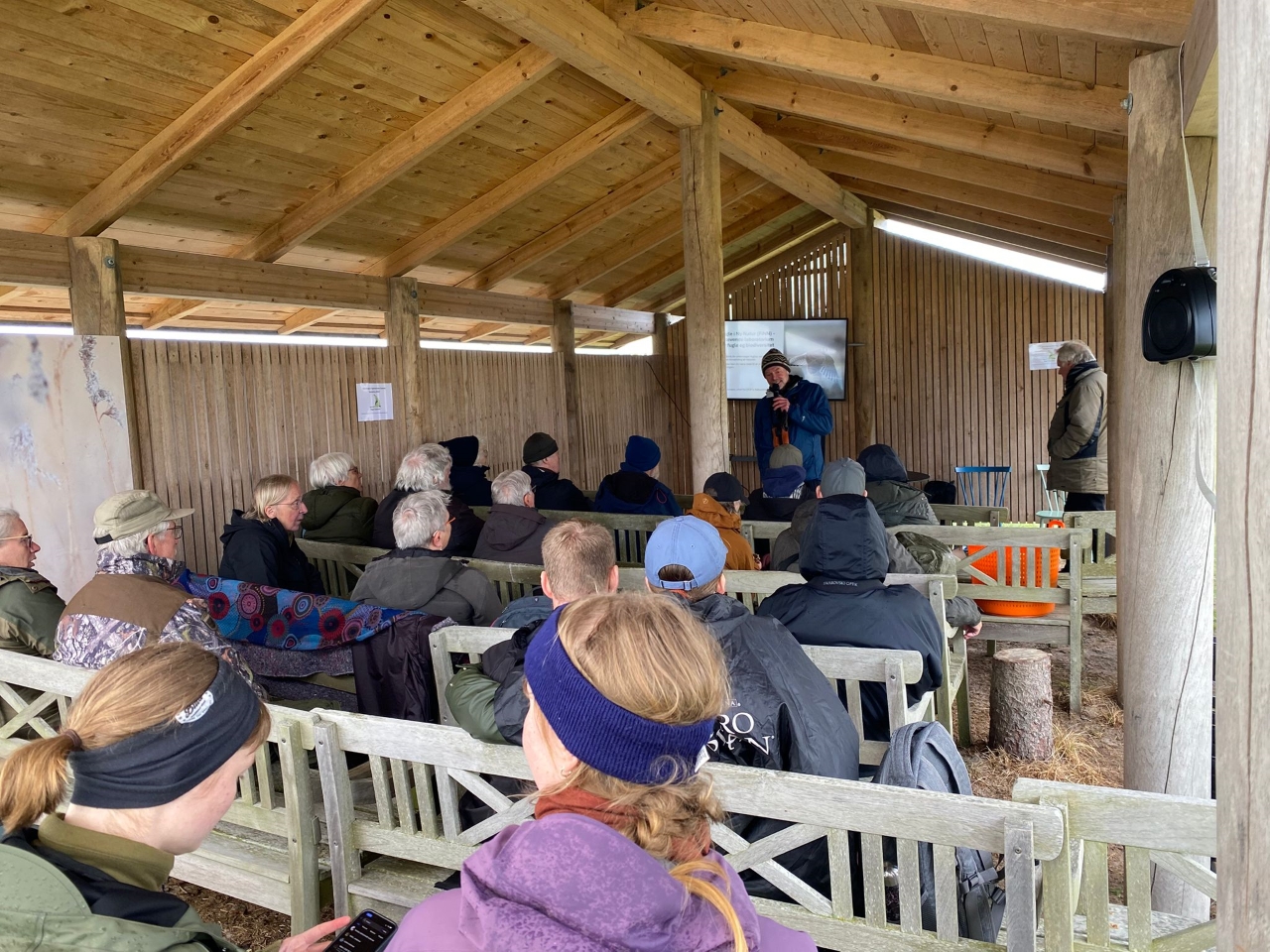
In general it was a calm day that let us rest, recover and do other activities. Julian baked cookies to offer them to the public tomorrow and designed a sign for donations.
However, the rain didn’t take away the enthusiasm for birdwatching. Ole and Anton went to the harbour and saw eiders (Ederfugl) and common sandpipers (Mudderklire), János and Mika saw a flock of one hundred oystercatchers (Strandskade) and Dylan watched 1 great snipe (Tredækker) and a male red-backed shrike (Rødrygget Tornskade). After dinner, Janos, Mika, Dylan, and Alvin saw three Arctic Skuas (Almindelig Kjove), one of them was a light morph that was very close to the beach. They also had very close fulmars (Mallemuk). We will end the day going to Kandestederne, where we will try to look for great snipes (Tredækker). Wish us luck!
Highlights from the observations:
Temminck's Stint (Temmincksryle) - 4
Great Snipe (Tredækker) - 1
Arctic Skua (Almindelig Kjove) - 3
Ringing (Grenen):
Short eared owl (Mosehornugle) - 1
Link to today’s observations in DOFbasen from observers in the area
Summary of today's raptor migration in DOFbasen
People: Alvin Johansson, János Schadl, Mika Schadl, Julian Helbig, Dylan Daunt, Simon S. Christiansen, Lisa Vergin, Sverre Dahl Porsgaard, Anton, Ole, Olga Fernández Enríquez, Karen Marie & Søren
Lapland Bunting and Bullfinches
onsdag 13. maj 2026
This morning I got up earlier to open up a net on the beach at Grenen to hopefully catch some more wagtails and pipits. Our hopes weren’t too high as the wind was coming from the North/West throughout the night and morning which would reduce the number of migrating birds drastically. We unfortunately didn’t catch any birds today, but it will not be our last attempt.
This morning’s migration count team was composed of János, Sverre, Ole and myself. It was a generally quiet morning count, but we had a period in the middle of the morning that was excellent. In twenty minutes, we found a Lapland Bunting (Lapværling) migrating east, saw two Shags (Topskarv) and 2 Arctic Skuas (Almindelig Kjove) as well as hundreds of Barnacle Geese (Bramgås). Lapland Buntings (Lapværling ) are becoming scarcer in Denmark, so it was a real highlight for us. In the last hour I left because it got really quiet to make some cake for everyone. During that time the observation team saw a Montagu’s Harrier (Hedehøg). Hopefully the first of a few that will turn up in the coming week.
Alvin, Julian, Olga and Anton were at the ringing this morning. The first two rounds were very quiet so their hopes for a good session were diminished. That quickly changed when they caught several birds in the next couple rounds including some Bullfinches (Dompap) and Lesser Whitethroats (Gærdesanger). The weather does not look good for ringing tomorrow because of rain so some of us may be getting some much needed rest.
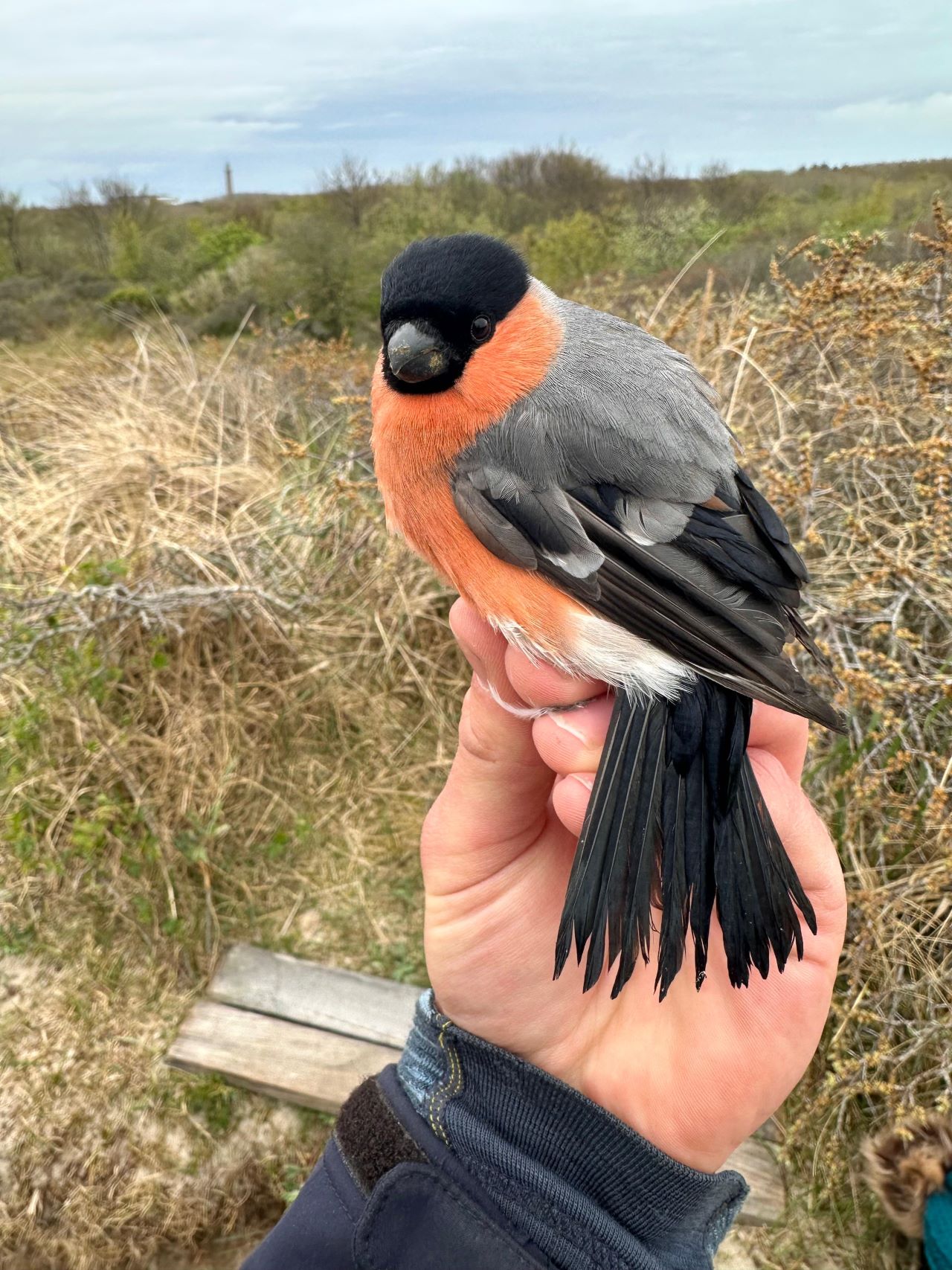
One of the Bullfinches (Dompap) caught in the nets this morning
In the morning a Yellow-headed Wagtail was spotted at Buttervej so a few of us decided to go to try and see it. Yellow-headed Wagtails (Gulhovedet Gul Vipstjert) breed in the United Kingdom and Skagen only has a few individuals each spring. We did not see it, but we did get some really nice views of the more common Grey-headed Wagtails (Nordlig Gul Vipstjert). Søren and Karen Marie also went to Batteriskoven to look at some butterflies. They had great success and saw a Glanville Fritillary (Okkergul Pletvinge) which is the first one seen in Skagen this spring.
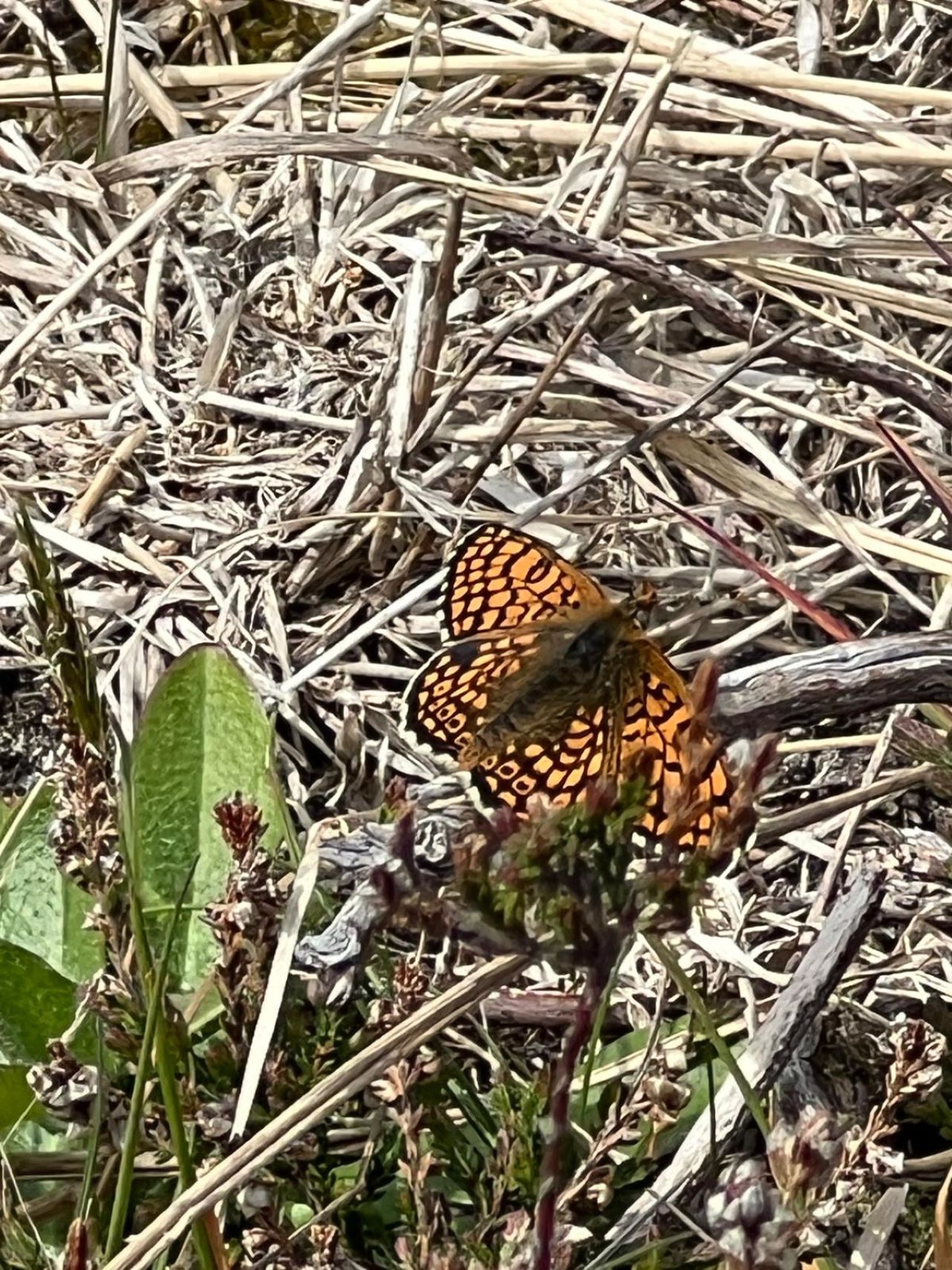
Glanville Fritillary (Okkergul Pletvinge)
The afternoon was a bit quieter which was nice as well will have a busy few days during the bird festival. We look forward to seeing everyone, learning more and meeting lots of new people. We also have our fingers crossed for some good birds!
Highlights from the observations:
Shag (Topskarv) - 2
Arctic Skua (Almindelig Kjove) - 2
Lapland Bunting (Lapværling) - 1
Shag (Topskarv) - 2
Arctic Skua (Almindelig Kjove) - 2
Lapland Bunting (Lapværling) - 1
Ringing (Kabeltromlen)
Gransanger - 1
Rødhals - 1
Gærdesanger - 6
Løvsanger - 2
Munk - 5
Dompap - 2
Havesanger - 1
Tornsanger - 1
Total: 19
Gransanger - 1
Rødhals - 1
Gærdesanger - 6
Løvsanger - 2
Munk - 5
Dompap - 2
Havesanger - 1
Tornsanger - 1
Total: 19
Ringing (Jennes Sø)
Løvsanger - 1
Broget Fluesnapper - 1
Løvsanger - 1
Broget Fluesnapper - 1
Total : 2
Ringing (Nordstjernevej)
Munk - 1
Total: 1
People: Alvin Johansson, János Schadl, Mika Schadl, Julian Helbig, Dylan Daunt, Simon S. Christiansen, Lisa Vergin, Sverre Dahl Porsgaard, Anton, Ole, Olga Fernández Enríquez, Karen Marie & Søren
Arctic skuas and big sticks
tirsdag 12. maj 2026
Good evening to all of you. Today János, Dylan, Mika, Ole and I did the morning observation from sandklitten. It was a very quiet morning, with very limited movement due to the northwestern wind. We had three nice arctic skuas (almindelig kjove), two light and dark morph as well as a great northern diver (Islom). Quiet does not mean boring though, and Dylan spend some time building a woody sort of statue (I think?), whilst listening for migrating passerines.
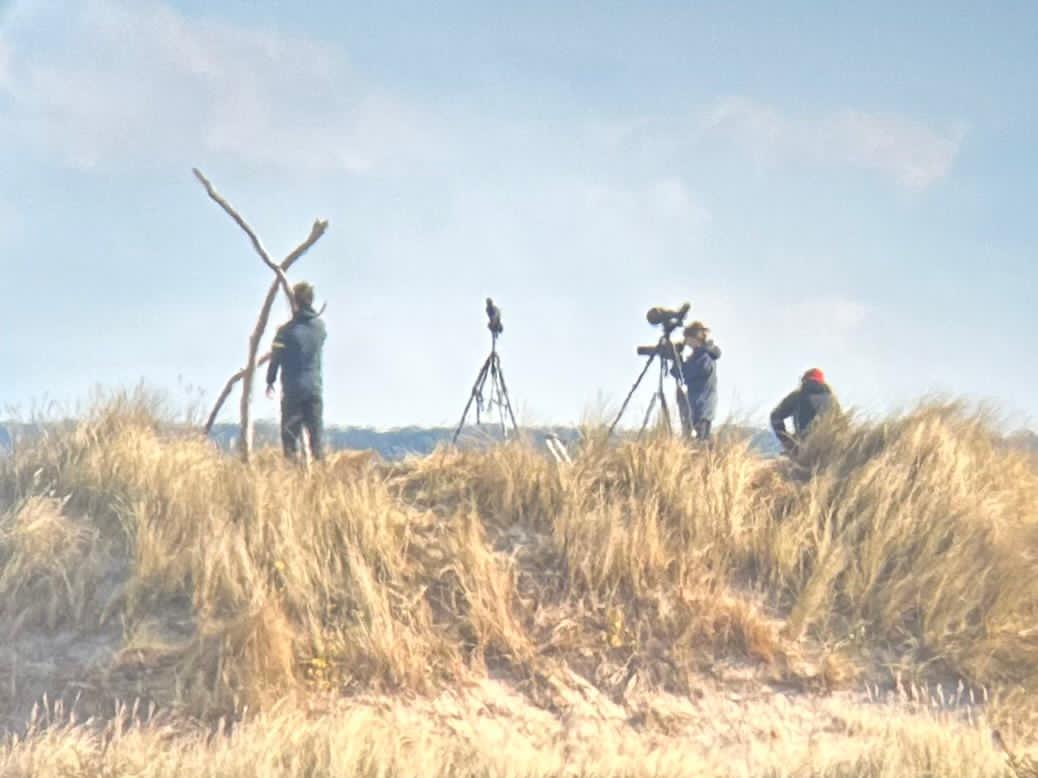 - Dylans stick artwork
Afterward we went to saftevandsbakken to look for raptors and butterflies. No dice, but some of us enjoyed a nice nap in the sun. Mika took the bike to the big city of Skagen to see the art museum. Sounds like he thoroughly enjoyed it:)
The ringers (Julian, Alvin, Anton, Simon and Karen Marie) caught 13 birds today of six different species. From what I hear they took great pleasure in catching an adult male pied flycatcher (broget fluesnapper), they are truly stunning with their black and white color palette. In between rounds they also enjoyed watching Dylans architectural skills unfold.
In the afternoon Karen Marie drove to Råbjerg hede to look for the Marsh Fritillary (Hede pletvinge). A rare and extremely beautiful species of butterfly. They saw five freshly hatched specimens and were kind enough to show me on a map where I might see them as well. Congratulations on the find to them.
The team is also working on a sound analysis on an Iberian chiffchaff (Iberisk gransanger) that Dylan heard at kabeltromlen two days ago, luckily Alvins recorder caught a lot of good calls. It is looking quite good, but we will wait for a final confirmation of this extremely rare species, before we pop the champagne.
János had made a tasty berry brownie with whipped cream today, we had a massive piece each and still have plenty for the coming days.
This is unfortunately my last full day at Skagen bird observatory. I have really enjoyed my stay here, and I have learned a lot about aging passerines and sound ID. I particularly enjoyed walking around in waders, and the outdoorsy ringing at kabeltromlen and staying with all of the nice people at the station. I will still be in the area until Sunday, as I join DOF-Ung for their upcoming trip. So if you see a young birder with a ponytail wearing a red spiderman hat, do not hesitate to say hi. I will be back at Skagen bird observatory again someday:)
- Sverre
Highlights from the observation:
Three arctic skuas (almindelig kjove)
Great northern diver (Islom)
Wonderful gannets (fabelagtigt smukke suler)
Ringing Kabeltromlen:
Gærdesanger – 3
Løvsanger – 6
Broget fluesnapper – 1
Munk – 1
Tornsanger – 1
Solsort – 1
Total: 13
Link to today’s observations in DOFbasen from observers in the area
Summary of today's raptor migration in DOFbasen
People: Alvin Johansson, János Schadl, Mika Schadl, Julian Helbig, Dylan Daunt, Simon S. Christiansen, Sverre Dahl Porsgaard, Anton, Ole, Olga Fernández Enríquez, Karen Marie & Søren
CES group trip
mandag 11. maj 2026
Today we started very early in the morning at 3am for the CES ringing at Skarvsøn. Luckily our new guests Søren and Karen offered to drive us there in the morning, which saved us the exhausting bike ride and made it easier to transport everything we needed for the ringing. So, thank you for that! Because we were a large group, and we had a steady amount of birds each round, there was plenty of time for everyone to ring a few birds and for Janos and Dylan to explain things. Some highlights have been two Reed Buntings (Rørspurv) and several Reed and Sedge Warblers ((Rørsanger and Sivsanger).
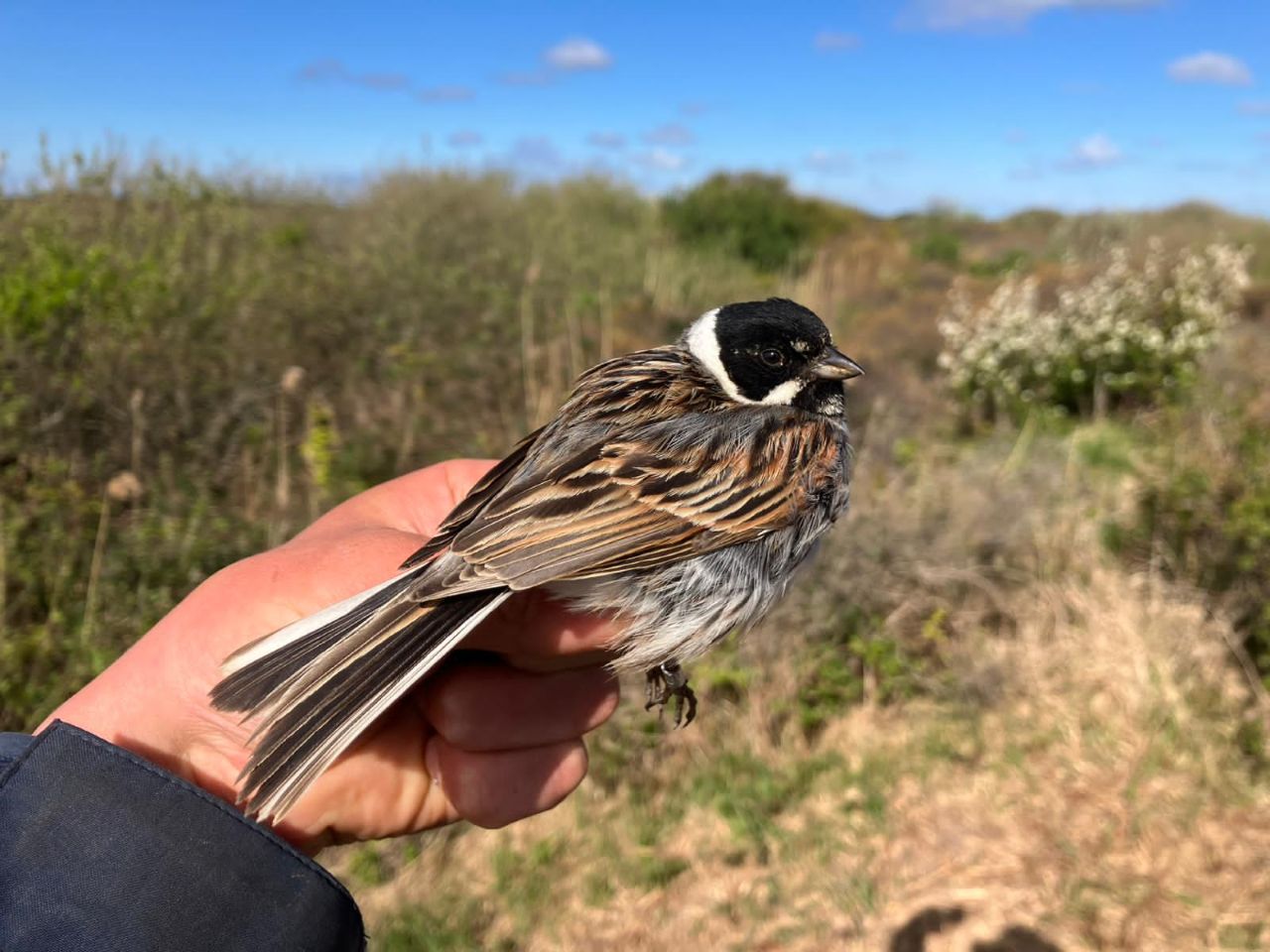
male Reed Bunting (Rørspurv)
For me it was a great opportunity to learn, as it is my first stay in Skagen. It was also the first day for Olga, she will stay at the station for a month as part of a Scandinavian triple. Earlier this spring she already visited the Ottenby and Gedser Bird Observatory.
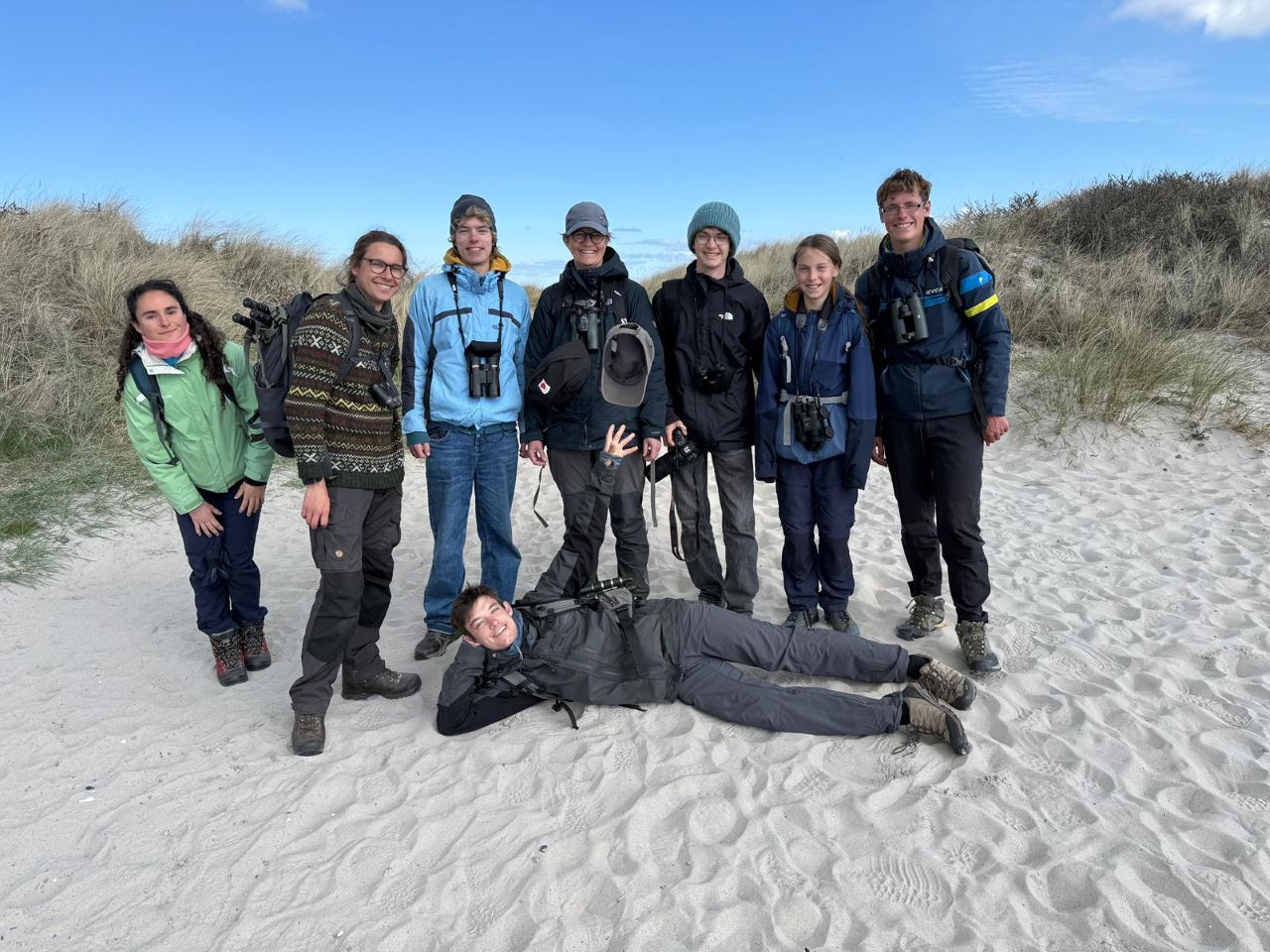
Group picture of the ringing team this morning
In the meantime, Alvin and Julian were busy with the migration count at Sandklit. Although it was very cold and the numbers were not overwhelming, they could see a close Arctic Skua (Almindelig Kjove), some Shags (Topskarv) and Fulmars (Mallemuk).
After 8 hours of ringing and observing, we got together again for lunch.
While some of us were already very tired from the day and were resting, Julian and Alvin decided to drive to Frederikshavn to witness Denmark's first sighting of a Dartford Warbler (Provencesanger).
Unfortunately, they had very bad luck, and even though there were many people looking for it, they could not relocate the bird during their 2-hour stay. Nevertheless, the trip was not entirely in vain for them, as they could see some waders at the beach, including a Spoonbill (Skestork) and a Whimbrel (Småspove).
Dylan, Simon and Olga decided to go to the industrial area for birding and ended their trip with some shopping in Skagen.
Søren and Karen went to Troldkaer, a promising area for butterflies. Unfortunately, the area is very dry this year, which also has an effect on the number of butterflies.
We had a delicious dinner by Dylan and afterward János and Dylan went out to do some evening birding without noteworthy sightings, though.
Highlights from the observations:
Shag (Topskarv) - 8
Arctic Skua (Almindelig Kjove) - 1
Fulmar (Mallemuk) - 39
Shag (Topskarv) - 8
Arctic Skua (Almindelig Kjove) - 1
Fulmar (Mallemuk) - 39
Whimbrel (Småspove) - 1
Spoonbill (Skestork) - 1
Ringing (Skarvsøn)
Solsort - 2
Munk - 1
Gærdesanger - 2
Tornsanger - 2
Løvsanger - 2
Gransanger - 6
Blåmejse - 1
Solsort - 2
Munk - 1
Gærdesanger - 2
Tornsanger - 2
Løvsanger - 2
Gransanger - 6
Blåmejse - 1
Rørsanger- 1
Sivsanger - 1
Rørspurv - 2
Total: 20Ringing (Jennes sø)
Løvsanger - 4
Tornsanger - 1
Havesanger - 1
Munk - 1
Total: 7
Løvsanger - 4
Tornsanger - 1
Havesanger - 1
Munk - 1
Total: 7
Link to today’s observations in DOFbasen from observers in the area
Summary of today's raptor migration in DOFbasen
People: Alvin Johansson, János Schadl, Mika Schadl, Julian Helbig, Dylan Daunt, Simon S. Christiansen, Lisa Vergin, Sverre Dahl Porsgaard, Anton, Ole, Olga Fernández Enríquez, Karen Marie & Søren
First for Denmark
søndag 10. maj 2026
The day began with an early first highlight: On their way to Kabeltromlen Alvin and Dylan saw a Nightjar (Natravn) fly off from the Sandormentracks just in front of them – they are only rarely seen this far out at Grenen. Dylan took the opportunity to wake everyone up with a 03:56 Zello call. Soon after, they also heard the first Cuckoo (Gøg) of the spring, from now on we will hear them every day. The ringing started off wonderfully with a really good first and second round. I joined them a bit later, since I’ve needed some more minutes of sleep in the morning after my very intense and restless day yesterday. We caught a nice collection of warbler species today: A Sedge, Reed, Icterine and Garden Warbler (Sivsanger, Rørsanger, Gulbug, Havesanger). The Icterine Warbler (Gulbug) was the first for Dylan to see in hand, and he really enjoyed it.
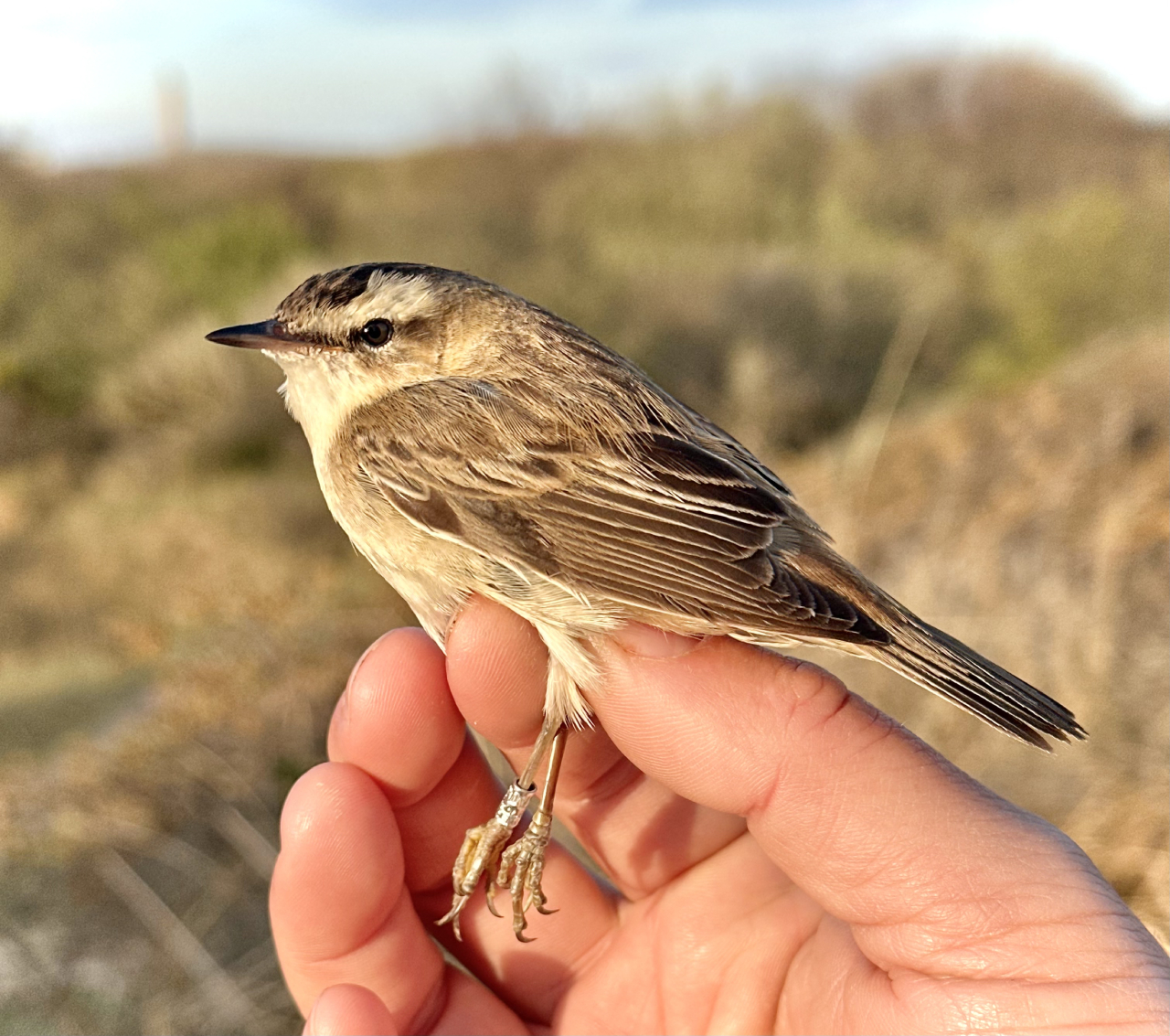
Sedge Warbler (Sivsanger) ringed at Kabeltromlen today.
The observations team also contributed to our variety at the ringing; before starting their count, János, Mika, Sverre opened the nets we’ve set up already yesterday evening at Sandklit to try and catch Yellow Wagtails (Gul Vipstjert) and Meadow Pipits (Engpiber). Anton and Ole joined them later. Their efforts were rewarded with both targeted species, and Anton brought us one beautiful male Thunbergi Yellow Wagtail (Norlig Gul Vipstjert) and two Meadow Pipits (Engpiber). Also apart from this extra mission, the team at Sandklit had a good time with some nice observations: Two Great Northern Divers (Islom), two Shags (Topskarv), five Honey Buzzards (Hvepsevåge) – the first time this spring that we had higher numbers of them – and one Arctic Skua (Almindelig Kjove) to name the highlights. Unfortunately, they missed a Citrine Wagtail (Citronvipstjert) that has been seen in the area by others. There also was a whale that was thought to be an Orca (Spækhugger) first, but turned out to be a Minke Whale (Vågehval).
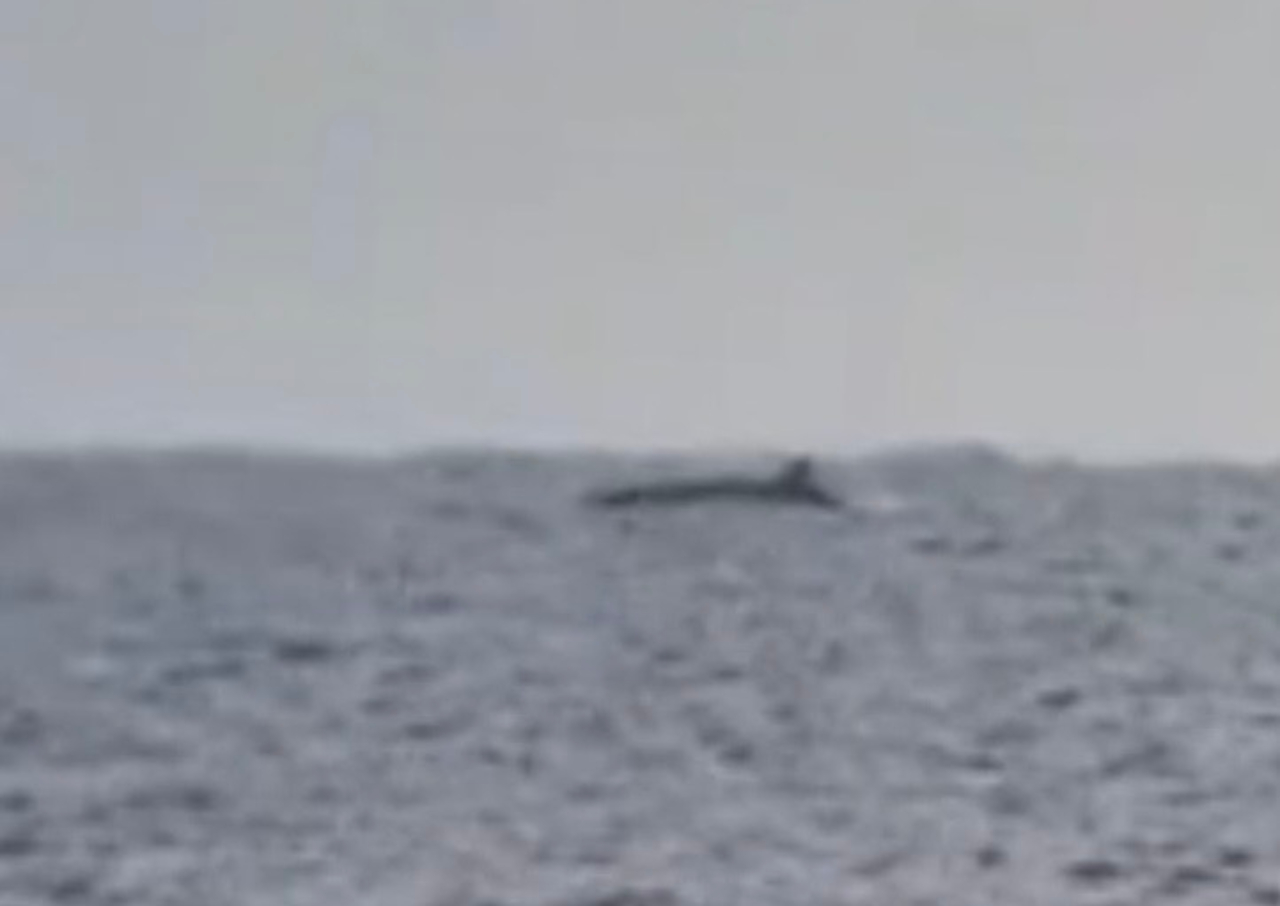
Minke Whale (Vågehval)
At half past nine the breaking news spread like wildfire: A Dartford Warbler (Provencesanger) was found in Frederikshavn, just 40 kilometres south of here! This is the first ever record of the species in Denmark. Simon spoke about the sighting on Zello, and only two minutes later all the birdwatchers started moving, heading for the train station or their cars. After only ten minutes, the whole area was almost completely deserted. Simon and Lisa left as well, later Sverre also decided to catch a train. In the end, all three of them got to see the bird as a lifer, just like hundreds of other birdwatchers who came from all over Denmark (literally). That way, they got to meet a lot of friends and fellow birders, and enjoyed the time together.
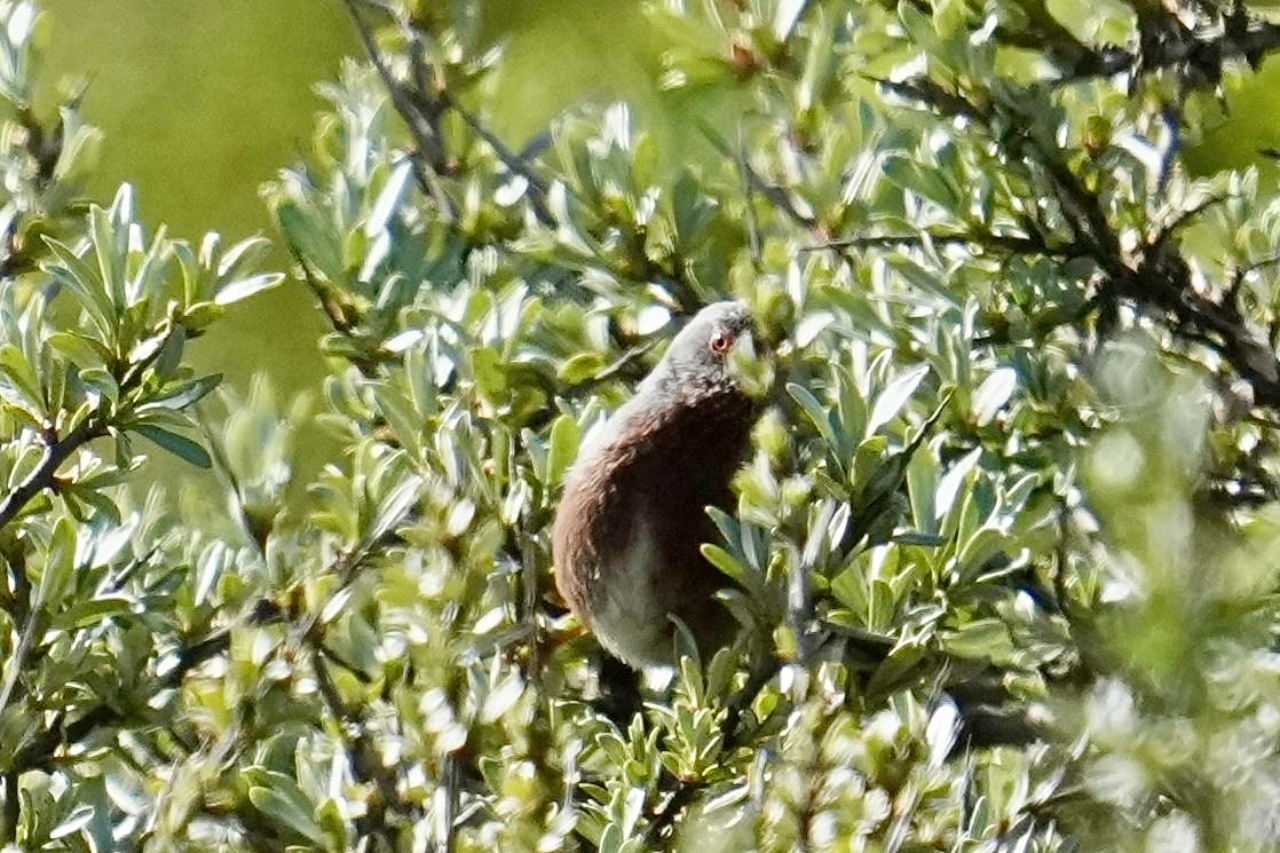
Male Dartford Warbler (Provencesanger) - first for Denmark! Photo by Søren Leth-Nissen
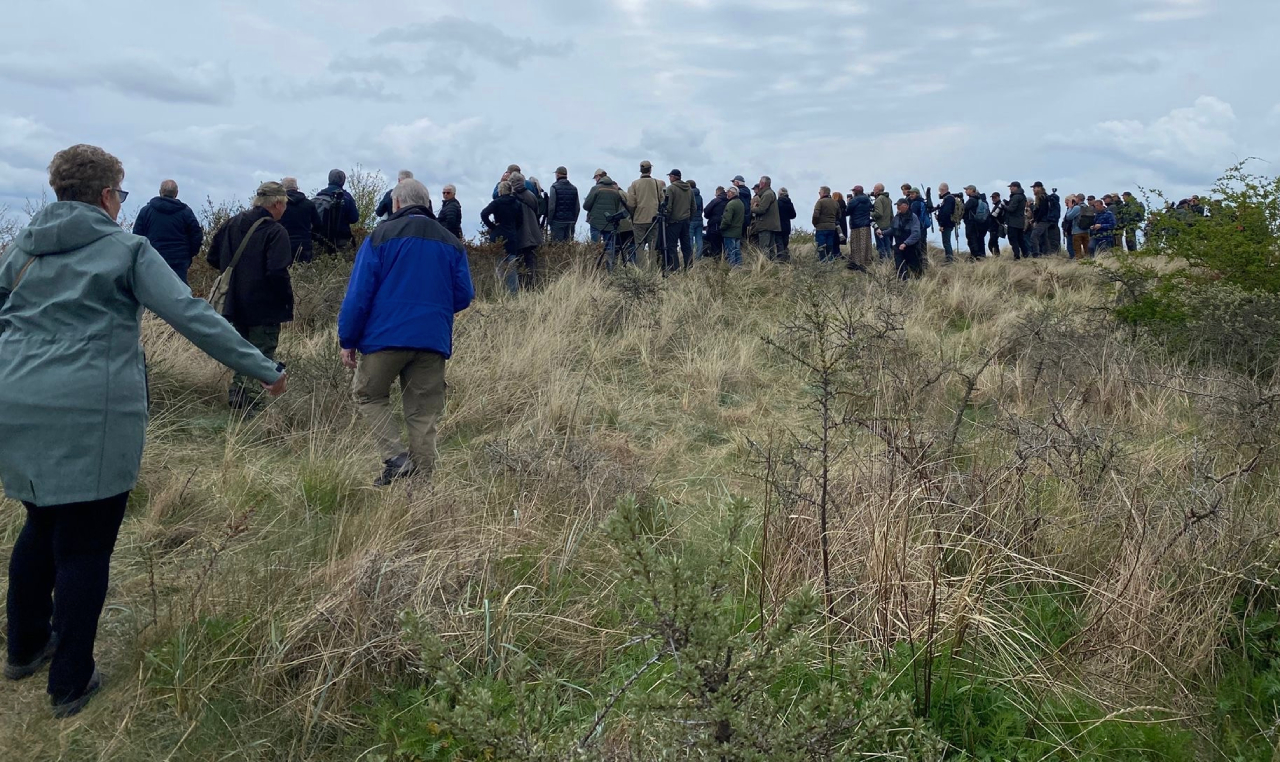
A large crowd of twitchers at Frederikshavn.
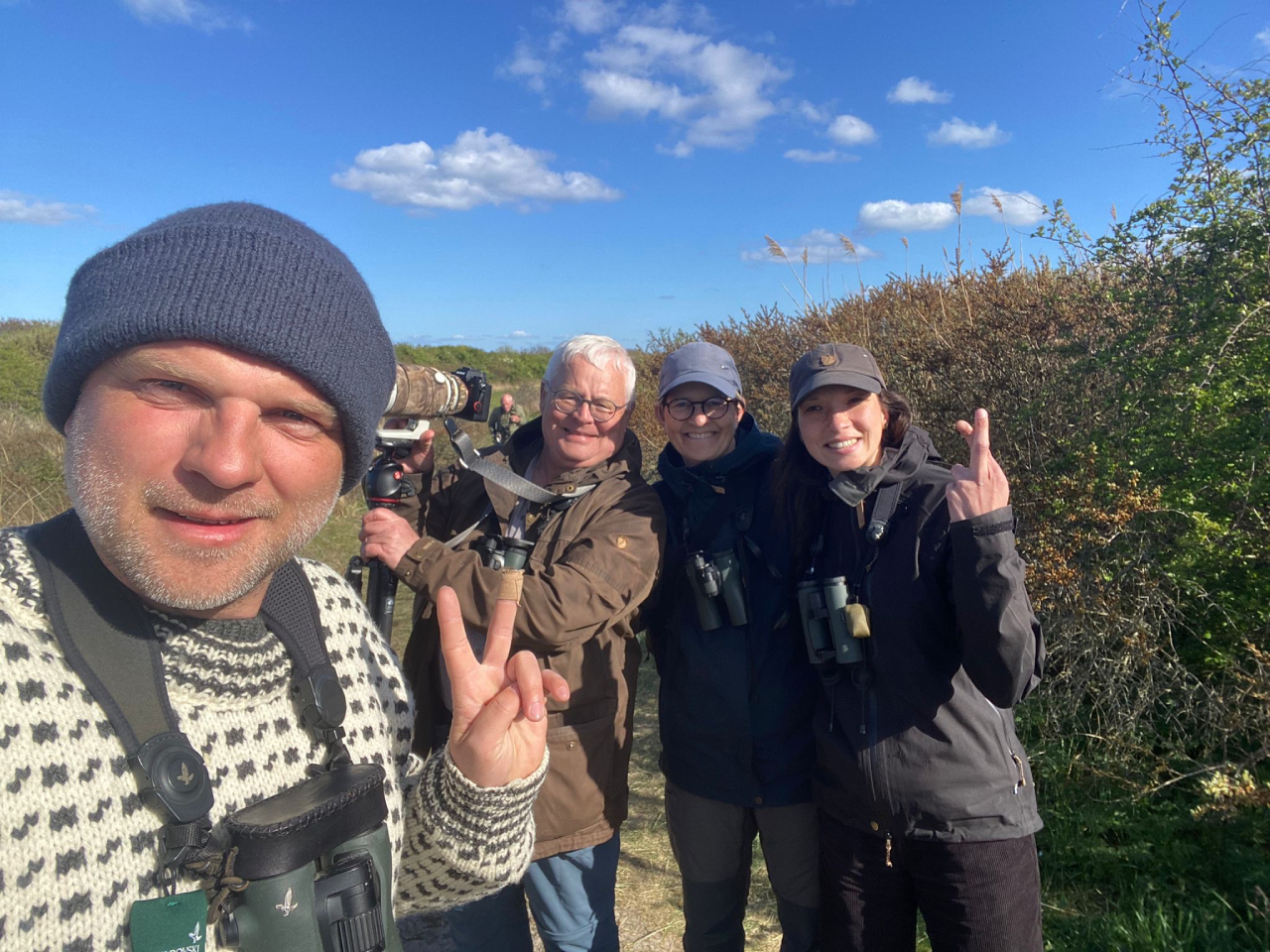
Some happy faces! Left to right: Simon, Søren, Karen Marie, Lisa
In the meantime, we took it slowly here at the station, completing a lot of the needed data work. Alvin went for a birding walk around Grenen, almost completely alone. He got extremely close to a young White-tailed Eagle (Havørn) that was sitting in the dunes.
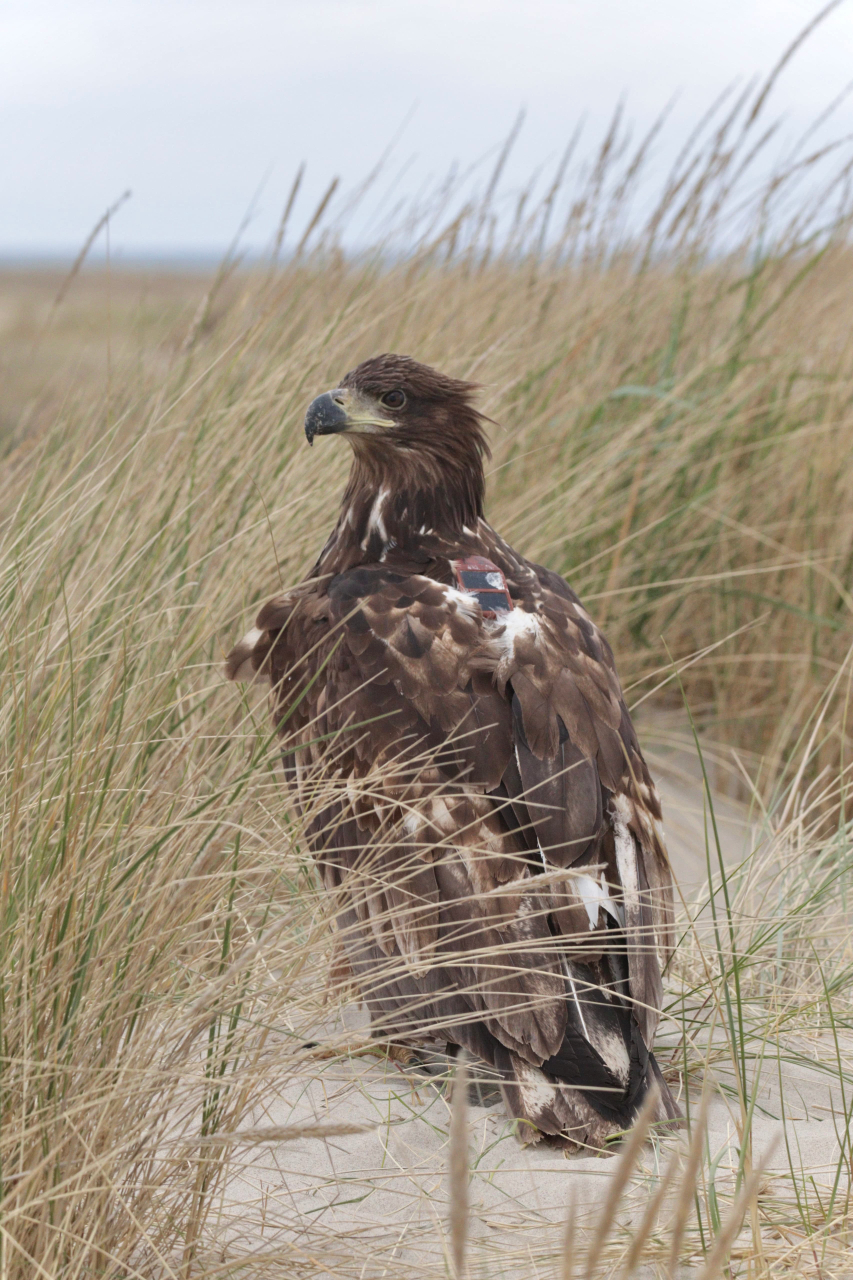
Young White-tailed Eagle found by Alvin in the dunes. This one even has a ring and a GPS-tracker, so maybe we'll find out some interesting information about it.
When opening the moth trap, we discovered another great surprise. A Small Lappet Moth (Phyllodesma ilicifolia, Hede-takspinder) found its way into the trap. It’s a pretty rare species in Denmark and thus a very good find, only the second ever record for Skagen on naturbasen.
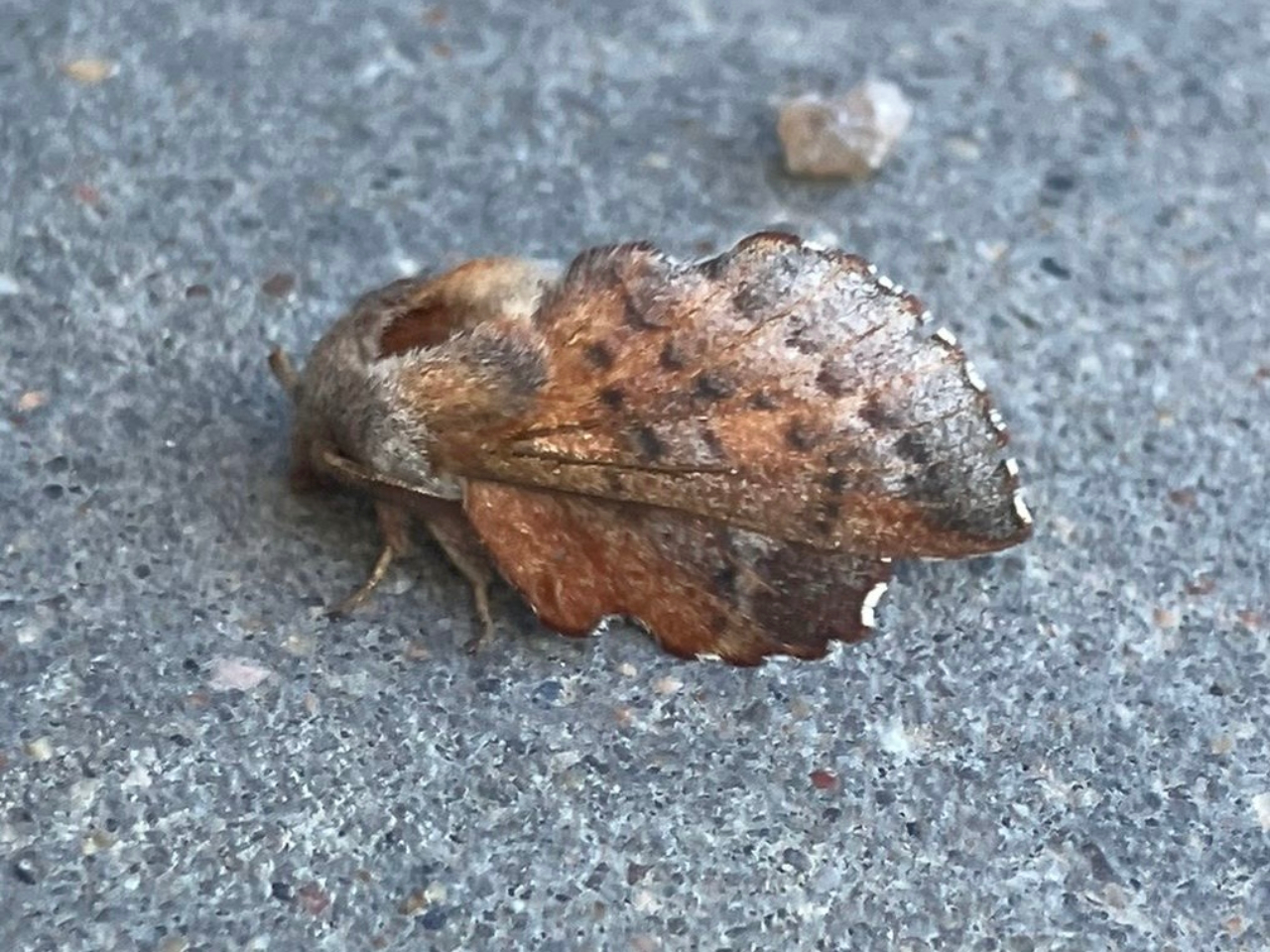
Small Lappet Moth (Hede-takspinder), little rarity.
In the evening, both our new guests at the apartment, Karen Marie and Søren, as well as Olga, our new volunteer from Spain who will stay with us for one month, arrived at the station. Welcome to the team! We had an evening meeting all together and got to know each other. Afterwards we went out to Grenen again for a relaxed evening birdwatch. At the same time, we also opened some of the nets at Kabeltromlen, in which we caught one bird, a Lesser Whitethroat (Gærdesanger) that Olga got to ring as her first ringed bird here at the station. A good start! We enjoyed the beautiful sunset for a bit and got back at dawn in need of some rest after a long and exciting day.
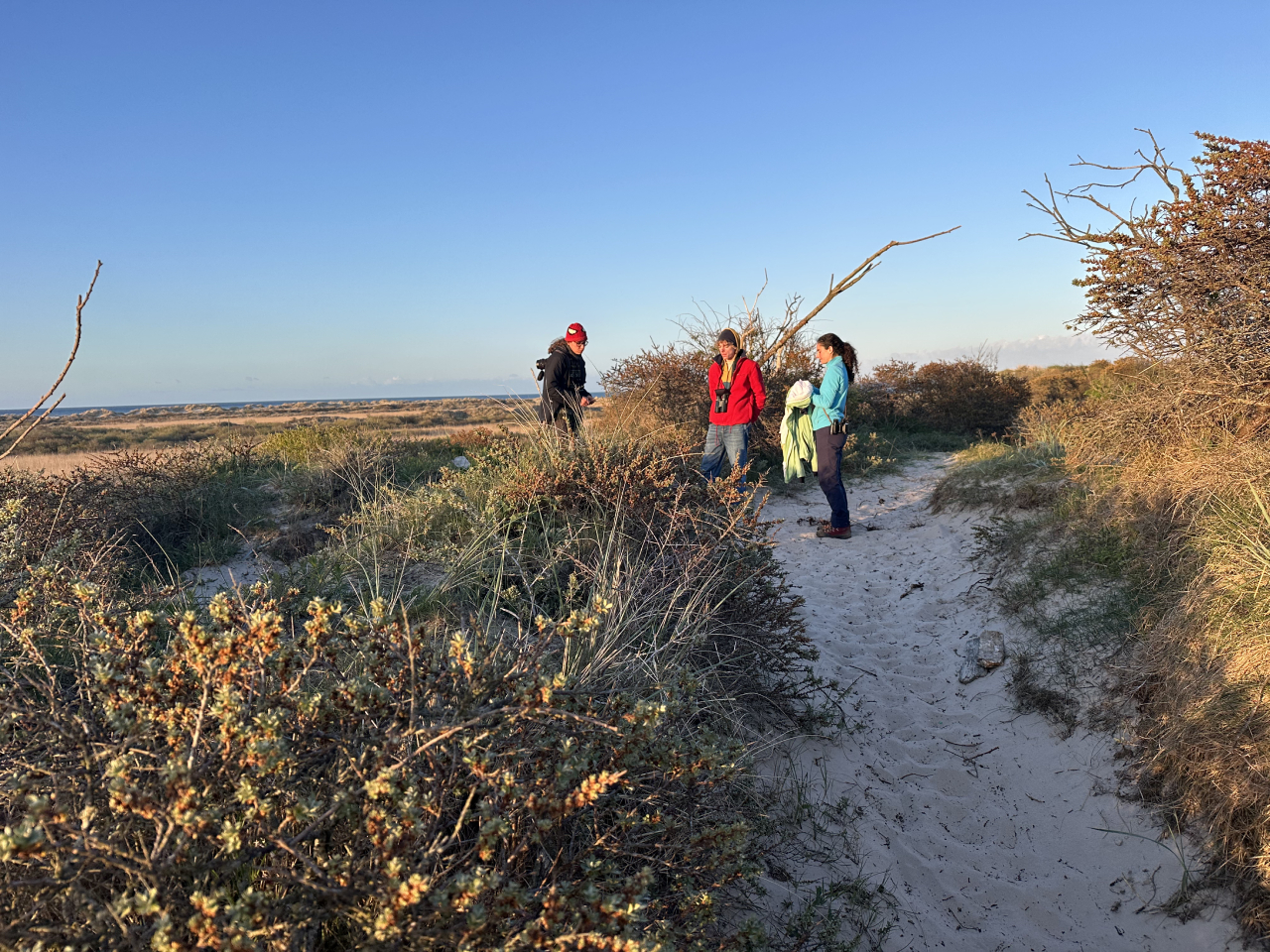
Evening at World's End 1
Highlights from the observations:
Great Northern Diver (Islom) - 2
Shag (Topskarv) - 2
Honey Buzzard (Hvepsevåge) - 5
Minke Whale (Vågehvale) - 1
Dartford Warbler (Provencesanger) - 1
Great Northern Diver (Islom) - 2
Shag (Topskarv) - 2
Honey Buzzard (Hvepsevåge) - 5
Minke Whale (Vågehvale) - 1
Dartford Warbler (Provencesanger) - 1
Ringing (Kabeltromlen)
Sangdrossel - 1
Rødstjert - 2
Rødhals - 1
Broget Fluesnapper - 3
Engpiber - 2
Nordlig Gul Vipstjert - 1
Munk - 9
Havesanger - 1
Gærdesanger - 9
Tornsanger - 6
Gulbug - 1
Sivsanger - 1
Løvsanger - 12
Gransanger - 2
Blåmejse - 1
Total: 52
Sangdrossel - 1
Rødstjert - 2
Rødhals - 1
Broget Fluesnapper - 3
Engpiber - 2
Nordlig Gul Vipstjert - 1
Munk - 9
Havesanger - 1
Gærdesanger - 9
Tornsanger - 6
Gulbug - 1
Sivsanger - 1
Løvsanger - 12
Gransanger - 2
Blåmejse - 1
Total: 52
Ringing (Jennes sø)
Løvsanger - 3
Rødstjert - 1
Gransanger - 2
Munk - 1
Total: 7
Løvsanger - 3
Rødstjert - 1
Gransanger - 2
Munk - 1
Total: 7
Link to today’s observations in DOFbasen from observers in the area
Summary of today's raptor migration in DOFbasen
People: Alvin Johansson, János Schadl, Mika Schadl, Julian Helbig, Dylan Daunt, Simon S. Christiansen, Lisa Vergin, Sverre Dahl Porsgaard, Anton, Ole, Olga Fernández Enríquez, Karen Marie & Søren