
Her på Skagen Fuglestations blog bringes korte nyheder i dagbogsformat om hændelser på fuglestationen.
-
FORSIDE

- Blog
Se indlæg fra måned: jan. (23)feb. (8)mar. (31)apr. (30)maj (31)juni (29)juli (31)aug. (31)sept. (30)okt. (10)
A Morning full of Chiffchaffs
søndag 20. september 2026
Yesterday evening, we all headed out for another nightcatching session. We were lucky enough to catch another Red Knot (Islandsk Ryle), which was a great highlight and a nice ending for our volunteer Alfred. There were noticeably fewer waders along the beach this time, but it was still a successful night for us!
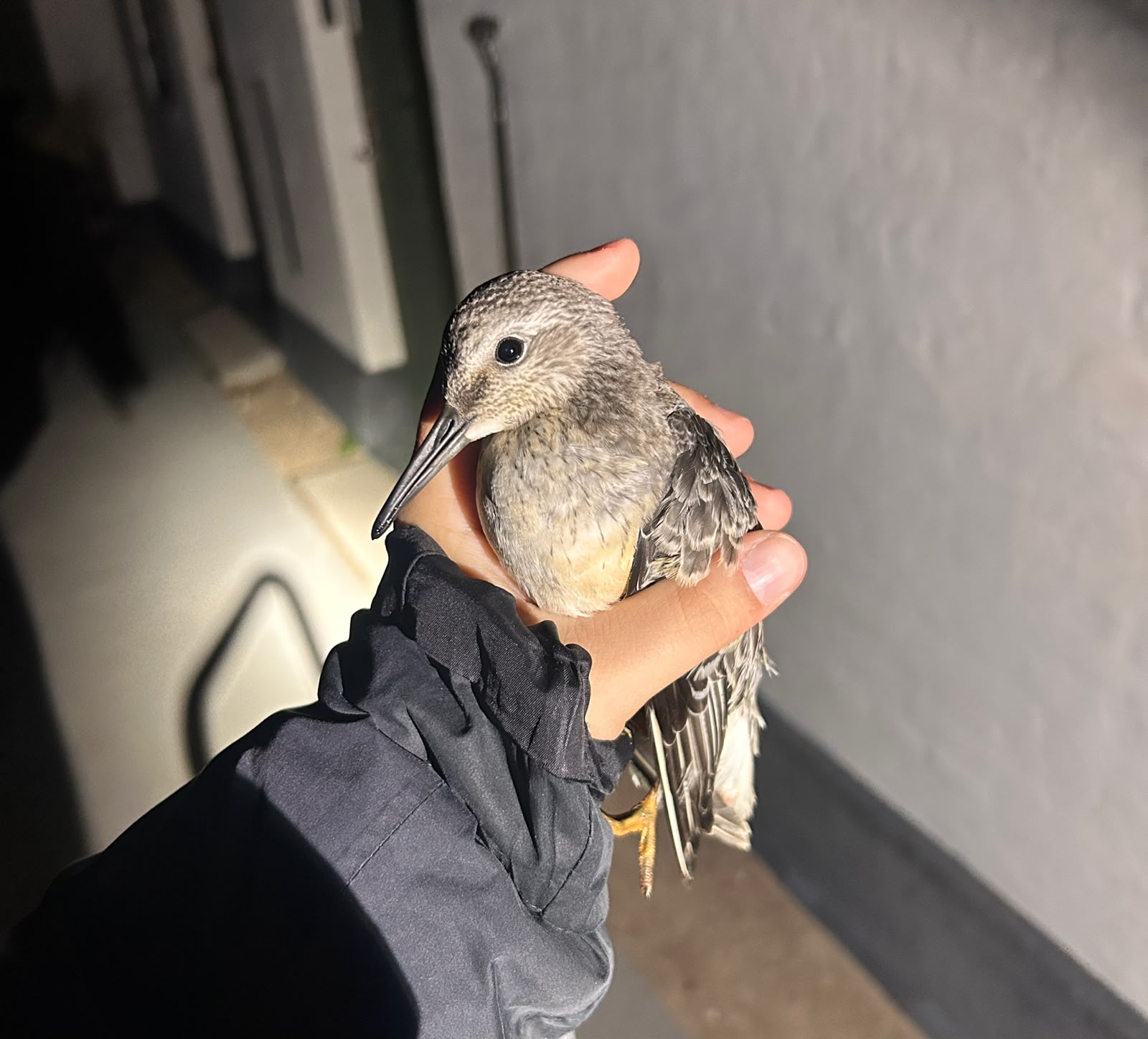 1k Red Knott Picture: Pauline N.
This morning, Anna and I opened the nets at Kabeltromlen. Simon and Alfred joined us for the first check at 7:00. I have to say, I’ve really learned to appreciate the Chiffchaffs (Gransanger) we get here. Today, we caught seven of them and they are great practice for me when it comes to finding moult limits! We also saw a flock of Crossbills (Lille Korsnæb) flying above Kabeltromlen! Fingers crossed for next week.
The Eagle Club joined us for the ringing with three children, who were very happy to see some of the birds up close and learn about the ringing process. Jørgen Kabel also stopped by with Igor, his dog :)
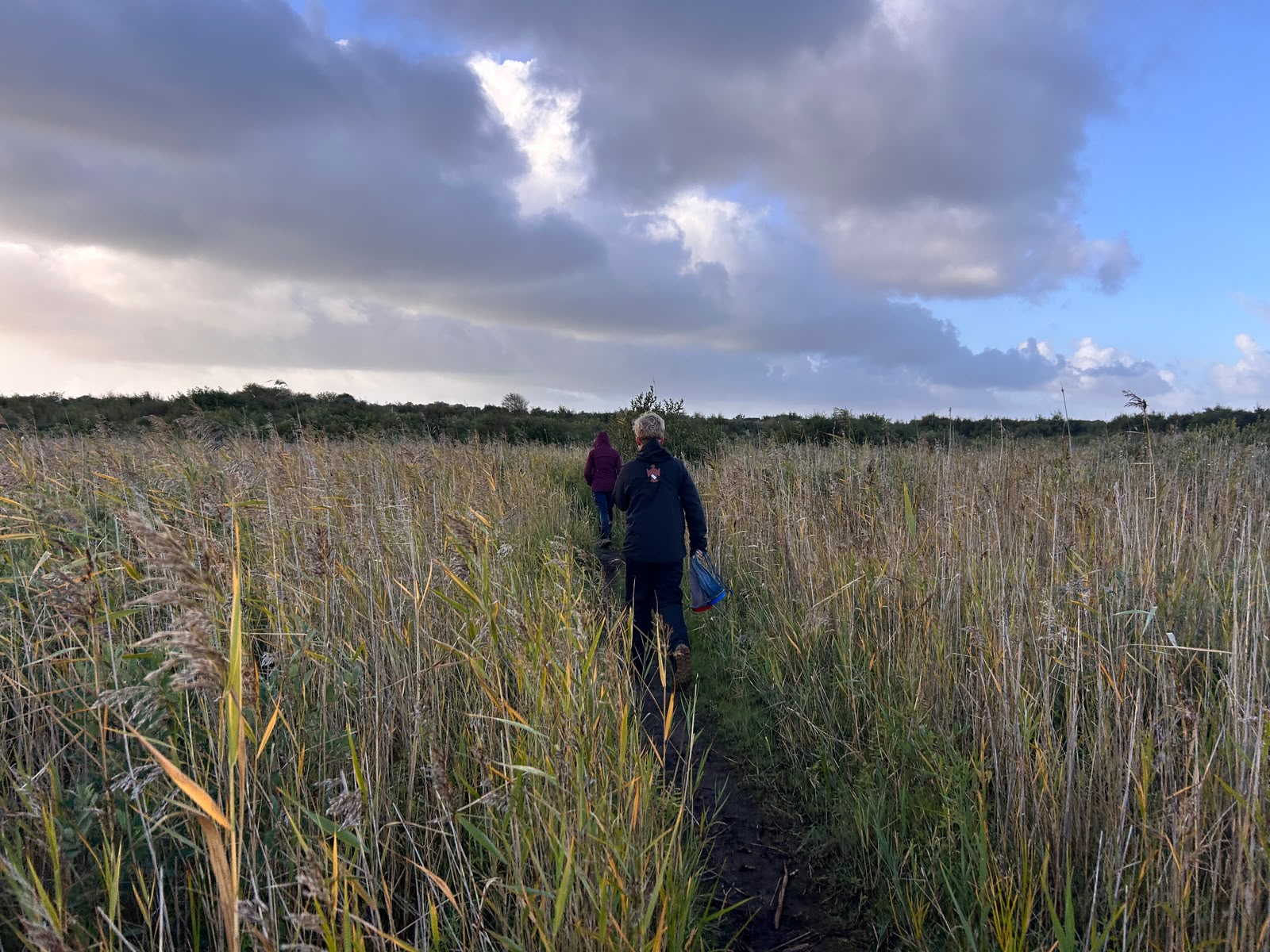
Anna and Alfred checking nets Picture: Pauline N.
Jule and Laura did the morning migration count, recording three Long-tailed Skuas (Lille Kjove), one Arctic Skua (Almindelig Kjove) and one Great Skua (Storkjove).
Back at the station, we worked on data and had lunch. Jule also continued with her new hobby, Jule Fugle, making a very cute Ringed Plover (Stor Præstekrave). Anna later got to try it out as well. While we had to say goodbye to Alfred and Kirsten, we greeted our new guests, Michael and Birgit, who arrived at the station this afternoon!
Ringing at Kabeltromlen
Chiffchaff (Gransanger) – 7
Robin (Rødhals) – 2
Dunnock (Jernspurv) – 2
Reed Bunting (Rørspurv) – 1
Blue Tit (Blåmejse) – 2
Wren (Gærdesmutte) – 1
Total: 15
People: Anja Gorbunova, Alfred Godsk Geckler, Pauline Nähring, Laura Tamminen, Jule Tappe, Simon S. Christiansen, Kirsten Bregn, Jørgen Kabel, Igor, Birgit and Michael
Rain or no rain, that is the question
lørdag 19. september 2026
Sometimes, being responsible for the blog of the day is a great joy. Most days at the observatory are exciting but of course, sometimes, a day is slow. This was the case today, since the answer to the question in the title was „rain“. So instead, we found our joys in the small things and I will tell you about it.
In the morning, Pauline and I opened nets at Kabeltromlen and were joined by Anja and Simon for the first round. Looking at the rain radar, all the optimism of the day disappeared: It was full of small, blue blotches and even though, in the moment of checking, there was no blue blotch over us, it was still raining! With this unforeseeable weather, we only did a few rounds and also had very little birds.
At World’s End 3 with Laura and Alfred, things did not look brighter. The opposite was the case with the rain and fog over the see blocking the view from migrating birds. The migration count then became a rain watching session that was ended after the first hour. They joined us for closing the nets at KAB before we all biked back to the station on our bikes, ate a quick lunch and then sat down in the office, to witness another of Simon’s legendary session.
Today, we talked about the identification of Phylloscopus Warblers. They are small, green birds that look extremely similar to one another if you don’t know what to look for. But now, we do! So when I now hear a Dipper (Vandstær) in Ellekrattet (local forest), I will know to be excited (the call of Arctic Warbler sounds similar to the call of the White-throated Dipper).
After the session, the normal Saturday routines followed. At some point during the day, everyone of us cleaned something around the station, I for example did the lab. While vacuuming the sand from the ground, an apple cake that I had prepared was spreading nice smells from the oven. Thanks again to my mother for sending me the recipe :).
The rain also continued in the afternoon and most of us were demotivated by that to go outside, but nothing could stop Alfred, who has to leave tomorrow and made the best out of his last proper day here. He biked to Skagen By, Nordstrand and Skarvsøen and watched the birds.
In the meantime, I went after my new found indoor-hobby: Making jule fugle. I am not entirely sure what they are yet, but apparently it is a Danish thing to make and then put on Christmas trees. We have books here with craft instructions and since my name is in the title, I felt a calling to try it out. After some difficulties at the start, I now have a Ruff (Brushane) and a Bittern (Rørdrum). Check them out:
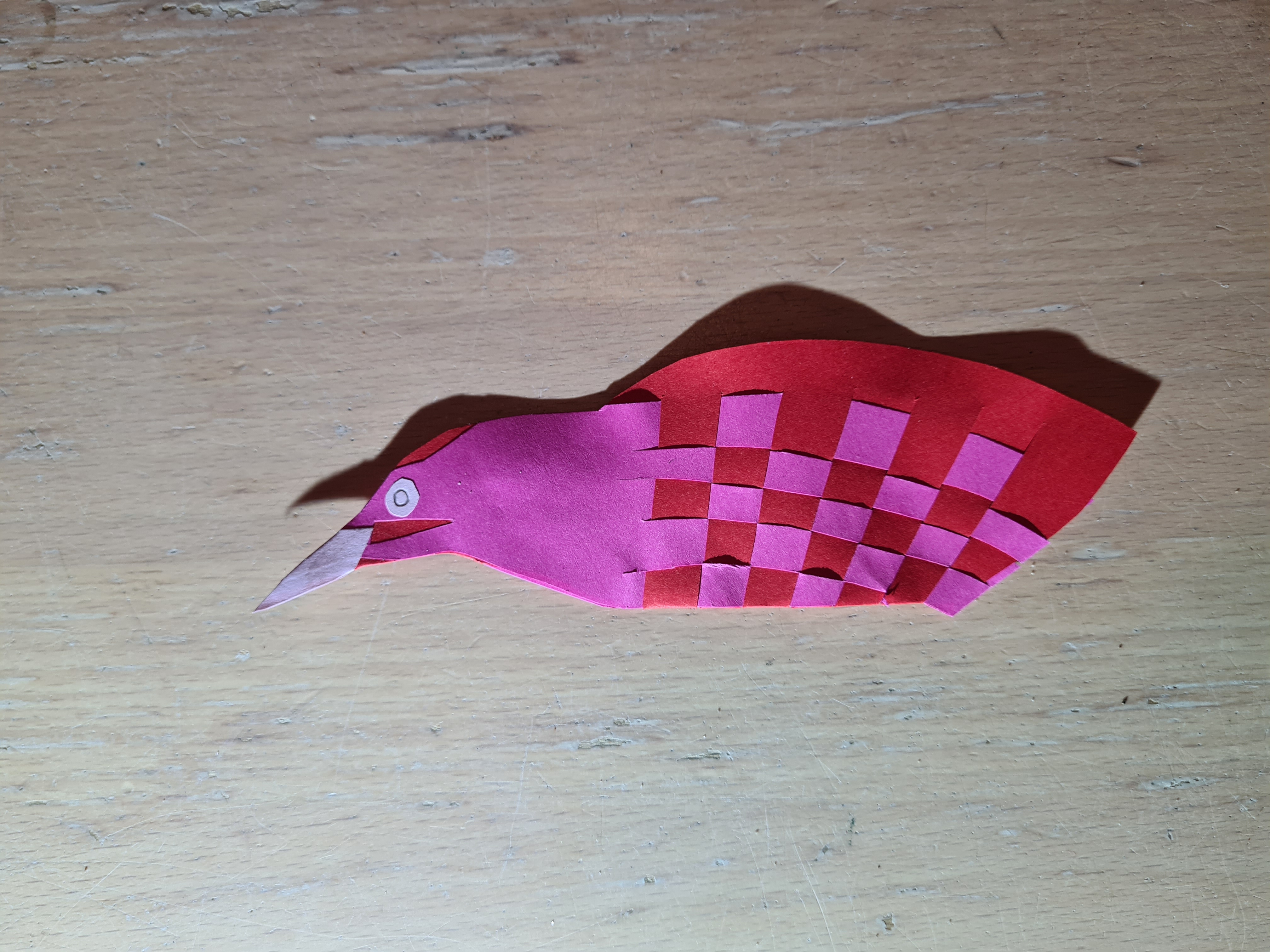 A jule rørdrum (Bittern).
With my crafting, I have now inspired Alfred who is trying to make Cranes (Trane) just while I am writing this blog. Anja was also creative by finished her knitting project – a nice headband.
In the afternoon, we had a little teatime with lots of cake. Because it was not only me who had made some, but leftover cake was also brought here from the shop. Thank you for that!
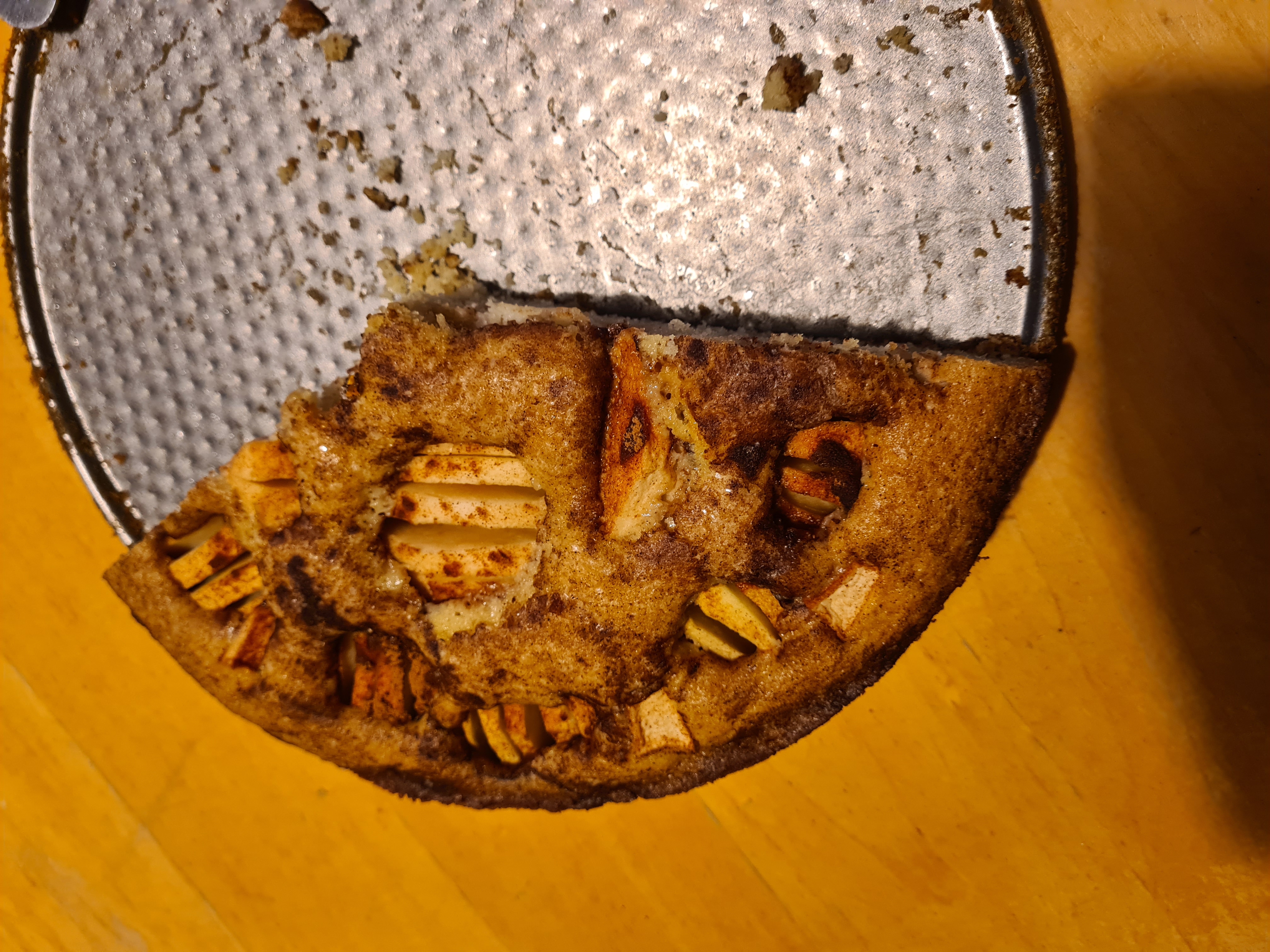 A small piece of apple cake that is still left.
 In the evening, we ate a delicious dinner cooked by Laura who made Quesadillas for us. But a day cannot stay so birdless for us: We will try to go nightcatching again at Grenen tonight. Let’s hope that the we have some wader pictures for you tomorrow!
Ringing (Nordstjernevej):
Gærdesmutte – 1
Ringing (Jennes Sø):
Gransanger – 7
Musvit – 3
Blåmejse – 1
Rødhals – 2
Jernspurv – 1
Munk – 1
Gærdesmutte – 1
Total: 16
Ringing (Kabeltromlen):
Rødhals – 1
Munk – 2
Total: 3
People: Anja Gorbunova, Alfred Godsk Geckler, Pauline Nähring, Laura Tamminen, Jule Tappe, Simon S. Christiansen, Kirsten Bregn, Michael Ancher
From Darkness to Rainbows
fredag 18. september 2026
Hey, Anja is here again!
I won’t keep you waiting, so I’ll start with the most important part of the previous day — the night catching.
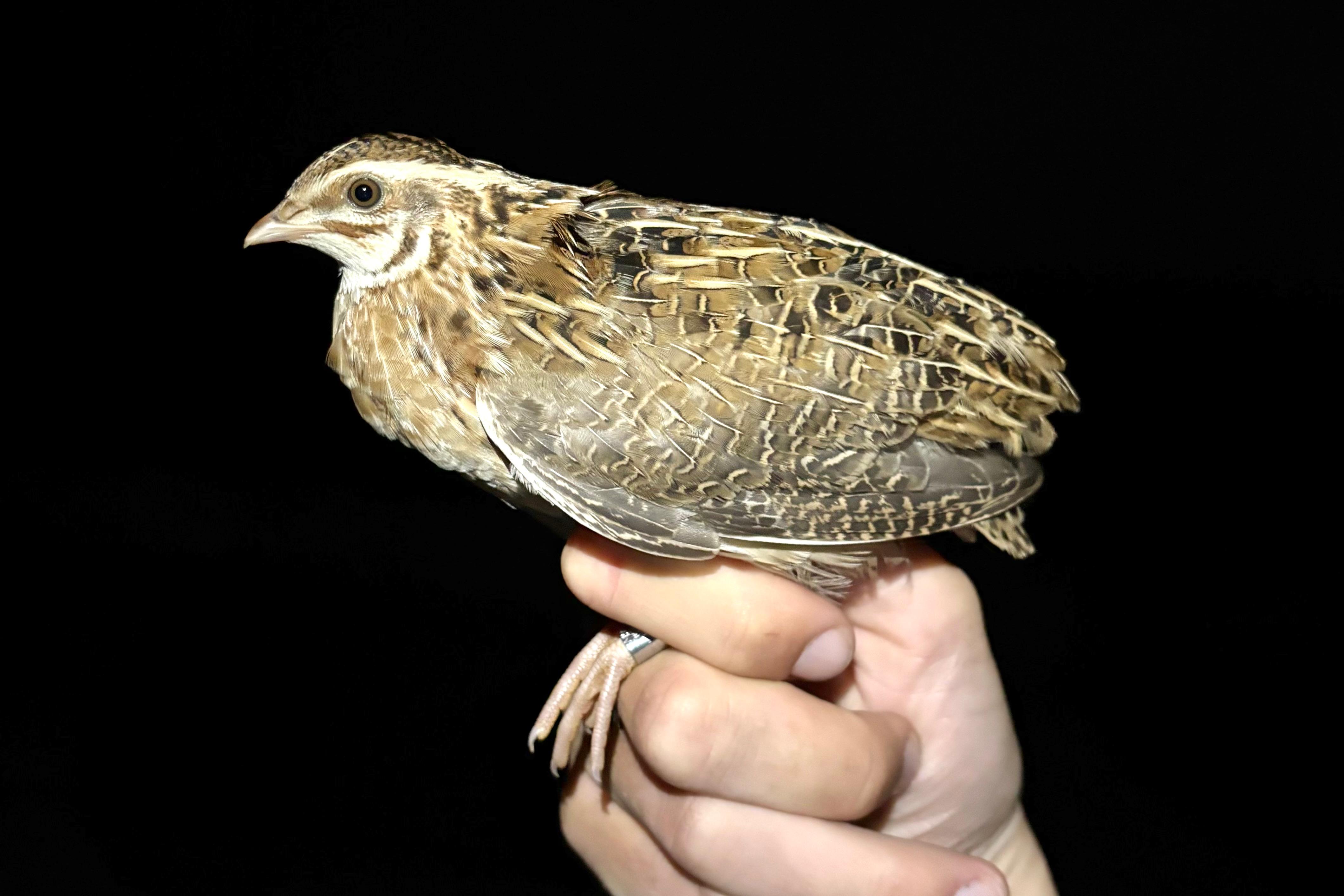
A couple of days ago, we were already discussing the possibility of going out for a night catch, but for different reasons it didn’t work out. Yesterday, however, we were brave and determined. Jule, Alfred and I had been looking forward to the evening since the morning, although we were also a little worried that once again nothing would happen because of the weather. The forecast was quite uncertain and it was a shower all the time. For Alfred and me, it was our first experience with night catching. Armed with a hand net, thermal binocular and flashlights, we headed towards the point. We expected to see some waders along the way, but the beach was completely empty. Only when we reached World's End 3 did we finally start seeing birds. The first few attempts were not very successful. We were trying to approach the birds too quickly, but once we changed our tactics and started moving more slowly, we finally caught our first bird. We couldn’t have been happier when we realised it was a Bar-tailed Godwit (Lille Kobbersneppe)! They are not particularly difficult to see here, but this was the first Bar-tailed Godwit ever caught and ringed at the station. After taking some photos and ringing the bird, we released it back into the wild. Wet, tired, but very happy, we finally went to bed.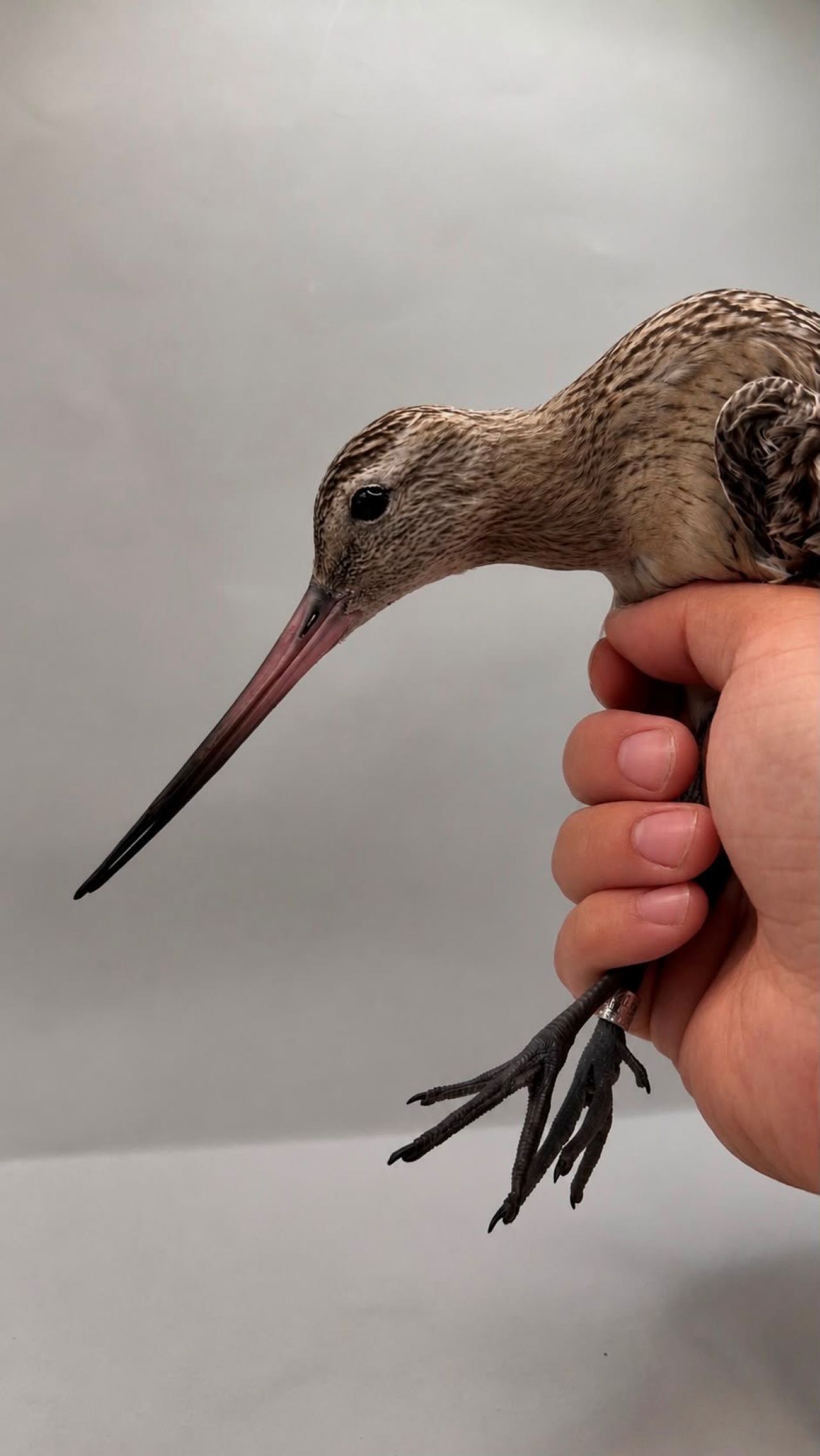
Our first Bar-tailed Godwit. Photo by Pauline Nähring
In the morning, it was raining, so we opened the nets an hour later than usual. We weren’t sure they would stay open for long, because the forecast showed a good chance of rain and wind. In reality, the weather turned out to be much better than expected. In the end, we managed to do the full four hours of ringing. The day turned out to be quite productive. The first few rounds were calm and steady, and Laura and I had time to practise ageing the birds. But then, after a short shower, a flock of Blue Tits (Blåmejse) and Chiffchaffs (Gransanger) suddenly appeared in the nets. We barely had enough bags for all of them. And once again, there was one interesting Chiffchaff among them. It was a bird with a moult limit in the primaries, meaning that it had an arrested moult.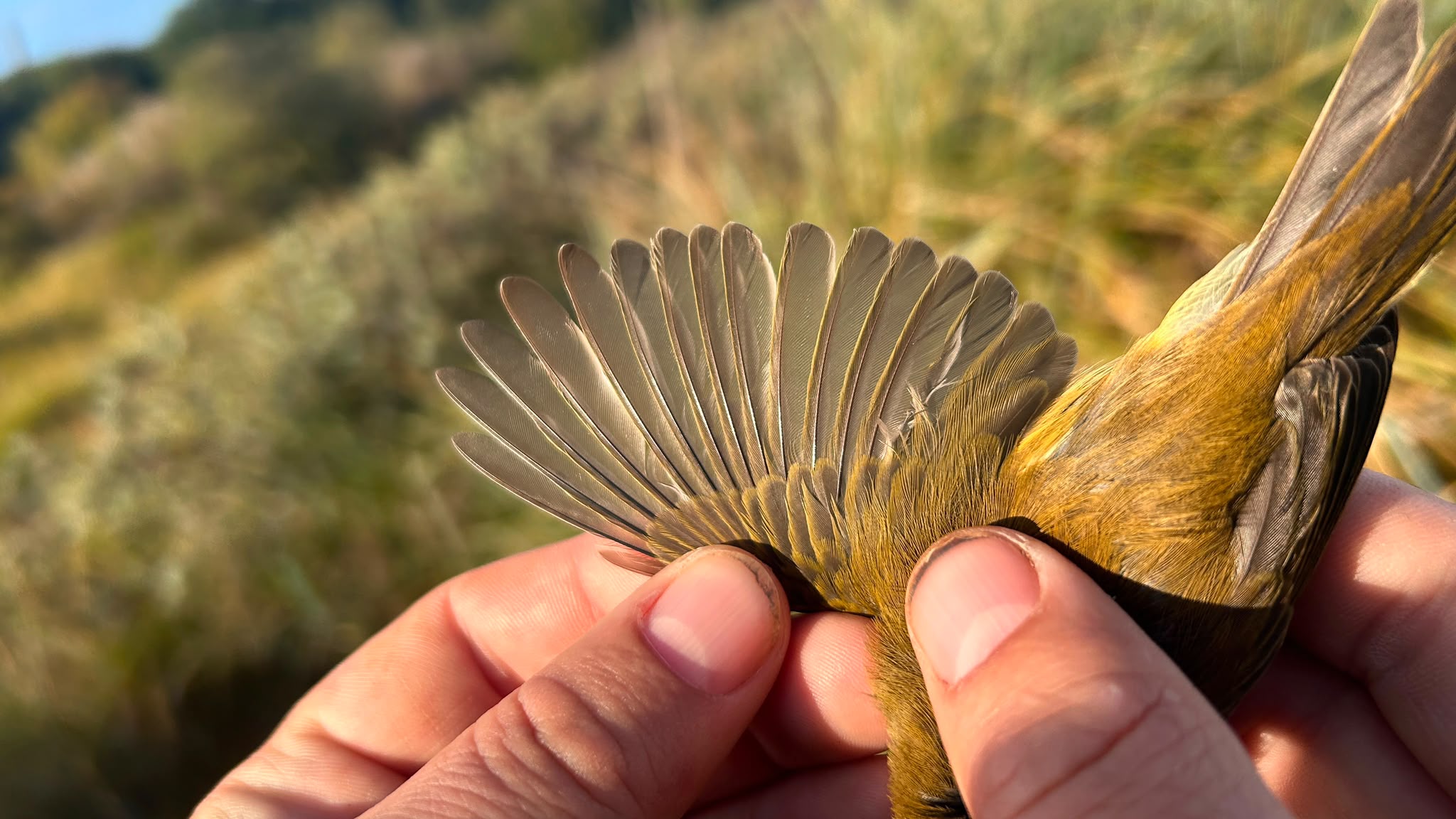
Chiffchaff with arrested moult. Photo by Pauline Nähring
Meanwhile, Jule and Alfred went out for the daily migration count. Today they saw three Long-tailed Skuas (Lille Kjove), three Arctic Skuas (Almindelig Kjove), a Black Tern (Sortterne) and a Rock Pipit (Skærpiber). One of the highlights was a Fulmar (Mallemuk) that flew quite close and gave us a really good chance to have a proper look at it. Since our ringing started later today, the others had enough time after the migration count to come back and join us for some ringing as well.
After that, we went home to rest. Everyone except Pauline, who went shopping with Kirsten, something we were very grateful for, because the fridge was almost completely empty.After a short rest, Alfred went for a long walk and took some more amazing photos. I managed to get a little bit of work done, Jule also spent some time outside, walking and relaxing by the coast, while Laura and Pauline stayed at home and continued recovering after the busy morning.
And you’ve probably noticed that Mio isn’t mentioned in the morning activities. No, we haven’t forgotten about him — he just went away for the weekend and will be back with us on Monday.
(Mio, I know you’ll read this, we’re already really looking forward to having you back!)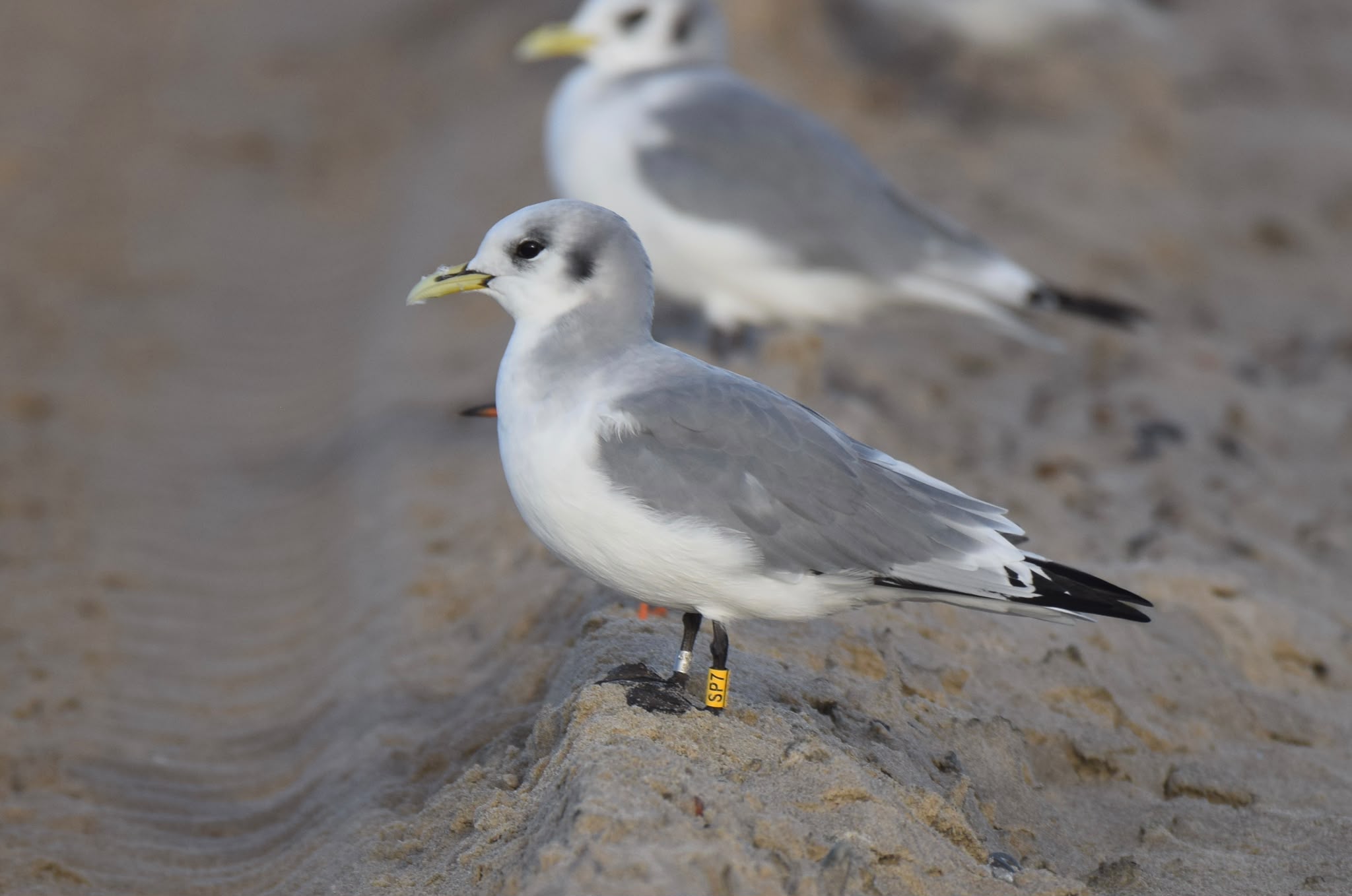
Kittywake with the yellow ring. Photo by Alfred Godsk Geckler.
We ended the day with a delicious dinner made by Alfred and some good conversations around the table, remembering the highlights of the day. I’ll share one of my highlights with you, it’s in the photo below.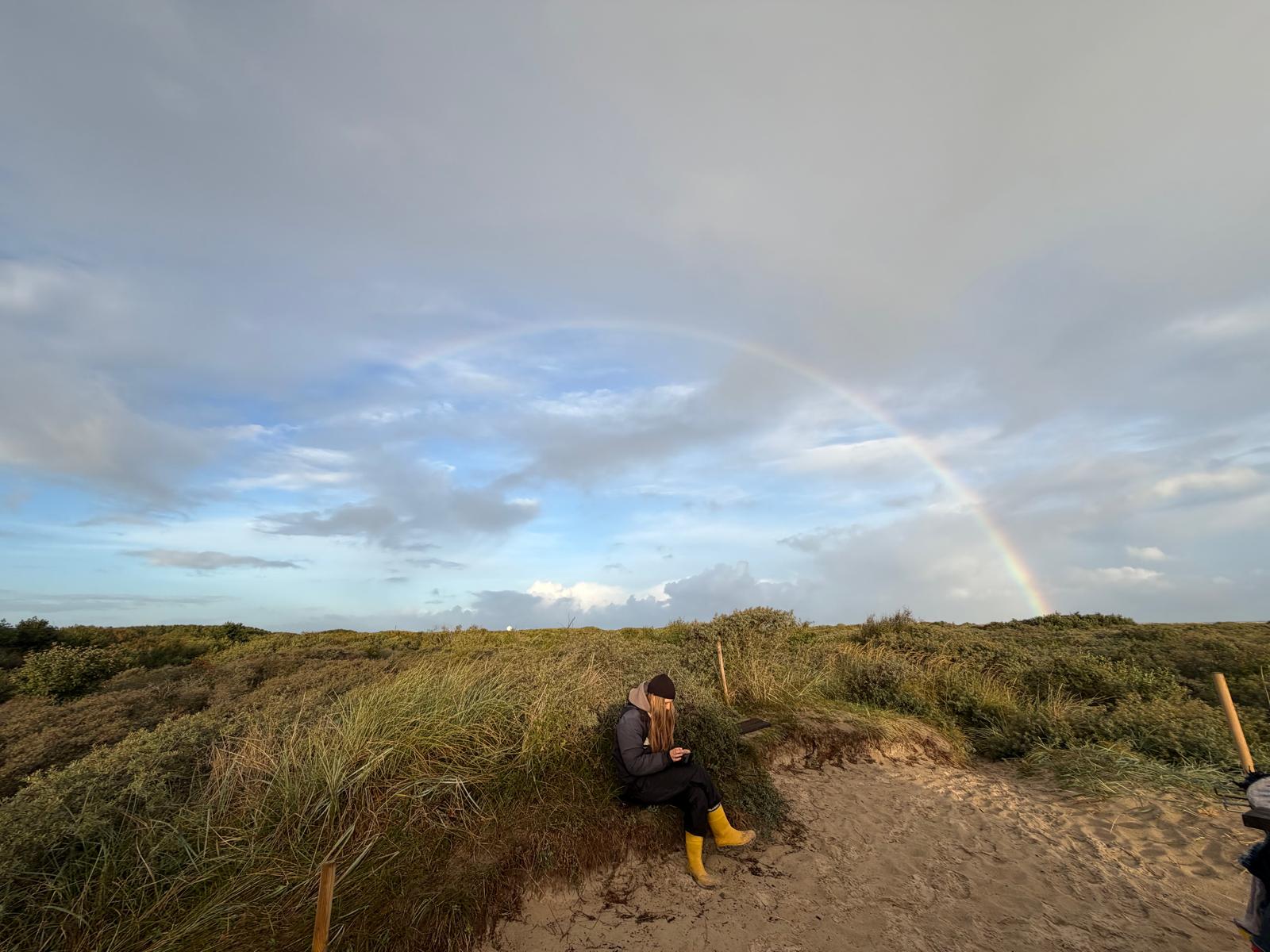
This rainbow is my personal hightlight of the day. Photo by Anja Gorbunova.
Ringing (Kabeltromlen):
Rødhals: 8
Jernspurv: 5
Munk: 2
Gærdesmutte: 1
Tornsanger: 1
Havesanger: 1
Gransanger: 11
Blåmejse: 13
Musvit:1
Total: 43
Ringing Jennes Sø (Michael Ancher):
Blåmejser 2
Topmejse 1
Lille gråsisken 4
Jernspurv 2
Musvit 1
Rødhals 1
Total: 11
Highlights from the observations:
Lille Kjove: 3
Almindelig Kjove: 3
Mallemuk: 3
Sortterne: 1
Skærpiber: 2
Link to todays observations in the Dofbasen from observers in the area.
People: Anja Gorbunova, Pauline Nähring, Jule Tappe, Laura Tamminen, Simon S. Christiansen, Kirsten Bregn, Alfred Godsk Geckler.
Early robin gets the ring
torsdag 17. september 2026
I slept in for 10 minutes this morning. Despite my sore neck I was tucked in so comfortably I almost considered falling asleep again. Just kidding, I was excited to go ringing after a few days doing observation. I did not have high hopes as the previous days had been a bit poor, but every day can surprise us.
Me, Mio and Pauline opened the nets this morning, though I was mostly still learning. We were later joined by Kirsten and Simon. We got 4 robins (Rødhals) on our first round. It was a great opportunity for me and Kirsten to ring them, because it is a bit easier to determine the age of those plump birds. During our ringing hours, we spotted several interesting birds that flew over us: Goshawk (Duehøg), mistle trush (Misteldrossel), a flock of starlings (Stær) and redpolls (Gråsisken). The others say the weather was cold this morning but as the master of temperature sensitivity I confidently say that it was a lovely warm weather today. Or maybe i just moved around enough to keep myself warm..
Fun fact! In Estonia we have a nickname for people who get cold very quickly, we call them “ külmavares “ which in direct translation means „ cold crow “.
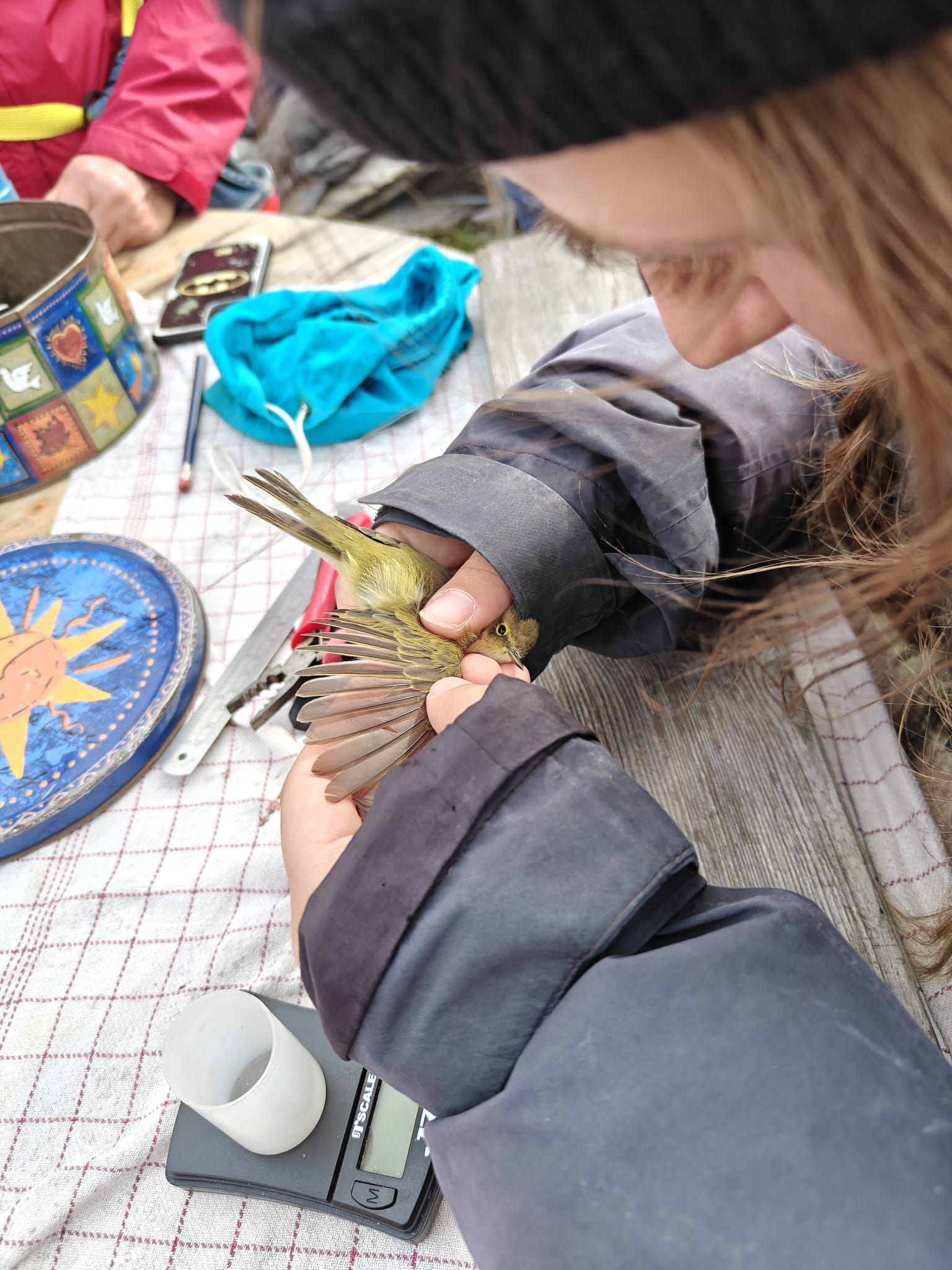
Pauline ringing a chiffchaff (Gransanger). Photo by Laura Tamminen
Jule, Alfred and Anja report that their day at the migration count went well. They were also accompanied by Knut. They counted a total of 9 skuas (Kjove) which will be listed below. They also registered over 1400 common scoters (Sortand)!! Kudos to Jule for counting them all wow.
After our daily ringing and obs we had a small rest back at the station. Later on Alfred went out to Skagen Havn to search for and photograph some mediterranean gulls (Sorthovedet måge) and he found 13 gulls! They are considered to be scarce visitors in Denmark, so it is great to see more than a dozen of them in Skagen.
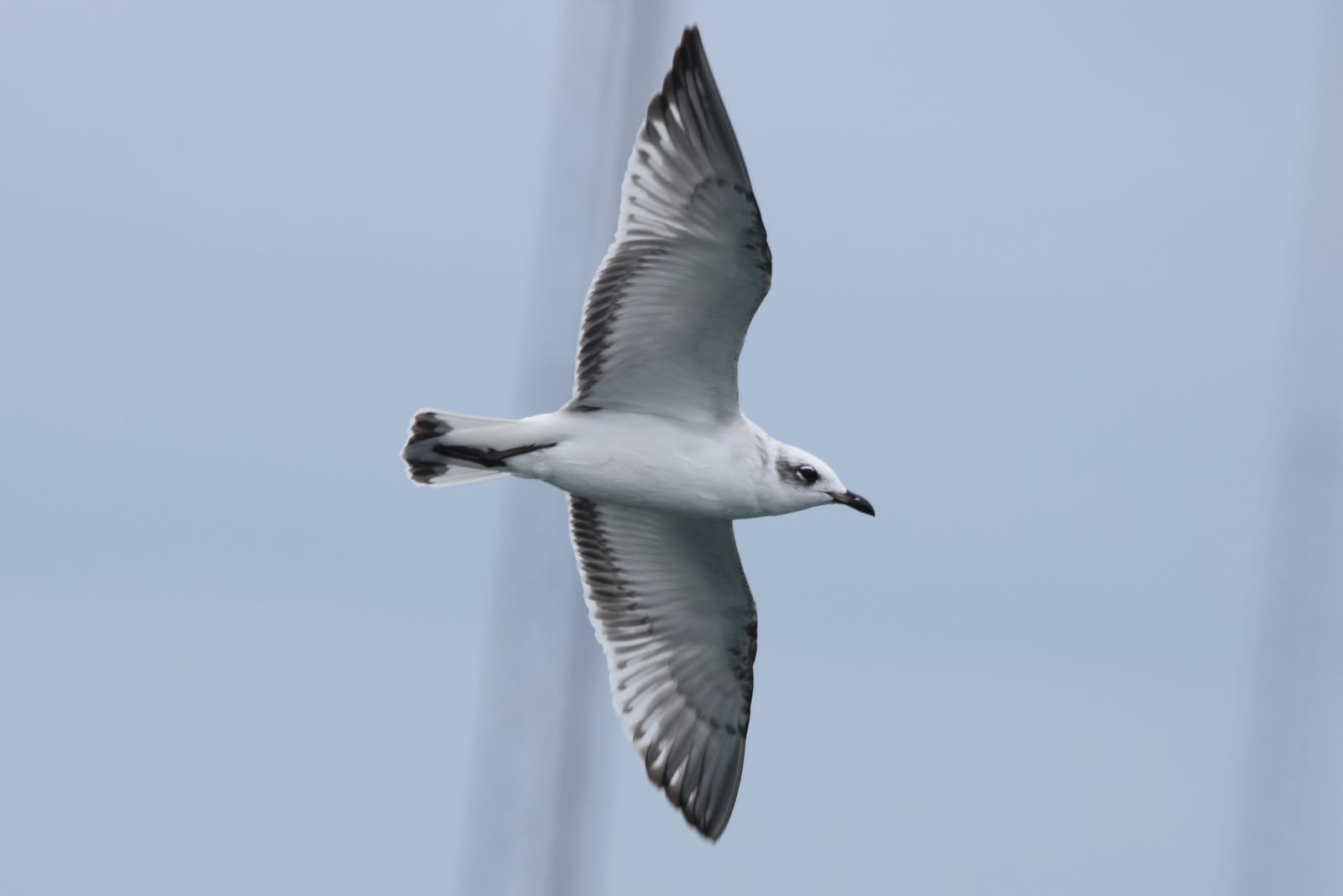
One of many mediterranean gulls in Skagen. Photo by Alfred Godsk Geckler
Having great motivation, he and Mio also took a small visit to Ellekrattet and found a magnificent little bird, a firecrest (Rødtoppet Fuglekonge)!! This bird is quite uncommon in many areas, especially on the Northern parts of Europe. I have only seen this bird once in my life before. Alongside goldcrests (fuglekonge) they are the smallest birds in Europe.
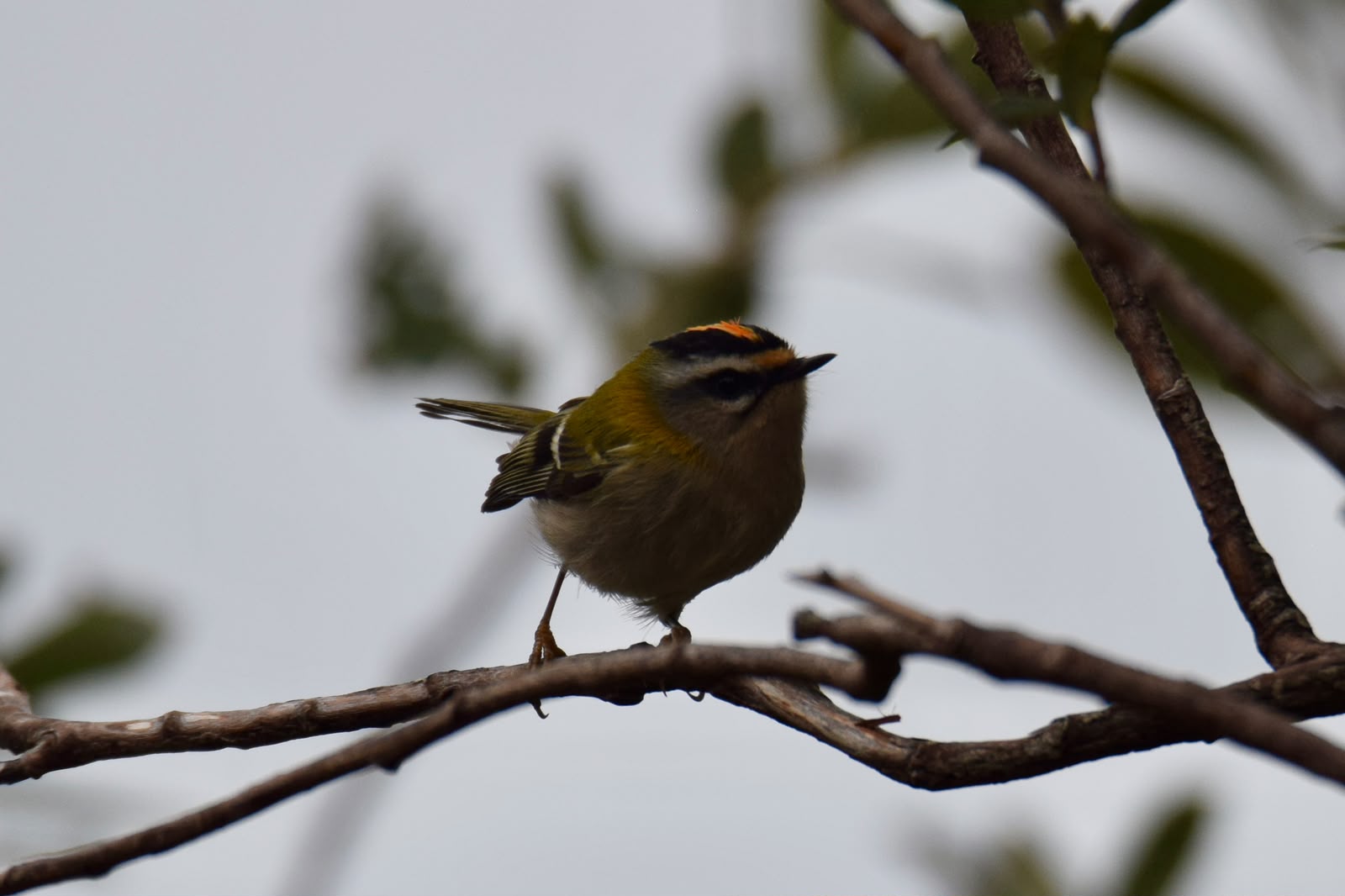
These guys are near impossible to get on camera as they restlessly jump from branch to branch. Firecrest (Rødtoppet Fuglekonge). Photo by Alfred Godsk Geckler
There is a plan of going night-catching tonight, so definitely look out for tomorrow’s blog!
Unfortunately, the pools around the beach have dried up, but one big one remains, so there is a chance we will catch a few waders (Vadefugl) or terns (Terne).
Dinner will be served very shortly, so I will be off to eat. Til tomorrow, loyal readers!
Ringing (Kabeltromlen):
Rødhals: 8
Jernspurv: 4
Munk: 1
Gærdesmutte: 1
Gransanger: 1
Blåmejse: 1
Rørspurv: 1
Total: 17
Ringing Jennes Sø (Michael Ancher):
Dompap: 2
Rødhals: 3
Lille gråsisken: 16
Gransanger: 11
Jernspurv: 1
Total: 33
Highlights from the observations:
Lille Kjove: 5
Storkjove: 3
Sorthovedet måge: 1
Sortterne: 1
People: Mio Brix, Anja Gorbunova, Pauline Nähring, Jule Tappe, Laura Tamminen, Simon S. Christiansen, Knut Pedersen, Kirsten Bregn, Alfred Godsk Geckler
A Lot of Wind!
onsdag 16. september 2026
Hello, im Alfred, I am in school practice here on the station, until Sunday.
I started my day with Mio and Laura at the migration-count. We quickly saw the first Long Tailed Skua (Lille Kjove) and not long after, the Black Tern (Sortterne). We also gota nice observation of a Long-tailed Duck (Havlit) At the end of the observation, a nice Merlin came in from Sweden.
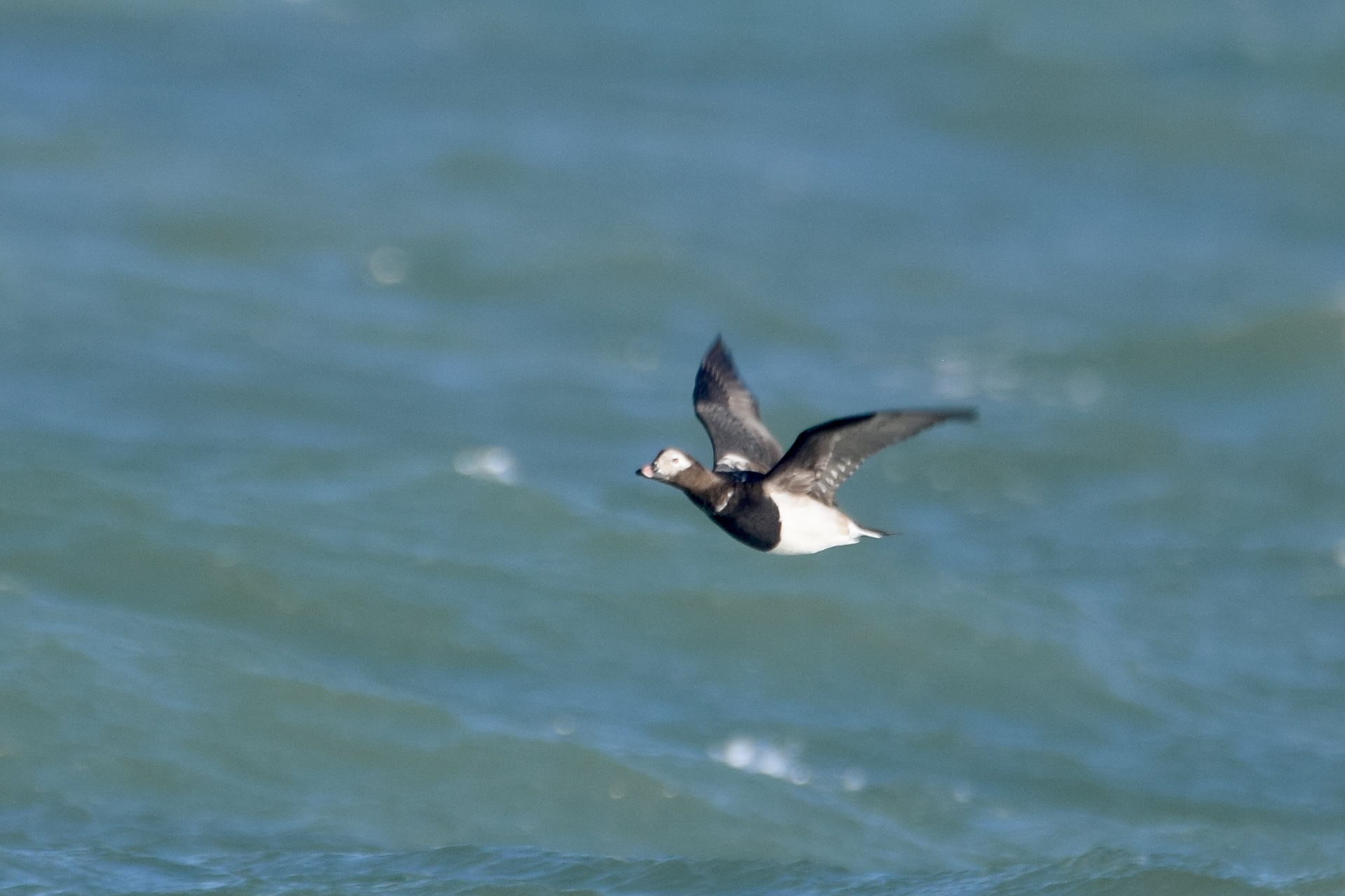
Long-Tailed Duck (Havlit). Picture by Alfred Godsk Geckler.
While we were having fun at the migration count with some other people, Jule, Anja, Pauline and Simon were ringing at Kabeltromlen. They caught a nice European Siskin (Grønsisken).
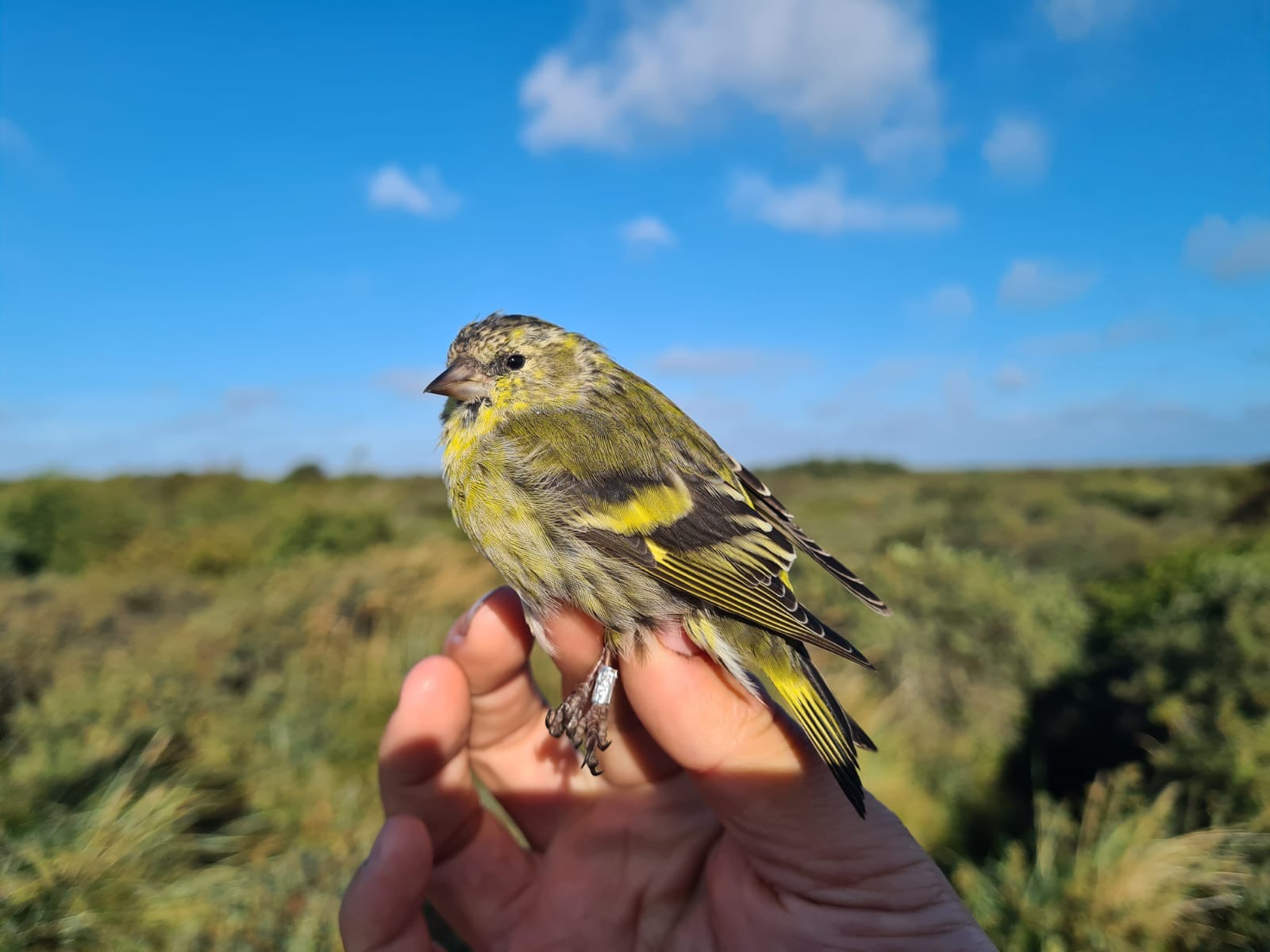
European Siskin (Grønsisken). Foto by Jule Tappe.
Anyways, after the morning obs, we went back to the station, where i got some yoghurt and bread. When I was done eating, Simon drove me, Anja, Pauline and Páll to Højen, from where we should walk back to the station while collecting dead seabirds, like Fulmars (Mallemuk) and Gannets (Sule). At first, we didn't find any birds, but around Grenen, we found the first collectible bird, a Fulmar (Mallemuk). Half an hour after, we had a Long Tailed Skua (Lille Kjove) flying around 3 meter over our heads! After that, we found a Cormorant (Skarv), a Gannet (Sule) and a Mute Swan (Knopsvane). When we came home after 10 km of intense starring at the ground, Simon helped us put the birds in the Freezer, so they can help science.
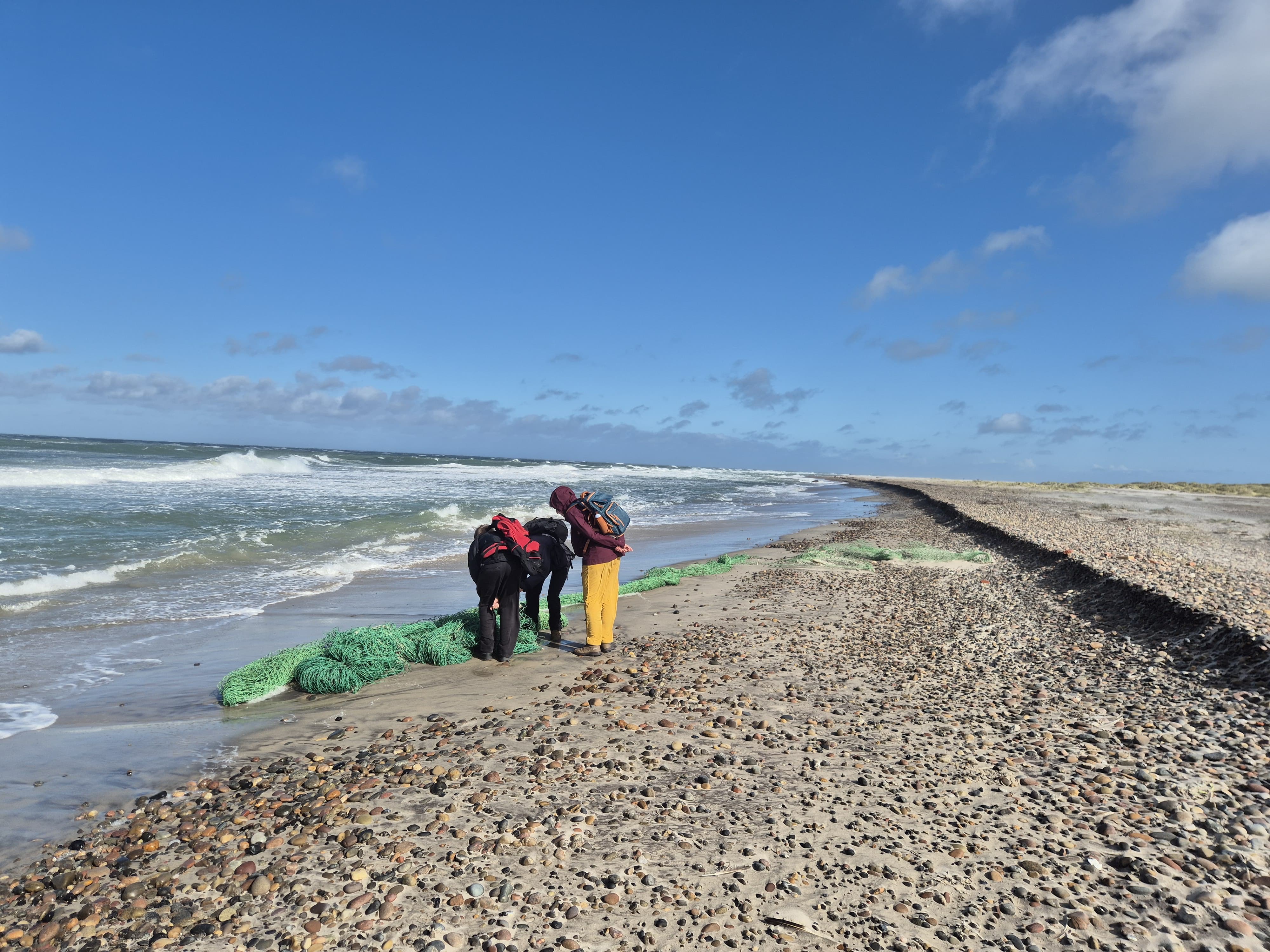
Pauline, Anja and Me looking at a dead Gannet (Sule)
Later, we entered data from today, and Mio made us very Tasty Spaghetti. We also got the message from Henrik at the rescue center that the young Honey Buzzard (Hvepsevåge) that we ringed there last week was released back into the wild the day after so it can continue it's first journey to the tropical Africa. Right now, I'm writing this on my computer, while Anja is knitting, and the others are in their rooms, getting rest for an exciting day tomorrow.
See you!
Ringing (Kabeltromlen):
Gransanger 2
Munk 2
Gærdesmutte 1
Jernspurv 1
Dompap, Lille (ssp. europaea) 1
Grønsisken 1
Total: 8
Ringing Jennes Sø (Michael Ancher):
Solsort 1
Lille gråsisken 5
Gransanger 2
Topmejse 1
Rødhals 1
Blåmejse 1
Rødstjert 1
Grønsisken 1
Lille gråsisken 5
Gransanger 2
Topmejse 1
Rødhals 1
Blåmejse 1
Rødstjert 1
Grønsisken 1
total: 13
Highlights from the Observations:
Long-tailed Skua (Lille Kjove): 5
Merlin (Dværgfalk)
Black Tern (Sortterne)
People: Mio Brix, Anja Gorbunova, Pauline Nähring, Jule Tappe, Laura Tamminen, Simon S. Christiansen, Kirsten Bregn, Alfred Godsk Geckler, Páll Kjærbo
Link to today's observations in the Dofbasen from observers in the area.
When strong winds come from the south
tirsdag 15. september 2026
There are two places that I combine directly with Skagen. One is called Kabeltromlen, or in short: KAB, where we are doing scientific bird ringing every day, except when there is rain or very strong wind. Also today, it was very much on the edge of whether we could go out ringing, but it was still okay...
With strong wind, of course, we can’t open all the nets. Some of the nets are just not sheltered enough from the wind, but these nets are then good when we don’t have wind. So there are advantages and disadvantages to them...
But back to the ringing: They didn’t catch many birds today, but they still had some nice ones. Jule always enjoys ringing Blackbirds (Solsort), so she, but also the others, were happy to see this bird. The second highlight must have been the Garden Warbler (Havesanger). This long-distance migrant could already be one of the last ones for the season, because most of them are already on their long way south.
And there is the second place, which comes directly to my mind when I’m thinking about Skagen: It’s Worlds End 3, the place where we are doing the migration count every day. And with the autumn migration, it’s becoming more and more interesting up here. I have to mention quickly our awesome observation of the Sabine’s Gull (Sabinemåge) yesterday again. It was one of the species I’ve wished to see and it already worked! So hopefully there are more of these nice birds coming over the next few days.
One of the now somehow everyday good birds is definitely the Long-tailed Skua (Lille Kjove), of which we got five again today. Almost all of these birds were more or less stationary today, which allowed Alfred and Knud to get some pictures down at the beach.
 1K intermediate Long-tailed Skua. Picture by Alfred Godsk Geckler
As Alfred searched for the Skuas at the beach, he just found a very close swimming Red-throated Diver (Rødstrubet Lom). He then started taking pictures of that bird, and while doing so, he noticed that the bird had a yellow colour ring! How awesome!
There aren’t many colour-ringing projects for this species, and that bird, which was ringed in a Finnish project, is only one of around 200 birds! And then, what a coincidence that it worked to read that ring on a diver while it was swimming.
Here you can see how he managed to read the ring:
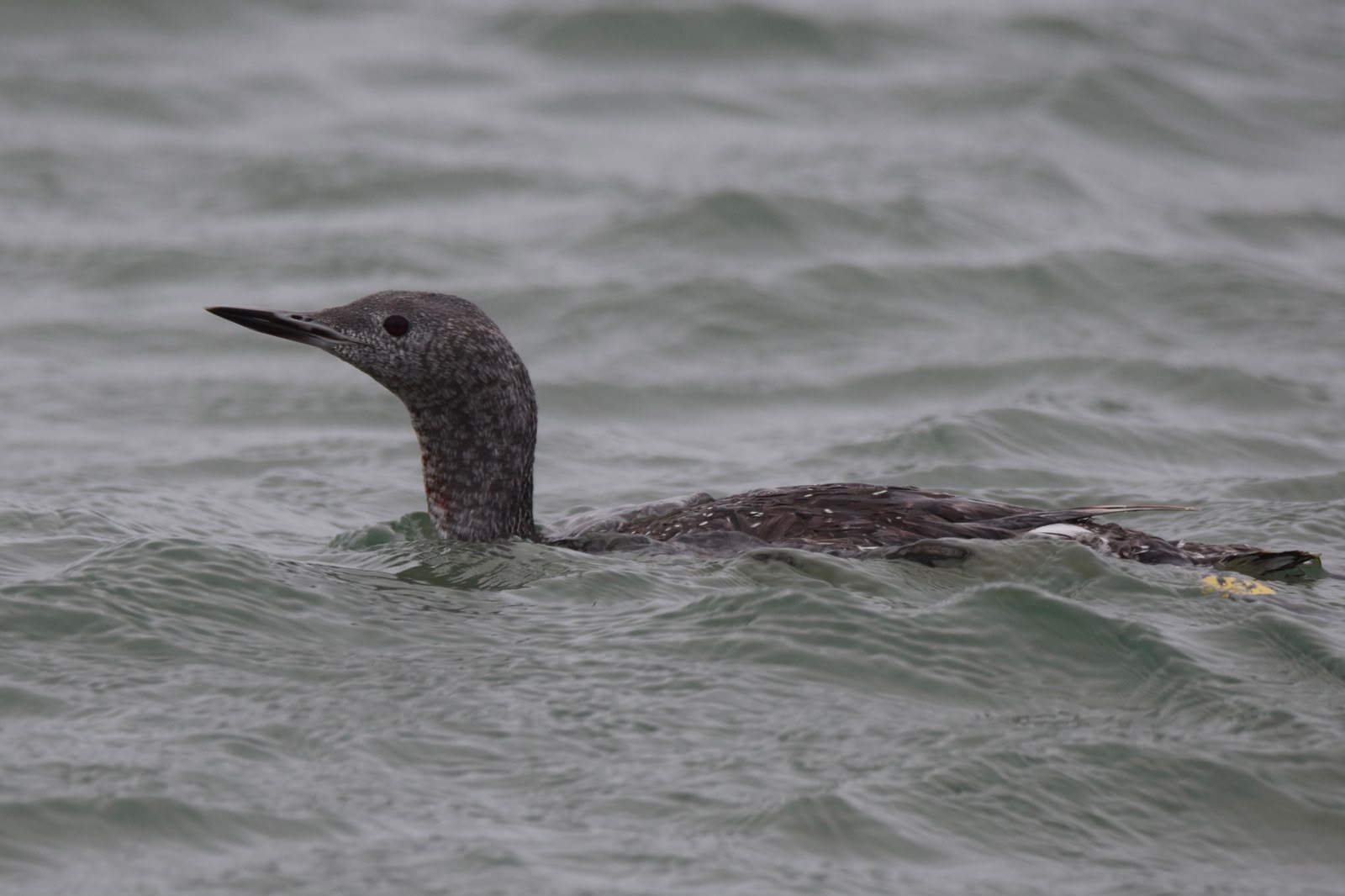 Adult Red-throated Diver (Rødstrubet Lom) close to the shore (you can already see the yellow ring on the right under the water).
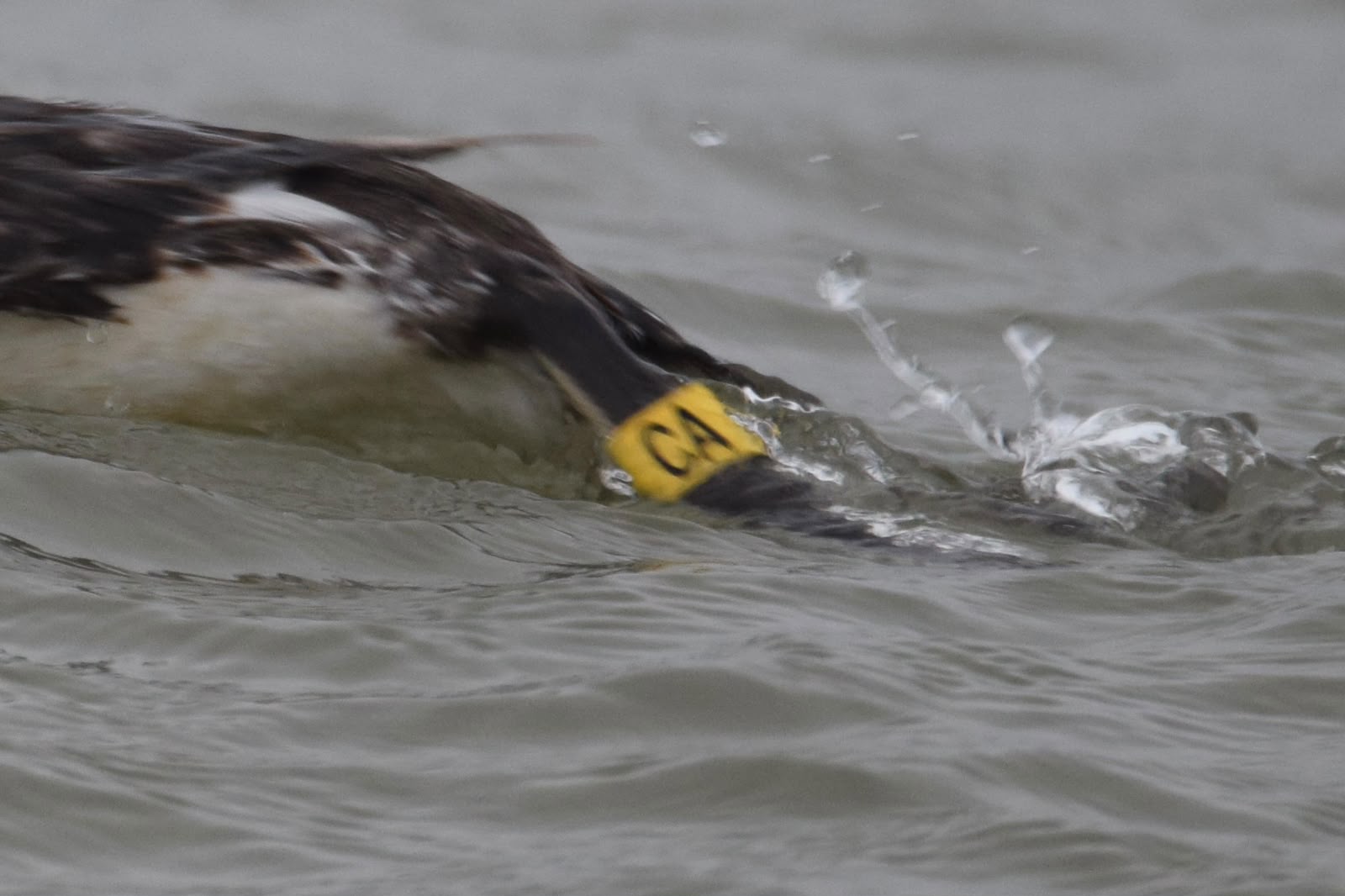 And here is the ring with the code!
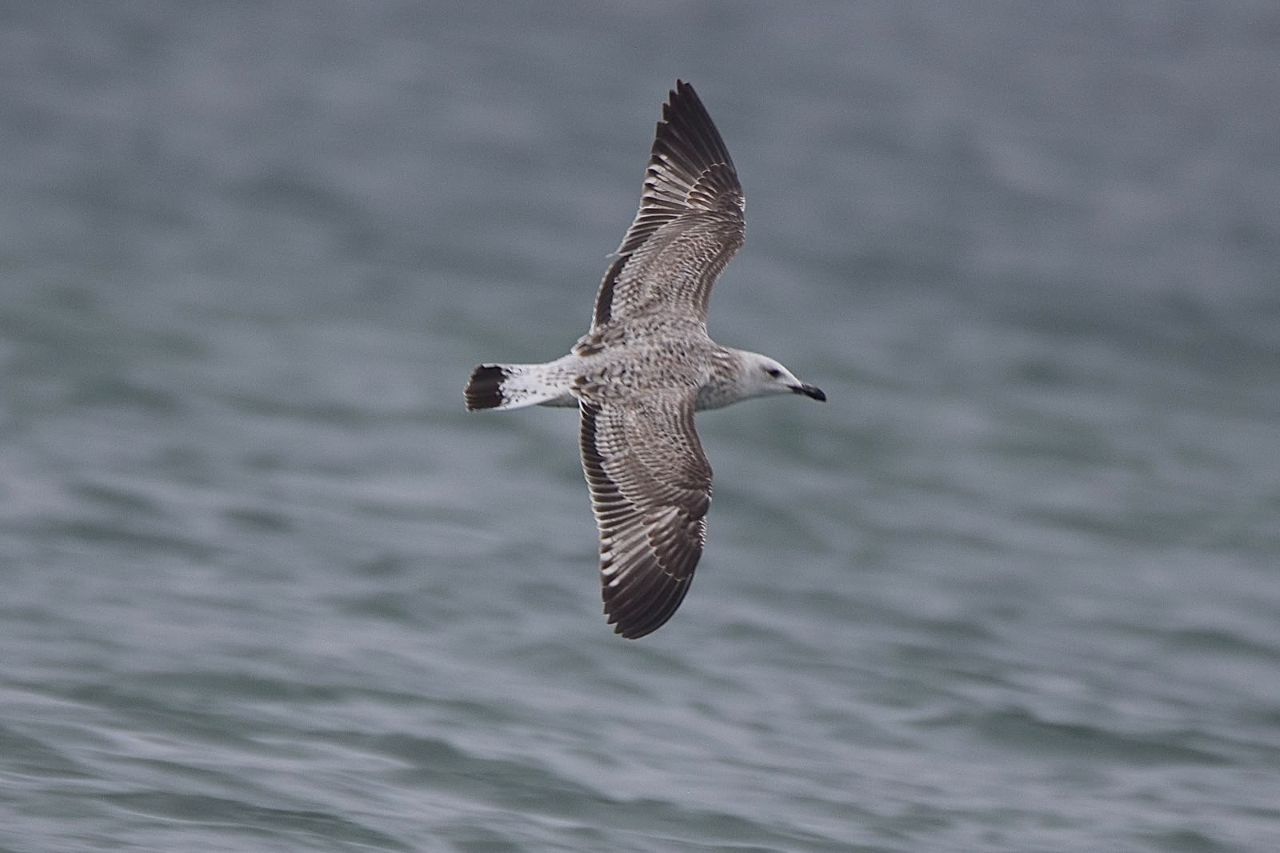 Caspian Gull 1cy. (Kaspisk Måge 1k). Photo: Alfred Geckler
And now I hope that you all remembered from my last blog post what DLN means, what we are doing after the count and ringing. Yes! You remembered right! It’s Data entry, Lunch and Napping!
But today was also picture archive day, so all of us also spent a bit of time archiving pictures we had taken in the field. But with all these data-entry tasks, you can really feel that your feet are sending you a signal to go out again.
And Jule took this signal seriously and went out to Batteriskoven to look for some passerines. But with the wind, the birds didn’t want to move or call either, so there wasn’t a lot happening.
In the evening, we had our proper evening meeting, and Pauline prepared us a delicious dinner and made cinnamon rolls again for dessert!
And for now, with dinner and cinnamon rolls in our stomachs, it got quieter and quieter at the station. The only thing you can hear here now, apart from the waves outside, is me writing the last sentence of this blog post...
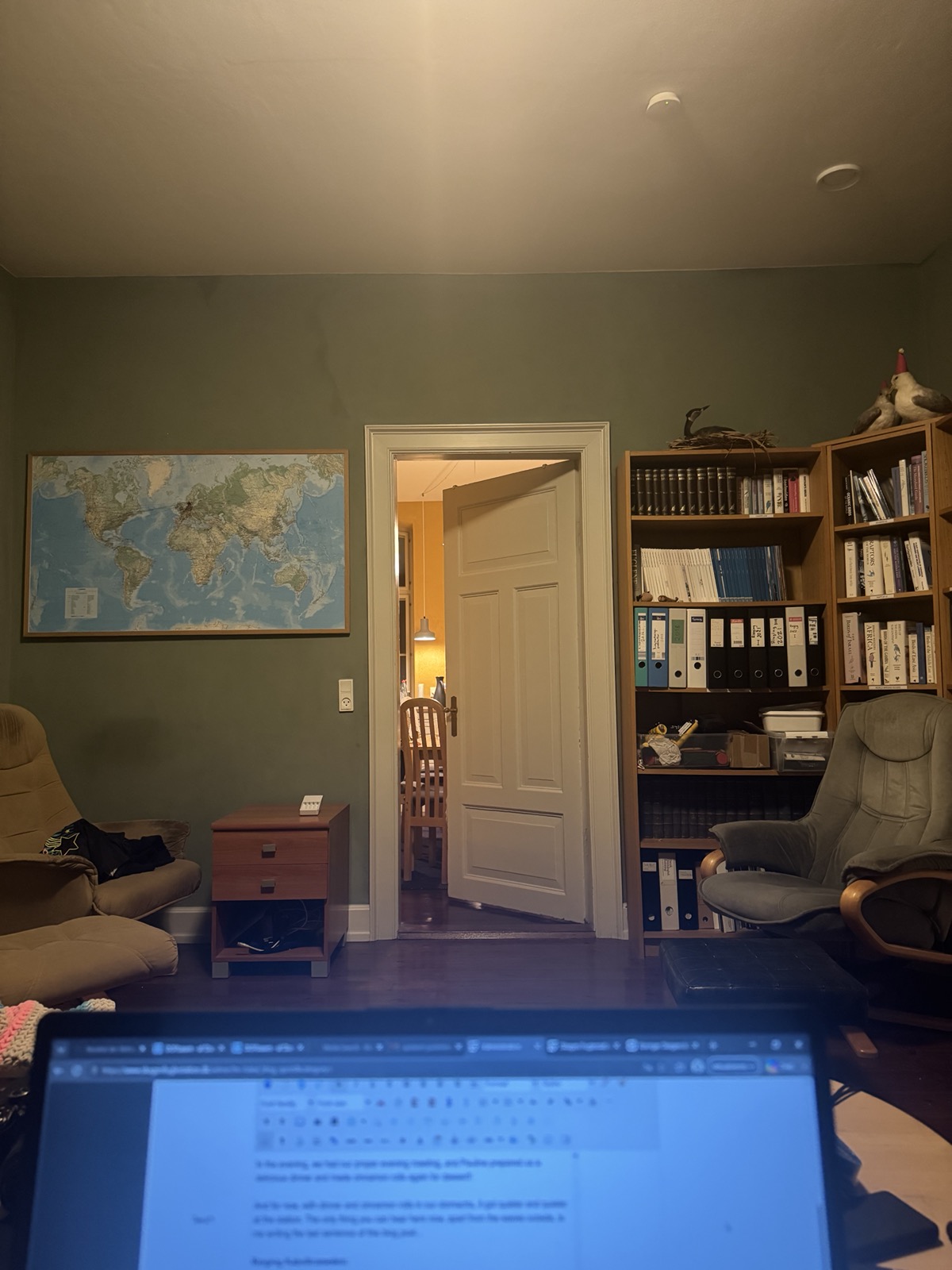 tip, tipp, tipp...
Ringing Kabeltromlen:
| Blåmejse | 1 |
| Havesanger | 1 |
| Gærdesmutte | 1 |
| Solsort | 1 |
| Rødhals | 4 |
Total: 8
Ringing Jennes Sø (Michael Ancher):
Blåmejse 1
Rødhals 1
Lille Gråsisken 26
Musvit 1
Gransanger 2
Jernspurv 1
Highlights from the Observations:
Long-tailed Skua (Lille Kjove)-4
Colour ringed Red-throated Diver (Rødstrubet Lom)-1
Link to today's observations in the Dofbasen from observers in the area.
People: Mio Brix, Anja Gorbunova, Pauline Nähring, Jule Tappe, Laura Tamminen, Simon S. Christiansen, Kirsten Bregn, Alfred Godsk Geckler, Knud Pedersen
New Arrivals
mandag 14. september 2026
Today my morning started at 6:45 when I cycled to Kabeltromlen (KAB) for ringing. It was a beautiful, sunny morning, and we had a surprisingly good variety of birds in the nets. In total, we caught 46 birds.
At the same time, Mio and Anja headed out for the morning observations. Laura joined me for the first ringing check and stayed for part of the morning before heading off. Kirsten also came along for the first check and was very happy with the morning. She got the opportunity to take some birds out of the nets and even do a little ringing herself.
Jule opened the nets together with Páll and Sophie. The highlight for everyone was probably a Brambling (Kvækerfinke), which is a good sign that autumn is finally getting closer! We also had a flock of Long-tailed Tits (Halemejse) moving through the area. Just before we closed the nets, some of them flew into one of our nets, giving us the chance to take a closer look at them. A Goldcrest (Fuglekonge) was another lovely addition to the catch.
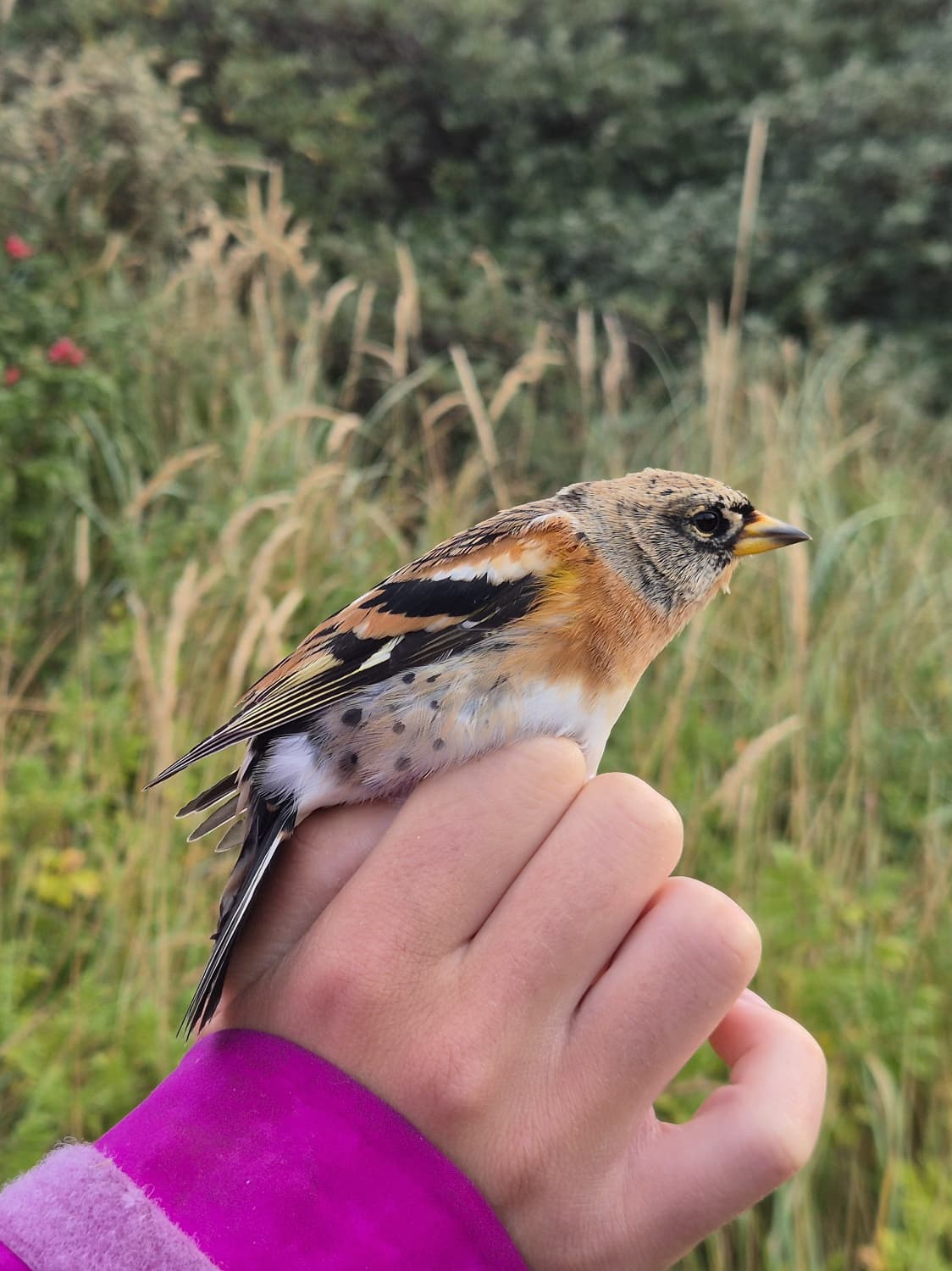
Brambling (Kvækerfinke) Picture: Jule T.
Meanwhile, Mio and Anja had some exciting observations during their morning out. A Sabine’s Gull (Sabinemåge) and a Merlin (Dværgfalk) were among the highlights. After returning to the station, Anna had some more computer work to finish, while Mio headed out again shortly afterwards to retrieve a recorder. On the way, he spotted an adult Hobby (Lærkefalk).
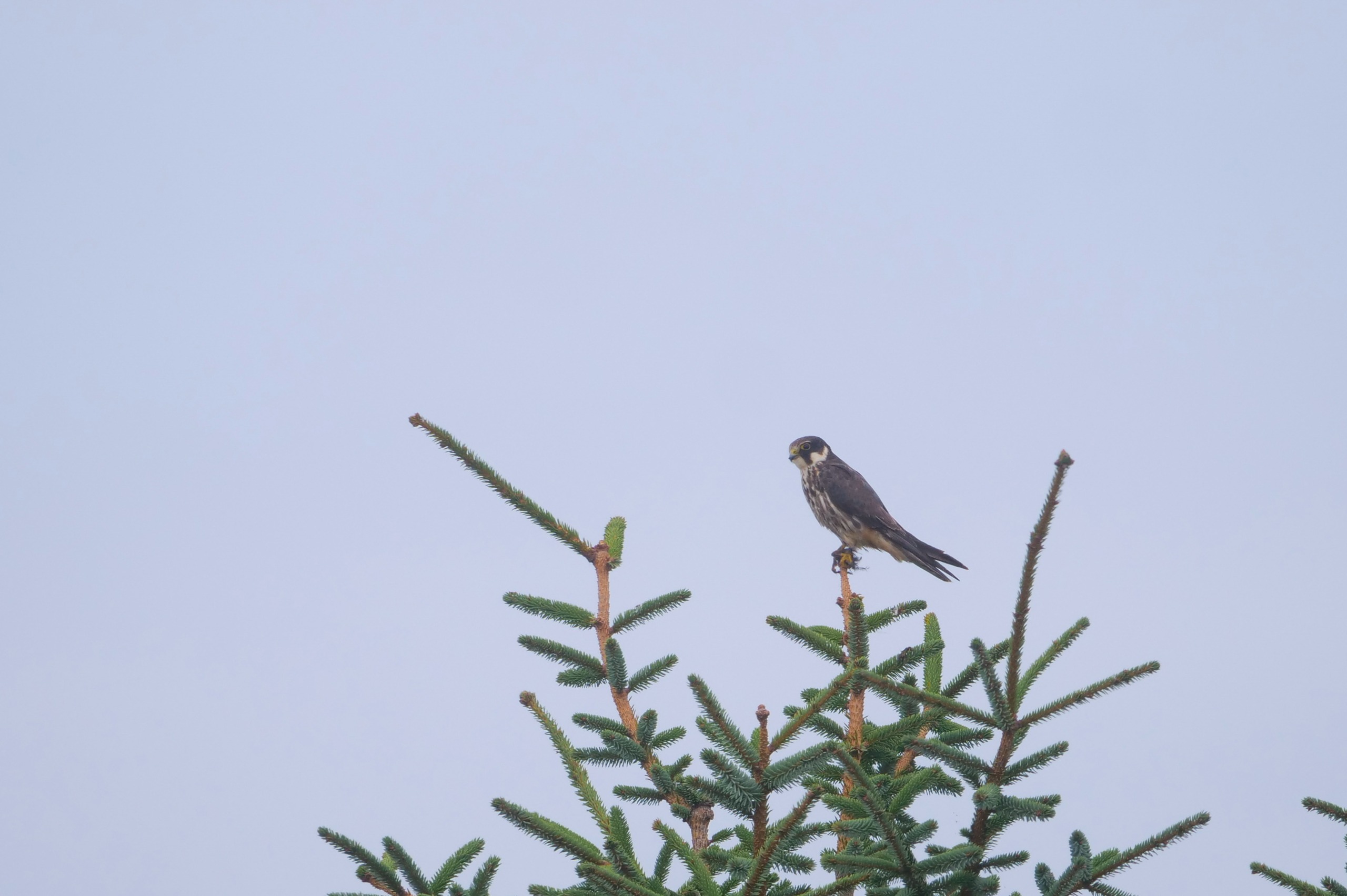
Hobby (Lærkefalk) Picture: Mio B.
After the morning activities, I returned to the station and went together with Jule and Simon to the train station to pick up Alfred. We went shopping afterwards, giving Alfred some time to settle in at the station and get to know everyone.
Back at the station, Laura and I entered some of the ringing data together, followed by a short nap for me. Jule cooked dinner for everyone in the evening and I am now spending some more time doing work on my laptop.
Alfred also went out birding again in the evening with Mio, Jule and Anja towards Nordstrand. Let’s see what they’re going to find!
Ringing at KAB:
Gærdesanger (Lesser Whitethroat) – 1
Halemejse (Long-tailed Tit) – 3
Halemejse, Sydlig (European Long-tailed Tit) – 1
Halemejse, Nordlig (Northern Long-tailed Tit) – 2
Fuglekonge (Goldcrest) – 1
Gransanger (Chiffchaff) – 11
Blåmejse (Blue Tit) – 2
Rørspurv (Reed Bunting) – 1
Kvækerfinke (Brambling) – 1
Munk (Blackcap) – 4
Jernspurv (Dunnock) – 3
Gærdesmutte (Wren) – 1
Rødstjert (Redstart) – 2
Rødhals (Robin) – 11
Musvit (Great Tit) – 2
Total: 46 birds
Nordstjernevej (Michael Ancher)
Gærdesmutte (Wren) – 1
Jennes Sø (Michael Ancher):
Munk (Blackcap) – 4
Rødhals (Robin) – 4
Musvit (Great Tit) – 3
Lille Gråsisken (Lesser Redpoll) – 17
Rødstjert (Redstart) – 1
Bogfinke (Chaffinch) – 1
Gransanger (Chiffchaff) – 2
Blåmejse (Blue Tit) – 3
Grønsisken (Siskin) – 1
Jernspurv (Dunnock) – 1
Observation highlights
Sabine’s Gull (Sabinemåge) - 1
Merlin (Dværgfalk) - 1
Hobby (Lærkefalk) - 1
Long-tailed Skua (Lille Kjove) - 2
Link to today's observations in the Dofbasen from observers in the area.
People: Mio Brix, Anja Gorbunova, Pauline Nähring, Jule Tappe, Laura Tamminen, Simon S. Christiansen, Kirsten Bregn, Henrik Christiansen, Alfred Godsk Geckler, Páll Vang Kjærbo, Sophie Booker
Awesome birds as close as never before
søndag 13. september 2026
When I woke up this morning, it was light outside. That’s weird. At least, when you work at a bird observatory and go bird ringing almost every day. But today, we switched our usual order and Mio, Pauline and Anna opened the nets at Kabeltromlen while Laura, Knud and me did the migration count.
Unfortunately for the ringers, the most birds were on the sea today. The first couple of rounds were still quite good, the highlight being to 2k+ Blackcaps (Munk). Then, it slowed down a little. While watching with a scope, it was still possible to see what was flying on the sea.
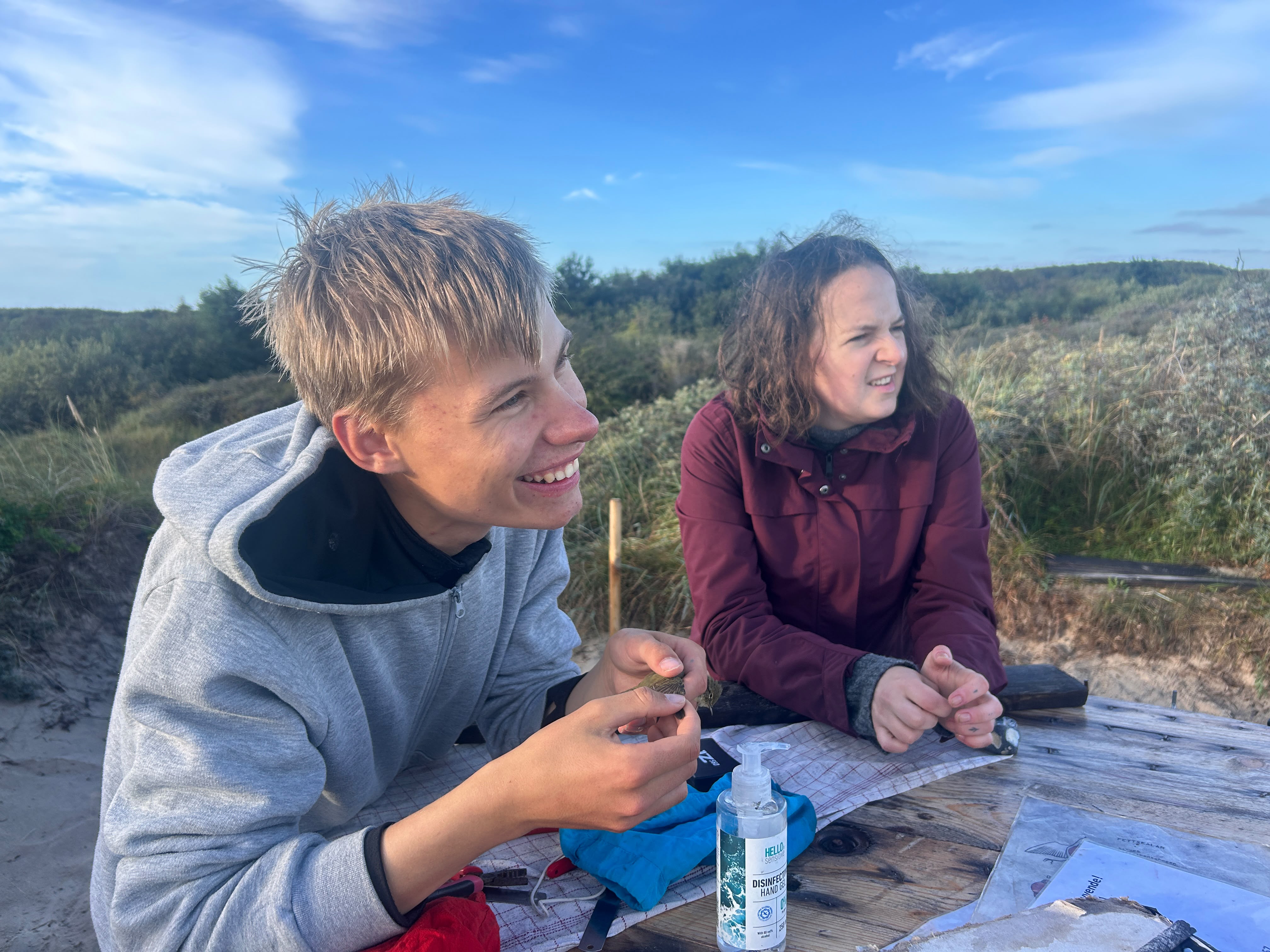 Mio and Anna having fun while ringing a Chiffchaff (Gransanger). Foto: Pauline Nähring.
The first thirty minutes of the migration count where quite busy: Once I had written down the nots on Long-tailed Skua (Lille Kjove), Knud and Anders Bojensen, who also joined us, called out to new ones. In total, we saw 15 Long-tailed (Lille), 8 Arctic (Almindelig) and 2 Great Skuas (Storkjove). There were even more Skuas far out that we couldn’t identify with certainty. While the sun was shining down on us, there were more exciting birds to come. The Black tern (Sortterne) from the day before was still resting around the beach, three Little Gulls (Dværgmåge) and many Gannets (Sule) feeding in Kattegat kept us company, when suddenly, the royalty of migration appeared: A Sooty Shearwater (Sodfarvet Skråpe). After it was first spotted pretty far out, it got closer until we got awesome looks. This was one of the best shearwater observations I ever had and it was really exciting. By the fourth hour of the migration count, activity had slowed down so once we were finished, we drove back to the station.
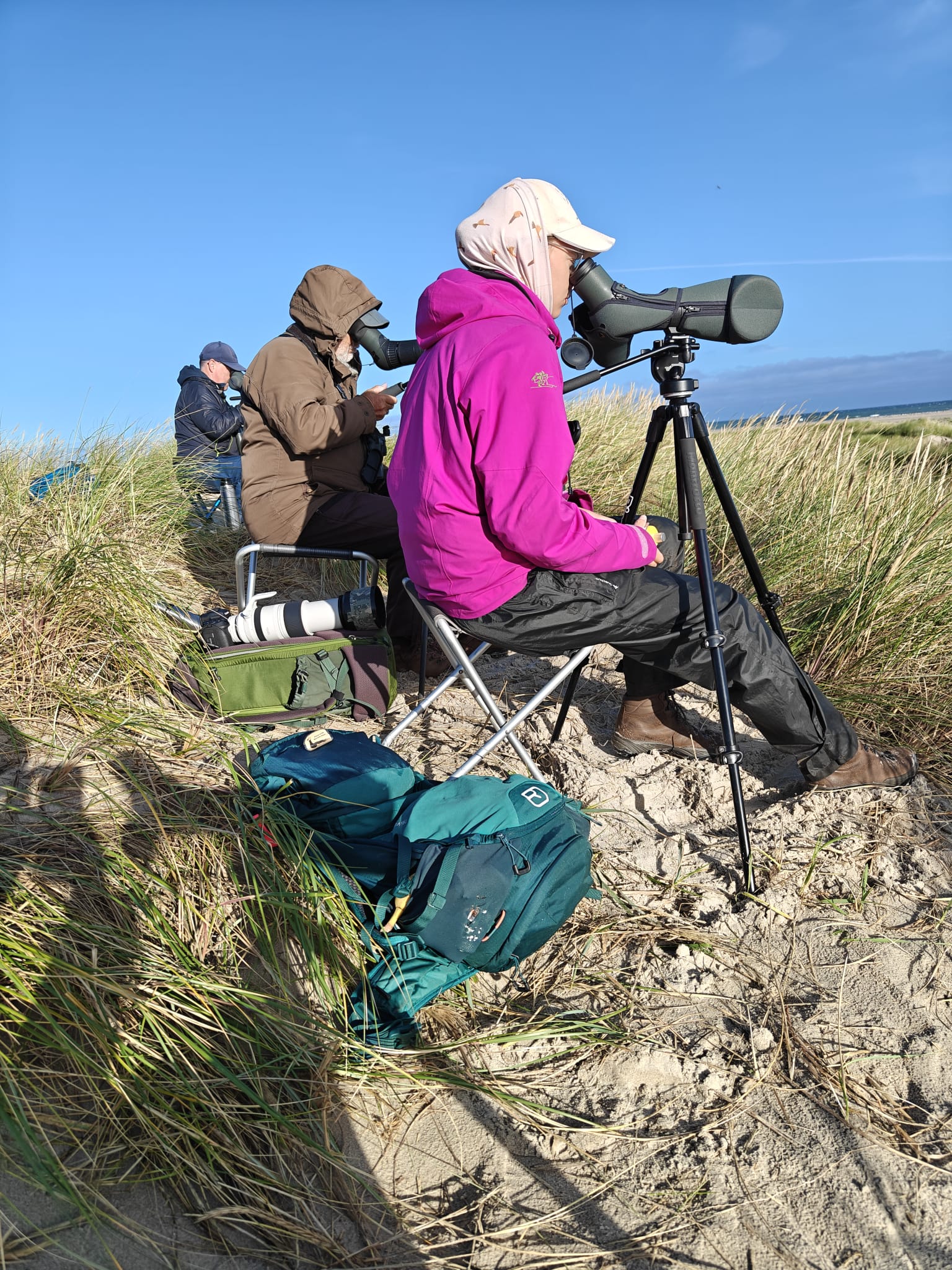 Jule, Knud and Anders watching Long-tailed Skuas (Lille Kjove) at World's End 3. Foto: Laura Tamminen.
There, our normal routines continued: Data entry, lunch and a nap. But this was not the end of the day! Around 4 pm, we drove down to the Rescure Centre in Jerup with Jørgen and Simon. The rescue had a Common Eider (Ederfugl) and a Honey Buzzard (Hvepsevåge) that were ringed by us before they will be released in the next couple of days. That was very exciting since they are two species which we don’t ring or see from up close often, especially the buzzard. While documenting the Buzzard with photos outside, Mio found a young Pallid Harrier (Steppehøg) in the distance. After landing in a field, it didn’t fly up again unfortunately. Still, it was a surprisingly nice observations. We also looked around the Rescue Centres were a number of different animals stay. This was very interesting to see, so thank you for the opportunity Henrik!
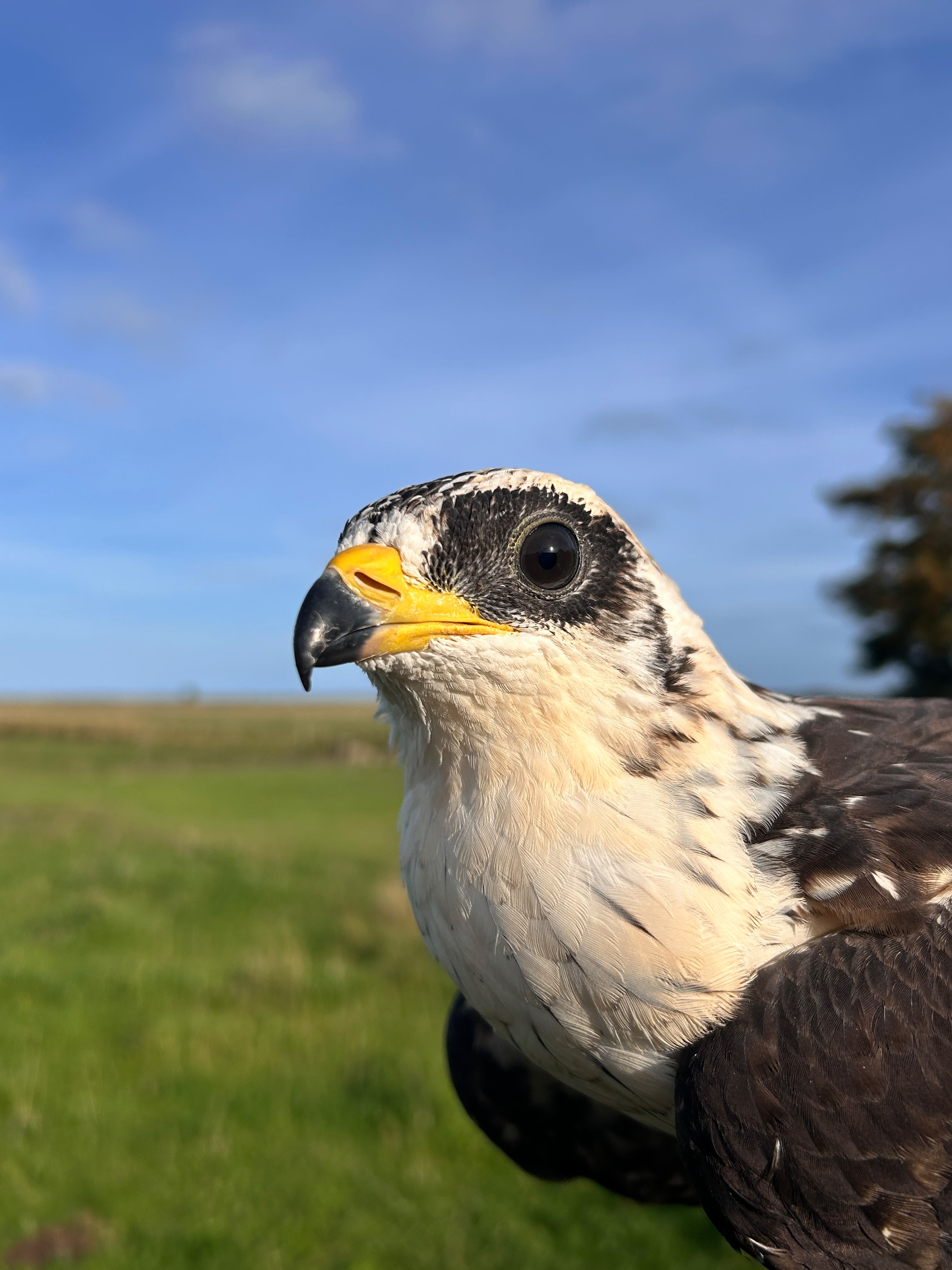 Honey Buzzard (Hvepsevåge). Foto: Pauline Nähring
Back at the station, we welcomed our new guest for the week, Kirsten. She has been here many times before, so welcome back! After our daily meeting and planning for the next week, I repaired Anna’s bike while she started cooking dinner.
Sitting in the living room, I can smell the dinner from the kitchen and I’m sure, it will taste very good. We might also have a Klask! (fun board game) tournament tonight. So if we will do this, we will be sure to tell you the results and winner tomorrow!
Highlights of the observations:
Little Gull (Dværgmåge) – 3
Black Tern (Sortterne) – 1
Long-tailed Skua (Lille Kjove) – 15
Arctic Skua (Almindelig Kjove) – 8
Great Skua (Storkjove) – 2
Sooty Shearwater (Sodfarvet Skråpe) – 1
Pallid Harrier (Steppehøg) – 1
Ringing (Jerup Rescue Centre)
Ederfugl – 1
Hvepsevåge – 1
Ringing (Michael Anker at Jennes Sø):
Stor Gråsisken – 1
Lille Gråsisken – 7
Rødhals – 2
Jernspurv – 1
Blåmejse – 4
Total: 15
Ringing (Kabeltromlen):
Gærdesmutte – 2
Jernspurv – 2
Rødstjert – 1
Munk – 2
Gransanger – 3
Blåmejse – 1
Rørspurv – 1
Total: 12
Link to today's observations in the Dofbasen from observers in the area.
People: Mio Brix, Anna Gorbunova, Pauline Nähring, Jule Tappe, Laura Tamminen, Simon S. Christiansen, Anders Bojesen, Kirsten Bregn, Henrik Christiansen, Jørgen Kabel
Few birds, big views
lørdag 12. september 2026
And once again, there is a new person on the blog! I’m Anja. I arrived at the station two days ago and I’ll be here for the next two weeks.
Today was my first day ringing here with Jule and Pauline.
I already had some experience checking nets and helping with ringing in Germany, but it still feels like starting from zero every time, because everything is a bit different here. A new route, a different way of handling the nets, new rules for entering the data. And, of course, beautiful new views of the sunset that are impossible to ignore.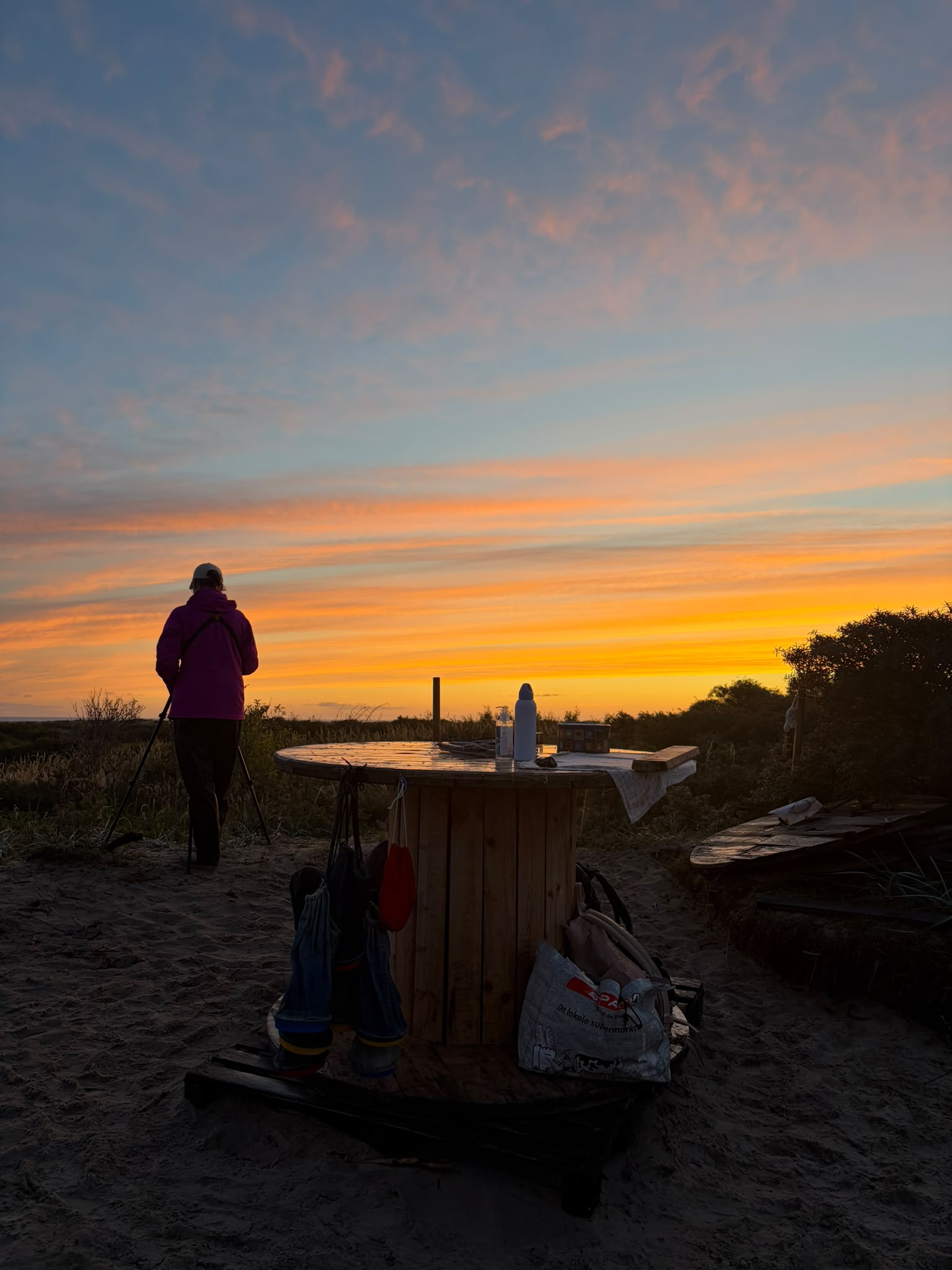 Proof of a beautiful view. Photo by Anja Gorbunova.
There weren’t many birds today. The first round was quite busy, but after that there were not many birds in the nets. The weather was really nice, so it was a good day to be outside and enjoy some of the last warm days of autumn.
A few birds made us think a little. We caught three Chiffchaffs (Gransanger), and it was quite difficult to see the moult limit on them. We took some photos to check in the evening.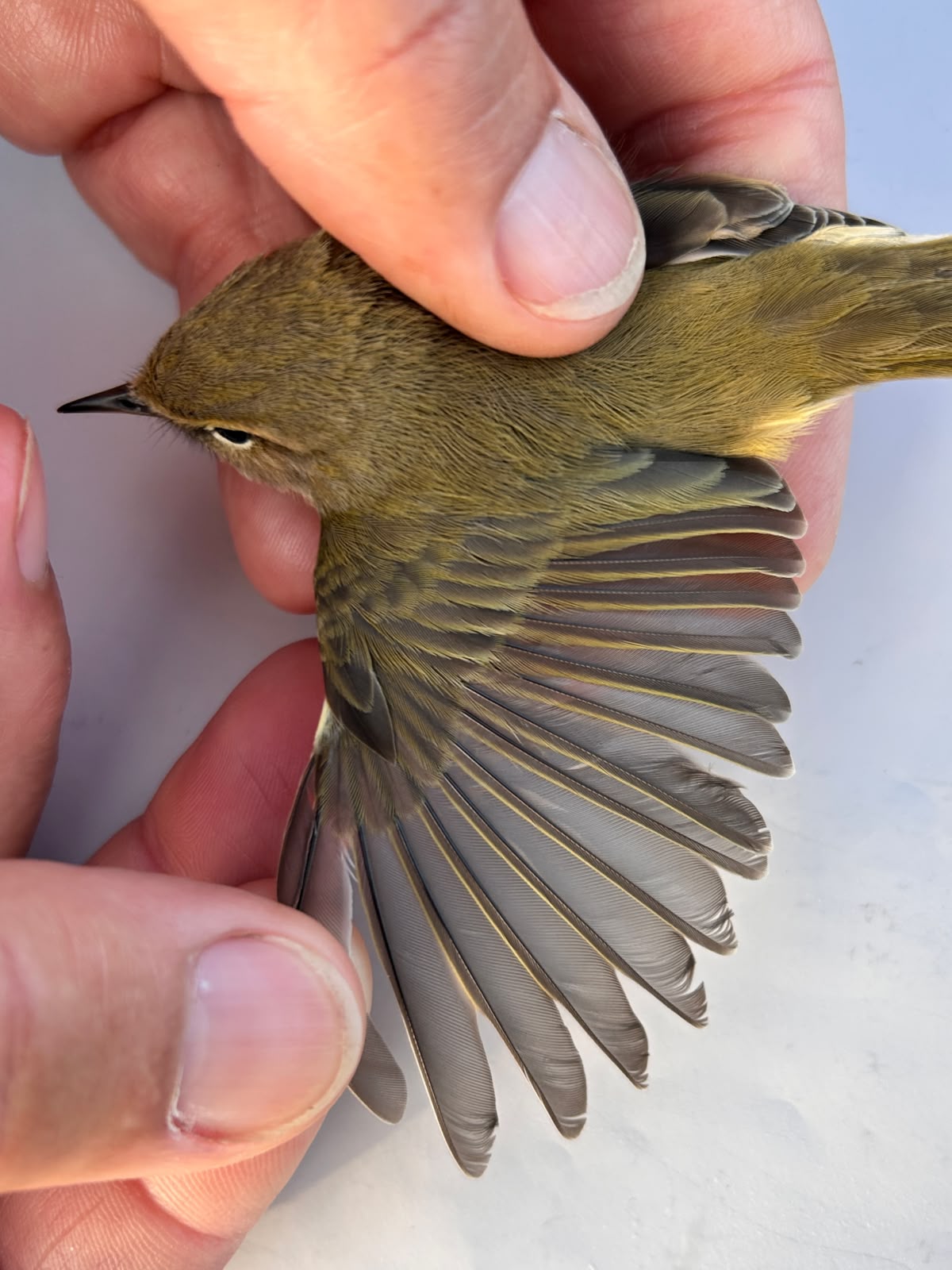 A Chiffchaff with an unclear moult limit. Photo by Pauline Nähring
At the same time, Mio, Laura and Knud, who joined them for the first hour, were watching birds from World’s End 3 and enjoying the nice weather too. There were fewer birds than yesterday, but they still saw some Arctic Skuas (Almindelig Kjove), a Black Tern (Sortterne), a group of Eurasian Jays (Skovskade) and a Raven (Ravn). They also saw a big flock of Golden Plovers (Hjejle) flying southwest and then back again.
When we got back to the house, we had breakfast (or lunch, who knows), entered the data into the computer and went to rest for a while, because we had some cleaning to do later.
In the afternoon, everyone did their own thing. Jule went for a walk to listen to music and think about life. Mio went birdwatching in the reserve and to the secret lake with the recorder. Pauline took some time to relax, Laura started making dinner, and I had to do a little bit of work even though it was Saturday.
By the evening, the house was quiet and clean. Laura made a really tasty dinner, and after that we just sat around for a while and relaxed after the day.
Tomorrow it’s an early start again and another day of ringing. But for now, it’s time to get some sleep.?
PS. I’m posting this blog one day later, so I can already tell you that there’s a very interesting story coming this evening. Today was definitely not a usual day at the station.
Observation Highlight:
Long-tailed Skua (Lille Kjove) — 1
Great Skua (Storkjove) — 2
Black Tern (Sortterne) — 1
Grey Plover (Strandhjejle) — 1
Ringing (Kabeltromlen):
Robin (Rødhals) — 2
Reed Warbler (Rørsanger) — 1
Lesser Whitethroat (Gærdesanger) — 1
Blackcap (Munk) — 2
Chiffchaff (Gransanger) — 3
Reed Bunting (Rørspurv) — 3
Total: 12
Nordstjernevej (Michael Ancher):
Great Tit (Musvit) — 1
European Robin (Rødhals) — 1
Blackcap (Munk) — 1
Total: 3
Jennes Sø (Michael Ancher):
Lesser Redpoll (Lille Gråsisken) — 21
Crested Tit (Topmejse) — 1
Spotted Flycatcher (Broget Fluesnapper) — 1
European Robin (Rødhals) — 2
Great Tit (Musvit) — 5
Willow Warbler (Løvsanger) — 2
Blue Tit (Blåmejse) — 1
Common Chiffchaff (Gransanger) — 2
Total: 35
Link to today's observations in the Dofbasen from observers in the area.
People: Mio Brix, Jule Tappe, Simon S. Christiansen, Pauline Nähring, Morten Jenrich Hansens, Laura Tamminen, Anja Gorbunova
Cats and dogs? Its raining skuas and more skuas
fredag 11. september 2026
Hello, everyone! I am a new (but very easily recognizable) face to the observatory and blog so this will be my first entry. My name is Laura and as mentioned in a previous blog, I come all the way from Estonia. I will be residing here til the 19th of October and hopefully will be able to write all kinds of lovely and exciting stories for you all.

Laura Tamminen and Pengu are sending their warmest greetings and best wishes to you all
Me, Pauline and Páll started our morning setting up the nets at 5.40. It was a calm and peaceful morning and seeing how the nets are set up was a first for me (Even though I have been around mist nets hundreds of times…). Right before we were about to go on a round to check the nets, Jule joined us as well. We had less birds than yesterday, but there was still a bird that took longer to analyze than the others: a Lesser whitethroat (Gærdesanger).
What made us suspicious was the fact that it was a bit late for that species to still fly into the nets. There were also colorations on some parts of the body that had us thinking that perhaps it could be one of the Eastern subspecies (S. curruca blythi/halimodendri) of said bird. We took photo and feather samples for further inspection. Later, during our evening meeting Simon (who had arrived shortly after Jule during ringing) figured that it probably is not one of the subspecies after all. But that is alright, I still think it is important to be suspicious because subspecies can look SO identical, and you never know!
Unfortunately we had to cut our ringing day short, because the rain decided to accompany us at 9 and the wind was really picking up. Still, it was an active few hours on the ringing field and I got to learn more about writing down data and how to spot moult limits.

One of the young male Redstarts (Rødstjert) being held by Simon. Photo by Laura Tamminen

Fierce little wren (Gærdesmutte) held by Simon. Photo by Laura Tamminen
Mio and Anna had a very successful day at Worlds End 3. Meanwhile the ringing ended a little before 9 they stayed at the beach til nearly 11. I was pleasantly surprised to hear the amount of skuas they spotted today: There were 4 long-tailed skuas (Lille Kjove) and 17 arctic skuas (Almindelig Kjove)!! That’s basically triple the amount of yesterday.
After the daily observations and ringing we all got ourselves some well-earned breakfast. Jule taught me how to enter all the ringing data on the websites and that was when our very lovely guests Marianne and Kurt said goodbye to us. They were so kind and curious, it was lovely having them at Skagen.
I also had time to peek in the gift shop downstairs. Our loyal readers, my eyes instantly locked on a woodcarving of a common cuckoo (gøg) and I KNEW I had to get it. I did not even bother looking at the price, it was coming home with me no matter what. They are one of my personal favorites so that will explain my intense need for it :D. I also bought a few other trinkets to bring home, a magnet and a poster.

A variety of woodcarved birds could be seen in the lighthouse gift shop

Ku-kuu! You are coming home with me, sneaky cuckoo (gøg)
In the evening Pauline prepared an enticing dinner for us. While writing this blog I could smell it from the other room and it felt super inviting. It tasted as good as it smelled, thank you Pauline! Tomorrow will be my turn to make dinner, I have got a few ideas already.

Pauline prepared us pasta with a sauce made of pumpkin with some vegetables and for dessert a lemon drizzle cake with rasberries
Observation highlights:
Long-tailed skua (Lille Kjove)-4
Arctic skua (Almindelig Kjove)-17
Great skua (Storkjove)- 2
Ringing (Kabeltromlen):
Reed bunting (Rørspurv)-3
Blue tit (Blåmejse)-1
Blackcap (Munk)-2
Lesser whitethroat (Gærdesanger)-1
Chiffchaff (gransanger)-2
Redstart (Rødstjert)-3
Robin (Rødhals)-3
Wren (Gærdesmutte)-3
Total: 18
Link to today's observations in the Dofbasen from observers in the area.
People: Mio Brix, Jule Tappe, Simon S. Christiansen, Pauline Nähring, Páll Vang Kjærbo, Laura Tamminen, Anna Gorbunova, Kurt Håkonsson and Marianne Mølgaard